Half of local Google reviews get no reply
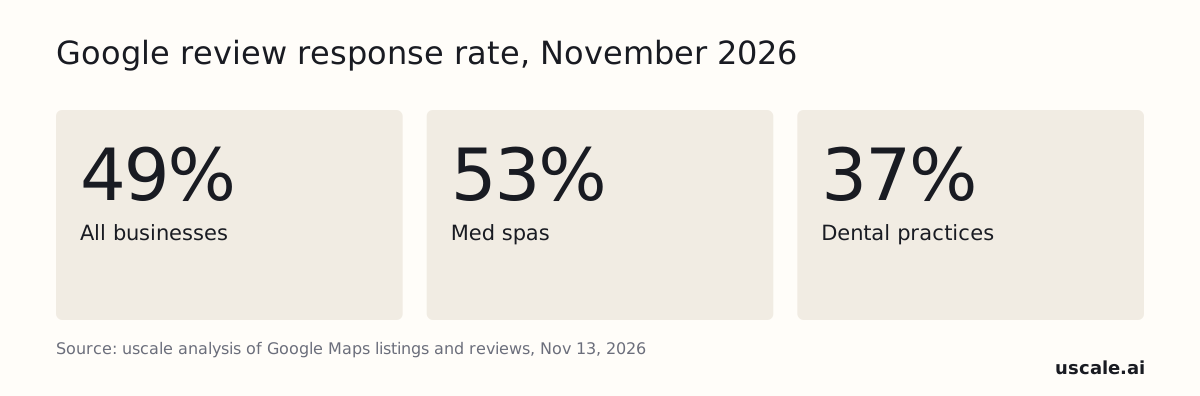
The Google review response rate for independent local businesses is 49%. Across 2,079 home-service, dental and med-spa businesses in six US metros, owners had replied to 10,260 of 20,781 reviews, counting each business's 10 most recent. The rate is not even across trades. Med spas replied to 53% of their recent reviews, and home-service businesses (HVAC, plumbing, roofing, electrical) replied to 51%. Dental practices replied to 37%. Dental practices also have the most reviews on a typical listing of the three trades, so the trade with the most customer feedback on show leaves the largest share of it unanswered.
This post covers the breakdown by trade and listing size, the gap between how owners treat good and bad reviews, and copyable 5-star, 1-star and HIPAA-safe reply templates.
First, a word on how we counted, because a reply rate is only as good as what it counts as a reply.
How we measured Google review reply rates
We measured the Google review response rate from public Google Maps listings and reviews in November 2026, across six US metros: Charlotte, Raleigh, Nashville, Columbus, Tampa and Indianapolis. For each business in the sample, we read its 10 most recent Google reviews and noted whether the owner had replied to each one.
| Parameter | Detail |
|---|---|
| What | Google Maps listings for home-service businesses (HVAC, plumbing, roofing, electrical), dental practices and med spas |
| Listings read | 4,187 home-service, 1,569 dental, 1,064 med spas |
| Reply sample | 2,079 independent businesses with 10 to 400 Google reviews and a website that lists an email address |
| Reviews read | 20,781, the 10 most recent per business |
| When | November 2026 |
| Held the same | The same 10-review window for every business. A reply counts whenever Google displays an owner response. |
These limits shape what the numbers can say. Six metros do not represent the whole country. Chains are left out, and so are businesses whose website lists no email. A reply counts whatever it says and however late it came, so these figures show whether owners reply, not how well they reply. The shares of businesses that never replied or replied to all 10 reviews use 2,078 businesses as the base.
With that in mind, here is how often owners reply.
How many local businesses reply to their Google reviews?
Local businesses reply to about half of their Google reviews. Across 2,079 independent home-service, dental and med-spa businesses in six US metros, owners had replied to 49% of their 10 most recent Google reviews: 10,260 replies out of 20,781 reviews, as of November 2026.
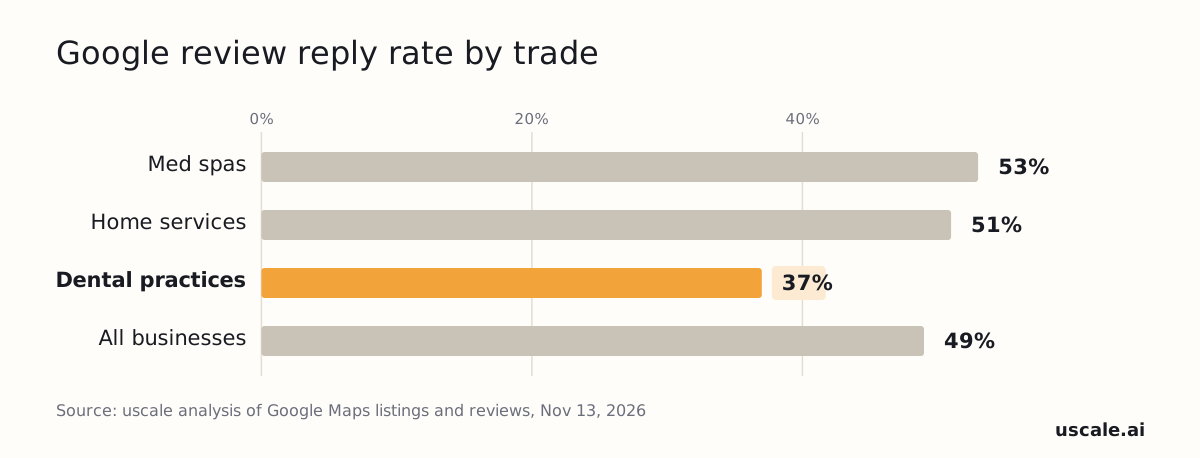
The split by trade is close at the top and wide at the bottom. Med spas replied to 53% of their recent reviews. Home-service businesses (HVAC, plumbing, roofing and electrical) replied to 51%. Dental practices replied to 37%, well behind the other two trades.
What the 49% actually measures
Most of the reviews in this sample were not complaints. 1- and 2-star reviews made up only 4.5% of the reviews we read (927 of 20,781). That changes how to read the headline number. A reply rate near 50% says little about how owners handle trouble. It mostly shows how they treat routine, mostly positive feedback.
For most local businesses, a Google review response rate is a measure of how they answer compliments, not complaints.
This is the part many owners get backwards. They treat replies as damage control, something to do when a bad review lands. But a person scanning a listing will mostly see good reviews, because good reviews are most of what is there. The replies under those reviews, or the lack of them, show whether anyone at the business is reading. A short thank-you on a 5-star review is the most common reply an owner will write, so it carries most of the signal.
An average of about half also hides the businesses at either end: the ones that answer every review and the ones that answer none. That is where the gap between trades grows wider.
Which trades reply least, and how many businesses never reply at all?
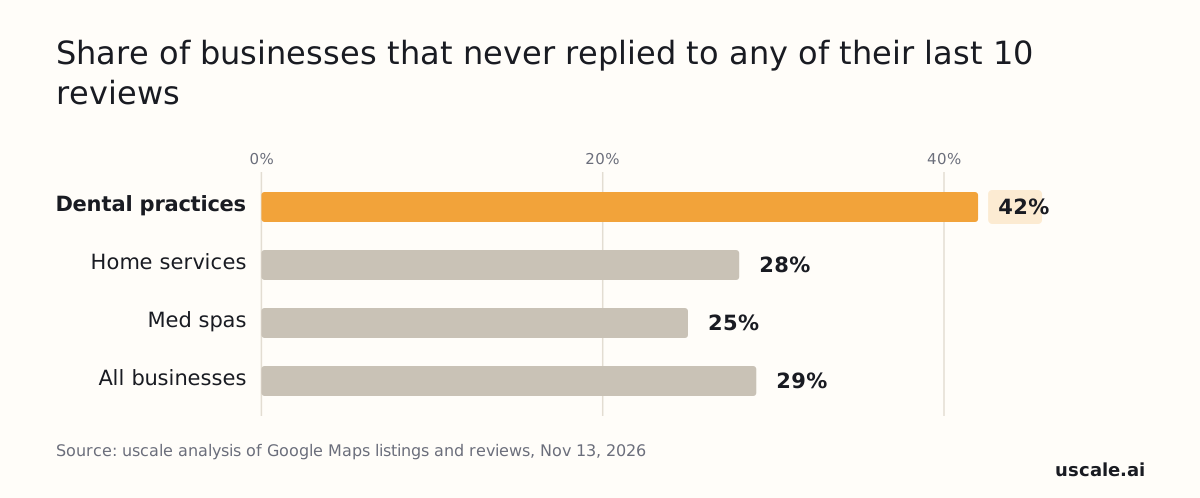
Dental practices reply least: owners answered 37% of their recent Google reviews, and 42% of dental practices had not replied to any of their 10 most recent reviews. That compares with 28% of home-service businesses and 25% of med spas. Across all three trades, 29% of businesses (607 of 2,078) had left every one of their last 10 reviews unanswered.
The averages hide a split
A trade-level reply rate looks like every business answers some reviews and skips others. The businesses we read did not behave that way. Alongside the 29% that never replied, 23% (478 of 2,078) had replied to all 10 of their most recent reviews. Together those two groups make up more than half the sample.
The pattern runs in mirror image across trades:
| Trade | Replied to none of last 10 | Replied to all of last 10 |
|---|---|---|
| Dental practices | 42% | 15% |
| Home services | 28% | 25% |
| Med spas | 25% | 24% |
| All businesses | 29% (607 of 2,078) | 23% (478 of 2,078) |
Home-service businesses are the most likely to reply to every review, and dental practices the least likely. The trade with the most silent profiles also has the fewest complete ones. At dental practices, a profile with no replies at all is far more common than one where every review got an answer.
Why the split matters more than the rate
Replying looks like a habit, not a judgment made review by review. A business either has someone whose job includes answering reviews, or it doesn't. So the useful question for an owner is not "what is my reply rate?" but "which group am I in?" Ten unanswered reviews in a row reads differently to a visitor than a few gaps among replies. For a business with no habit yet, the fix is a routine, not better wording.
Which reviews still go unanswered among businesses that do reply is the next question, and the answer runs the wrong way.
Do owners answer bad reviews more often than good ones?
No. Owners of local businesses reply to bad Google reviews less often than to good ones. Across 2,079 independent home-service, dental and med-spa businesses, owners replied to 39% of 1- and 2-star reviews (359 of 927) and to 50% of 5-star reviews (9,802 of 19,579).
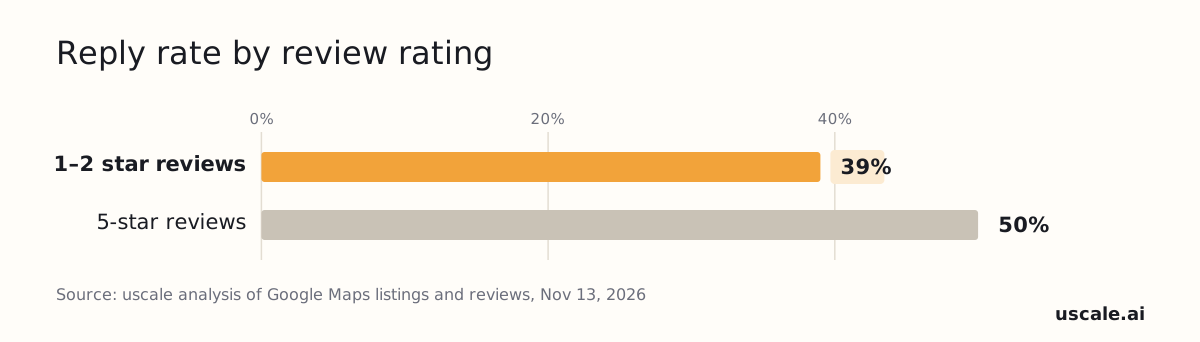
That pattern is upside down. A 5-star review persuades without any help, so a thank-you under it is a courtesy. A 1-star review sits on the profile and argues against the business. The owner's reply is the only other voice next to it. An unanswered complaint gets the last word on your own listing.
The gap by trade
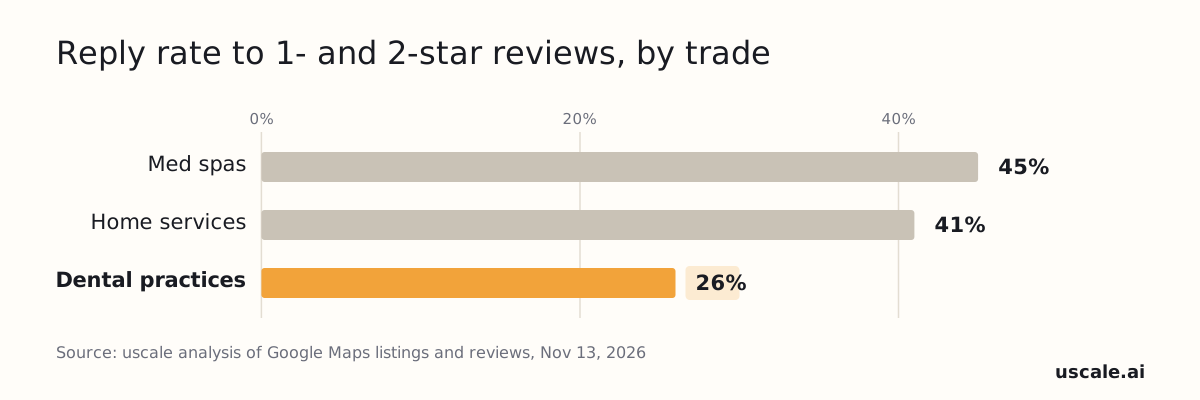
| Trade | Reply rate to 1- and 2-star reviews | Bad reviews read |
|---|---|---|
| Med spas | 45% | 76 of 170 |
| Home services | 41% | 234 of 572 |
| Dental practices | 26% | 49 of 185 |
Dental practices answered about one bad review in four, the lowest of the three trades. That is also well below their 37% reply rate across all recent reviews. Each of the three trades answered bad reviews less often than reviews overall: med spas 45% against 53%, and home-service businesses 41% against 51%. The drop shows up in every trade, so it is not one trade's habit.
Why this is the easiest fix on the list
Bad reviews are rare. 1- and 2-star reviews were 4.5% of the 20,781 recent reviews we read, 927 in total. For a single business, catching up usually means a handful of replies, not a project. The reviews owners skip take the least time to clear and sit where a reply counts most. That leads to the next question: what does replying actually earn a business, on Google and with customers?
Does replying to Google reviews help your ranking or bring in more customers?
Replying to Google reviews does not directly raise a business's local ranking, but replying does affect whether customers choose that business. As of November 2026, Google's own local-ranking help page says local ranking is "mainly based on relevance, distance, and popularity." The page does not list owner replies as a ranking factor, and it states there is no way to pay or request a better local ranking.
Google still says replies count for something. The same page says replying to reviews "shows that you value their feedback," and that positive reviews plus helpful replies "can help your business stand out." That means standing out to the person reading your listing, not to the ranking system.
The real payoff is in what customers expect. In BrightLocal's 2026 Local Consumer Review Survey, 89% of consumers say they expect business owners to respond to reviews. 80% are more likely to use a business that responds to every review, and 42% are unlikely to use a business that never replies.
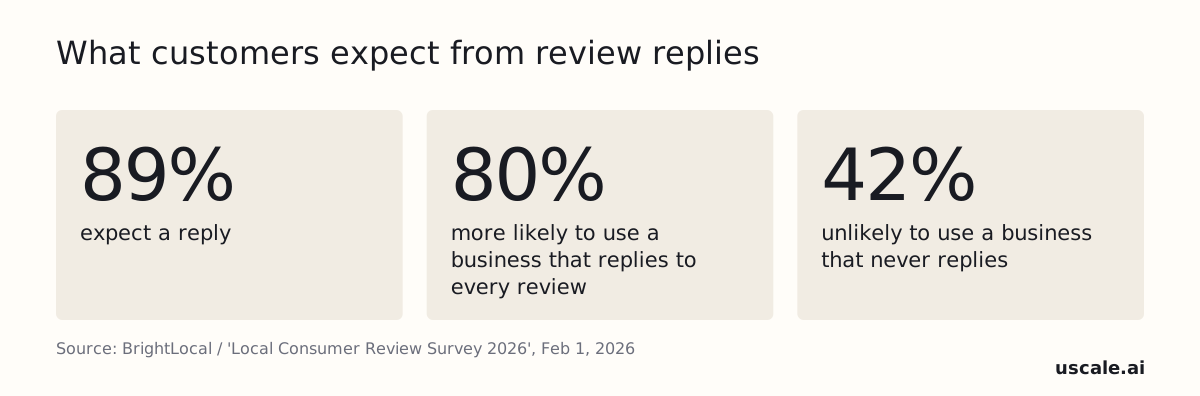
Owners have not caught up. BrightLocal's small-business survey found that "only 51% of business owners actually respond to reviews," which is close to the reply rate we measured. That is a trust gap, not a ranking problem. A customer who expects an answer and finds none learns something about the business before making the first call.
A reply won't move you up the map, but a missing reply can move a customer to the next listing. If replies are about trust rather than rank, then what a reply says matters as much as whether there is one.
What should a reply to a 5-star and a 1-star review say?
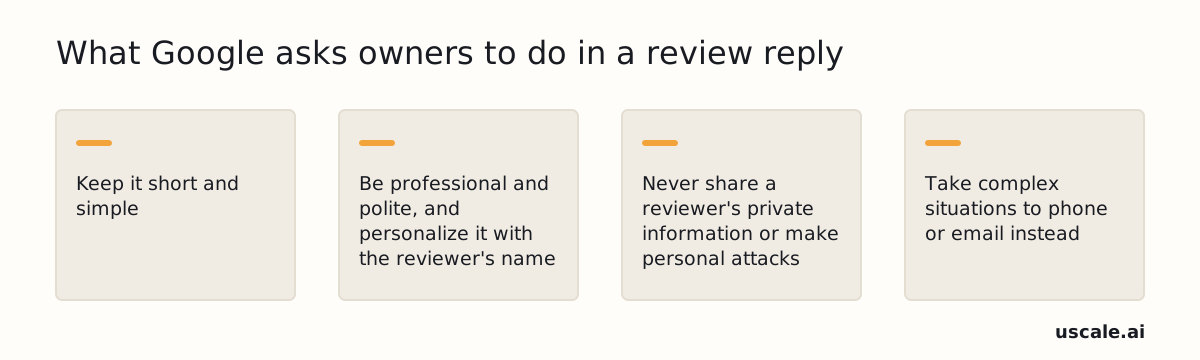
A good reply to a Google review is short, polite and uses the reviewer's name. It never argues in public. As of November 2026, Google's own help pages ask owners to "keep it short and simple," to "be professional and polite," to address the reviewer by name and sign off with a name or initials, and to take complex situations to phone or email.
The reason to keep a reply short is the audience. Once Google approves an owner reply, it posts the reply publicly under the review and notifies the reviewer. So every reply has two readers: the person who left the review and every future customer scrolling past it. A long defence loses that second reader before the main point. Google warns about this when it says customers value "direct and honest responses."
A 5-star reply
Thanks, [first name]. We're glad [specific detail: the water heater was in before dinner / the cleaning was gentle / the team walked you through every step] made the visit easy. We look forward to seeing you next time. — [your name or initials], [business name]
The specific detail does the work. A line that could sit under any review reads as a template. A line that names what happened shows someone actually read it.
A 1-star reply
[First name], thank you for telling us about this. We're sorry your visit wasn't what you expected, and we'd like to understand what happened. Please call us at [phone] or email [address] and ask for [name] so we can sort it out directly. — [your name or initials], [business name]
This reply acknowledges the complaint and apologizes for the experience. It doesn't accept the reviewer's version of events or debate the details. The details move to a phone call or an email, where they can actually get resolved.
The rule that never bends
Google's guidance tells owners to "never share a reviewer's private information or engage in personal attacks." That rules out repeating anything from the customer's account or file, and it rules out hinting that the reviewer is lying. Most owners get this backwards. Correcting the record in public feels fair to the owner and reads as a fight to everyone else.
For a dental office or med spa, Google's privacy rule meets a stricter legal one, and the 1-star template above needs one more change.
Can a dental office or med spa reply to reviews without breaking HIPAA?
Yes. A dental office or med spa can reply to Google reviews without breaking HIPAA if the reply never confirms the reviewer is a patient and never mentions a health condition, treatment or insurance detail. That holds even when the review is wrong and the practice wants to set the record straight. The correction is where practices get caught.
The HHS Office for Civil Rights has penalized dental practices for exactly this:
- Elite Dental Associates of Dallas agreed to pay $10,000 and adopt a two-year corrective action plan. Its reply to a patient's Yelp review disclosed her last name and details of her health condition. OCR found similar disclosures in replies to other reviews on the same page.
- Brandon Au, DDS, Inc. (New Vision Dental) in California paid $23,000 and agreed to a corrective action plan. Its responses to online reviews disclosed patient names, treatment and insurance information.
- Dr. U. Phillip Igbinadolor, D.M.D. & Associates in North Carolina received a $50,000 civil money penalty. It disclosed a patient's protected health information on a webpage that responded to a negative review, then failed to cooperate with OCR's data request and subpoena.
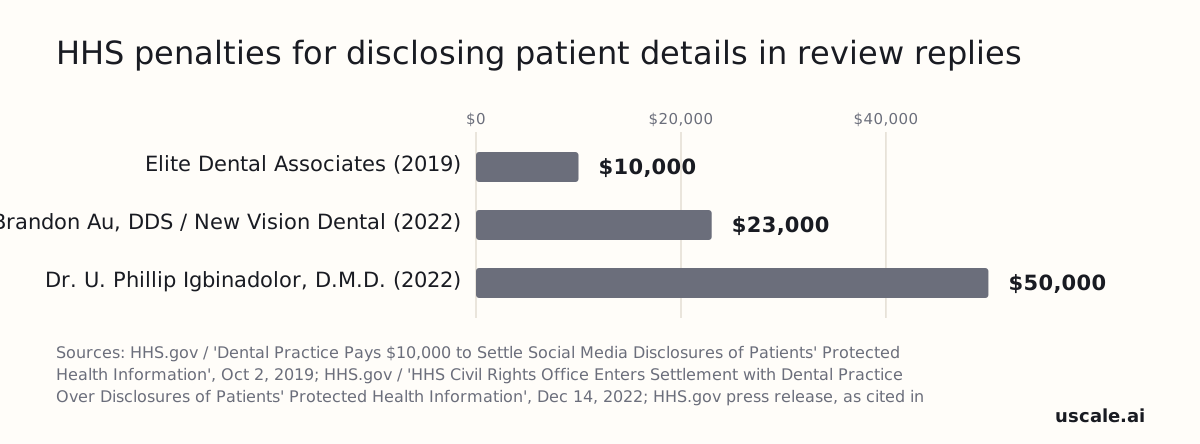
None of these cases involved a hacker or a breach. Each began with a practice answering a reviewer in public. A reply that wins the argument by quoting the chart can still lose the case. Google's own reply guidance points the same way: never share a reviewer's private information, and take complex situations to phone or email.
A HIPAA-safe reply template
The safe reply thanks the person, says nothing about whether they were seen, and moves the conversation offline:
Thank you for taking the time to share this. We take every comment seriously. To protect everyone's privacy, we don't discuss anyone's care online. Please call our office at [phone number] and ask for [name] so we can talk it through. — [Initials], [Practice name]
Apply the same caution to glowing reviews: thank the person warmly, but leave out "your treatment" or "your visit." This matters most for dental practices because they already reply least. The replies they add should be safe from the first one.
So you have the numbers and the wording. The remaining question is where to start on your own listing.
What should you do about your Google reviews this week?
Start with your open 1- and 2-star Google reviews. They are the reviews owners reply to least, and the ones where a missing reply costs the most trust. Once those are cleared, size your backlog and set a weekly check you can keep.
Size your backlog
Smaller listings have the most ground to make up. In our analysis, businesses with 10 to 49 Google reviews replied to 42% of their recent reviews. Those with 50 to 149 replied to 52%, and those with 150 to 400 replied to 54%.
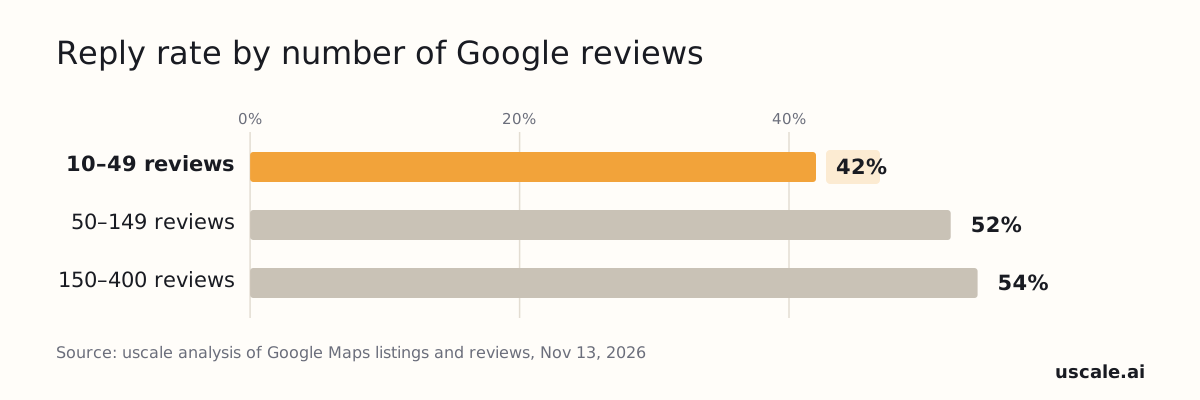
Dental practices break the pattern. They replied to 25% at 10 to 49 reviews and 23% at 50 to 149, and reached 47% only at 150 to 400. For a dental office, a bigger review count does not close the gap. A reply habit does.
Set the floor at once a week
BrightLocal's 2026 survey found 19% of consumers now expect a same-day reply and 81% expect one within a week. A weekly check is the minimum that meets most reviewers. Same-day is better if someone can cover it. A recurring calendar reminder and the free Google Business Profile app are enough to start.
Your checklist for today
| Step | What you do | Done when |
|---|---|---|
| 1 | Answer every open 1- and 2-star review with the template above. Dental offices and med spas use the HIPAA-safe version | No bad review in your last 10 is unanswered |
| 2 | Count the unanswered reviews in your last 10 | You have one number to work down |
| 3 | Reply to the 5-star backlog, newest first, by name and with one detail from the visit | All of your last 10 have a reply |
| 4 | Book a recurring weekly slot in your calendar for new reviews | The event repeats every week |
If you do only one thing, answer your newest bad review in the next hour. Success looks like this: no unanswered complaint at the top of your profile, a reply under each of your last 10 reviews, and a weekly slot that holds.
Here is the whole plan in three lines.
Before next week's reviews come in
Owners in our sample replied to 49% of their recent Google reviews, so the bar for being the business that answers is lower than it looks. A week is enough to clear it:
- Answer every open 1- and 2-star review first. Keep each reply short and polite, and move the details to phone or email.
- Reply to the rest, newest first, using the templates above.
- Pick one day a week to check for new reviews, and keep it.
How you keep that weekly habit is up to you. A recurring calendar reminder works. So does a part-time hire. uscale, which we make, drafts a reply to every Google review in the owner's voice for the owner to approve. You can see how uscale's review replies work.
A reply rate isn't a marketing number. It's the record of who got answered.
Questions
What is a Google review response rate?
A Google review response rate is the share of a business's Google reviews that have a public reply from the owner. In a November 2026 analysis of 2,079 independent home-service, dental and med-spa businesses in six US metros, owners had replied to 49% of their 10 most recent Google reviews, 10,260 of 20,781. The rate shows whether owners reply, not how good or how fast those replies are.
Do businesses respond to Google reviews?
About half of local businesses' Google reviews get a reply. Across 2,079 independent businesses in six US metros, owners replied to 49% of their 10 most recent reviews: med spas 53%, home-service businesses 51% and dental practices 37%. Businesses tend to sit at the extremes, with 29% replying to none of their last 10 reviews and 23% replying to all 10. BrightLocal's small-business survey found a similar 51% of owners respond.
Should I respond to Google reviews?
Responding to Google reviews is worth doing, though it is not a direct ranking factor. Google says local ranking is mainly based on relevance, distance and popularity. Replies matter to customers instead: in BrightLocal's 2026 survey, 89% of consumers expect owners to respond, and 42% are unlikely to use a business that never replies. Reply to good and bad reviews alike, keep replies short and polite, and never share private details.
How fast should you reply to a Google review?
A reply to a Google review within a week meets most customers' expectations, and sooner is better. BrightLocal's 2026 survey found 81% of consumers expect a response within a week, 32% expect one by the next day and 19% expect a same-day reply. Google also checks owner replies before publishing them, which usually takes up to 10 minutes but can sometimes take up to 30 days.
How many Google reviews do businesses in my trade typically have?
The typical number of Google reviews depends on the trade. On Google Maps in six US metros in November 2026, the median home-service business had 40 reviews, the median med spa 92 and the median dental practice 355. At the 75th percentile the counts were 166, 232 and 616. Thin listings were most common in home services, where 37% had fewer than 20 reviews, against 17% of med spas and 7% of dental practices.