A quarter fewer no-shows, from one text
An appointment reminder text is one of the few no-show fixes with hard numbers behind it. In a meta-analysis of 21 studies, patients who got a text notification were 25% less likely to no-show than patients who got none: 15% missed their visit instead of 21%. The global average outpatient no-show rate is cited at 23%, so that drop puts a real share of empty chairs back on the schedule.
The catch is that "send a reminder" is only half the fix. Three choices decide how much of that gain a dental office or med spa keeps: when the texts go out, how many go out, and what the practice is allowed to put in them. This guide covers timing, copy-paste templates, HIPAA and TCPA limits, deposits and no-show fees, and whether your current software already does it.
Before any of that, it helps to know how big the problem is in your own chairs, and how far reminders can move it.
What is a normal no-show rate, and how much do reminder texts cut it?
No-show rates vary widely by setting, region and patient mix, so no single number counts as normal. Text reminders reduce no-shows: across controlled trials and a meta-analysis, patients who get a reminder text miss fewer visits than patients who get none.
Where your rate might sit
- All healthcare, worldwide: A 2018 review of 105 studies put the average no-show rate across specialties at about 23%. Regional averages ran from about 13% in Oceania to 43% in Africa.
- Dental, academic study: A 2025 study at an academic dental clinic found a 14.3% no-show rate across 7,379 pediatric visits. Adolescents aged 12–17 missed most often, at 24%.
- Dental, vendor estimate: An industry blog puts the average dental practice at about 15%, the top 10% of practices near 1%, and some practices as high as 30%. This figure is not peer-reviewed. Treat it as a rough guide, not a benchmark.
Compare your own last 90 days against these ranges before you decide how big your problem is.
How big the fix is
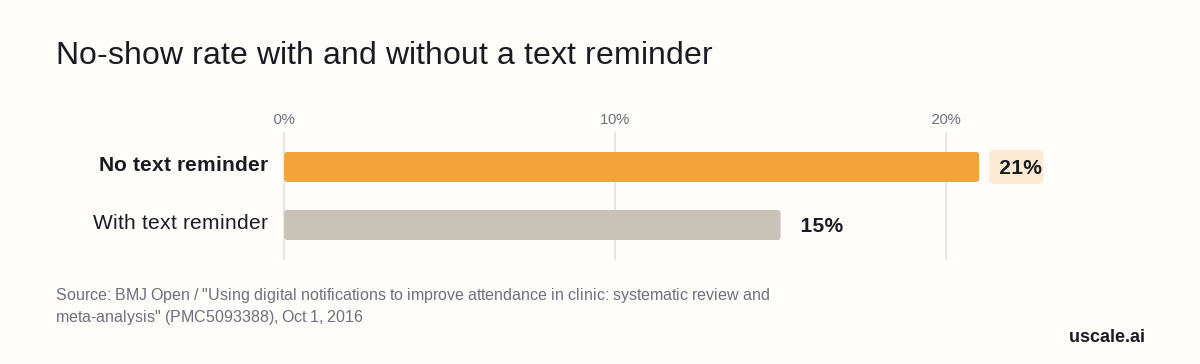
The 2016 BMJ Open meta-analysis pooled 21 studies. Patients who got text notifications no-showed 15% of the time, against 21% for patients who got none. That is a risk ratio of 0.75, or 25% less likely to miss. In a pediatric clinic trial, the no-show rate fell from 38.1% to 23.5%, a gap of 14.6 percentage points.
The effect is measured as a ratio. That means a practice with a high miss rate has more visits to win back.
The drop is not automatic, though. How many texts you send, and when you send them, changes how much of it you get.
How many reminder texts should you send, and when?
Send three texts per appointment: a confirmation when the patient books, a confirm-or-reschedule text three days before the visit, and a reminder the day before. The two pre-visit reminders do most of the work. In a randomized trial of 54,066 patients across 25 primary care clinics, patients reminded both 3 days and 1 day ahead missed 4.4% of appointments. Patients who got only the 3-day reminder missed 5.8%, and those who got only the 1-day reminder missed 5.3%.
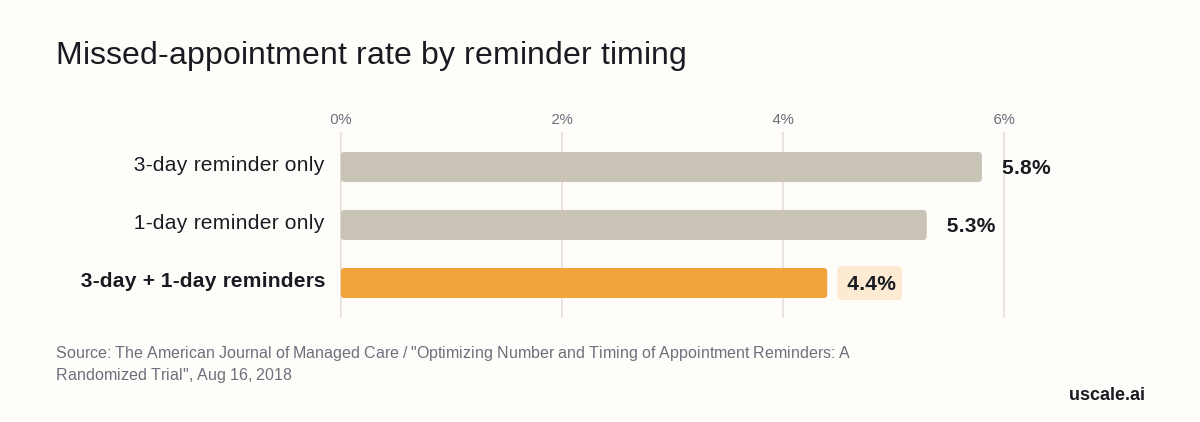
| Reminder schedule (AJMC trial, 2018) | Missed-appointment rate |
|---|---|
| 3-day reminder only | 5.8% |
| 1-day reminder only | 5.3% |
| 3-day + 1-day reminders | 4.4% |
Two reminders beat one because each catches a different failure. The 3-day text arrives while you can still refill the chair. The 1-day text catches the patient who simply forgot. A 2016 meta-analysis points the same way: two or more notifications raised the odds of attendance by about 25%, against roughly 6% for one. That review did not find a significant difference between multiple and single reminders for no-show rates specifically.
Should the text ask for a reply?
Yes, but be clear about what the evidence says. The research shows multiple reminders beat one. No cited study isolates a reply-required confirmation as its own tested arm, so recommending it is reasoned from the data, not a direct finding. The reasoning is simple. A reschedule reply three days out is a slot you can still fill. Silence the day before is a slot you can't.
Text or phone call?
Use whichever channel your system handles well. In the same trial, text messages and automated phone calls were equally effective. The benefit of the second reminder was concentrated in the highest-risk quarter of patients. A 2018 review of 105 studies names long lead time and prior no-show history as the main drivers of missed visits. Those appointments are where the extra text matters most, and that makes the wording of each message the next thing to get right.
What should an appointment reminder text say?
An appointment reminder text needs six things: the patient's first name, the practice name and phone number, the day, date and time, one clear action, a way to reschedule, and an opt-out. Everything else, including what the visit is for, stays out.
| Element | Example wording | Why it's there |
|---|---|---|
| First name | Hi [First name], | Shows the text is meant for them |
| Practice name and contact | [Practice], [Phone] | The FCC healthcare exemption requires the provider's name and contact information |
| Day, date, time | [Day, Date] at [Time] | Leaves no doubt about which visit |
| One action | Reply C to confirm | A single ask is easier to act on than three |
| Way to reschedule | Reply R or call [Phone] | A moved visit beats an empty chair |
| Opt-out | Reply STOP to opt out | A condition of qualifying for that no-consent exemption |
Keep each text short. Twilio's documentation says a message over 160 GSM-7 characters, or over 70 if it includes an emoji, splits into multiple segments and is billed for each one. The FCC exemption also expects texts to be concise, generally 160 characters or less. Count after filling in the placeholders, because a long practice name can push a text over the line.
At booking
Hi [First name], you're booked at [Practice] on [Day, Date] at [Time]. To change it, call [Phone]. Reply STOP to opt out.
3 to 7 days out: confirm or reschedule
Hi [First name], [Practice] here. See you [Day, Date] at [Time]. Reply C to confirm or R to reschedule. [Phone]. Reply STOP to opt out.
24 to 48 hours out
[First name], reminder: [Practice] tomorrow at [Time]. Reply C to confirm or R for a new time. [Phone]. Reply STOP to opt out.
Same day
Hi [First name], see you today at [Time] at [Practice]. Running late or can't make it? Call [Phone]. Reply STOP to opt out.
A reminder works because it is plain: who, when, and what to do next. None of the four templates names the treatment, and the next section explains why that is the line not to cross.
How does your business look to people searching nearby?
Type your business name and I check your Google profile, reviews, website and whether AI answers name you, then show what to fix first.
Check my businessWhat can't you say in a reminder text under HIPAA?
A HIPAA-safe appointment reminder text carries only what the patient needs to show up: first name, day, date, time, practice name and a number to call. A reminder text should never name the treatment, the diagnosis or the amount owed.
The reason is simple. A text lands on a lock screen that a spouse, parent or coworker can read. Write every reminder as if someone else will see it first, because often someone does.
| Don't write this | Write this |
|---|---|
| "Reminder: your Botox and filler touch-up is [day] at [time]." | "Hi [First name], you're booked at [Practice] on [day, date] at [time]." |
| "Your root canal with Dr. [Name] is tomorrow at [time]." | "Your appointment with Dr. [Name] is tomorrow at [time]." |
| "Follow-up on your [diagnosis] results, [day] at [time]." | "Your follow-up visit is [day] at [time]." |
| "Please bring your $[balance] balance to your visit." | "Questions? Call [Practice] at [phone]." |
The last row matters for a second reason. Under the FCC's healthcare exemption for patient texts, a qualifying message must be concise (generally 160 characters or less), must give the provider's name and contact information, and must leave out billing and debt-collection content. A balance reminder belongs in a separate message, not in the appointment text. These rules are as of the 2025 edition of the federal code.
How far HIPAA reaches into your texts depends on how your practice bills. Confirm three things with your own HIPAA counsel: how the minimum-necessary standard applies to your messages, whether your texting vendor needs a signed business associate agreement, and whether a med spa that doesn't bill insurance is a covered entity at all. This section gives wording practice, not a legal opinion.
Clean wording solves the privacy question. Whether you may send the text in the first place is a separate rule, covered next.
Do you need consent to text patients? The TCPA rules
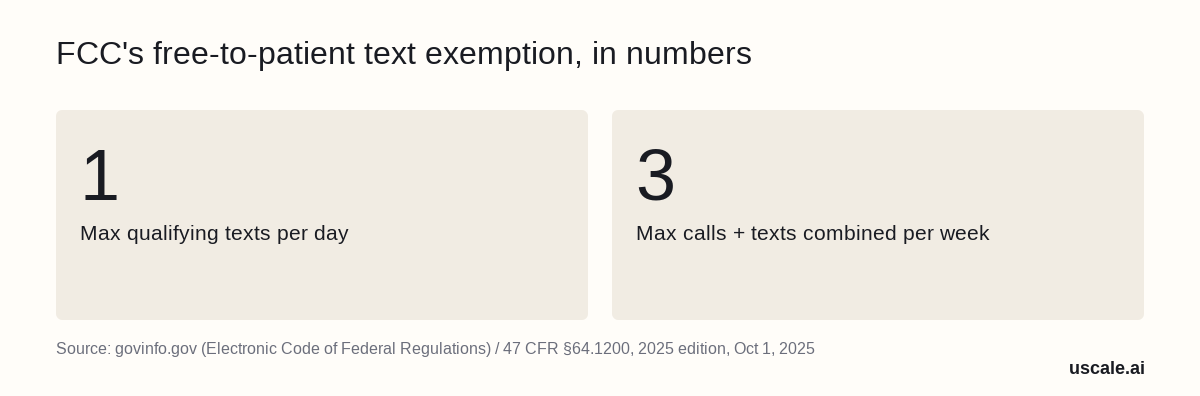
Healthcare providers do not need separate written consent to send appointment reminder texts, as long as every text stays inside the FCC's "free-to-patient" healthcare exemption. That exemption, in 47 CFR 64.1200(a)(9)(iv) (2025 edition), lets a provider text the wireless number a patient gave without collecting consent first. In return, the provider accepts hard limits on how often it texts and what each text says.
The volume limit
The exemption allows one qualifying message per day and no more than three calls or texts combined per week to the same patient. Plan your sequence against that cap. Suppose a patient books five days out. A booking confirmation, a 3-day reminder and a 1-day reminder in that same week use all three. Adding a same-day nudge would put you over the limit.
The content conditions
Each text has to meet every one of these to qualify:
- Concise, generally 160 characters or less
- States the provider's name and contact information
- No telemarketing, solicitation, advertising, billing or debt-collection content
- Sent only to the wireless number the patient provided, at no charge to the patient
- An easy way to opt out in every message, and for texts, a line saying the patient can reply STOP
The STOP line is a condition of this particular no-consent exemption. It is not a blanket HIPAA rule for every healthcare text. Keep it in anyway, because dropping it takes the text out of the exemption.
The exemption covers the reminder, not the offer. A line like "20% off filler this month" is advertising, so it falls outside the exemption and needs separate marketing consent. The same goes for billing language, which shapes how a reminder can mention a no-show fee or deposit.
Should you charge a no-show fee or take a deposit?
For a med spa, the usual approach is a card on file or a deposit credited toward the treatment, especially for injectables and laser appointments. For a dental office, the more common approach is a written 24-hour cancellation policy, with the first miss waived. Either one works only if the patient sees it twice: in writing at booking, and again in the reminder before the visit.
| Med spa: deposit or card on file | Dental office: cancellation policy | |
|---|---|---|
| What it is | Deposit credited toward the treatment, or a card held for late cancels | A 24-hour notice rule, first miss waived |
| Disclose it | At booking, in writing, acknowledged by the patient | At booking or in new-patient paperwork, in writing |
| Repeat it | One short line in the 24–48 hour reminder | One short line in the 24–48 hour reminder |
| Set the amount from | Your own treatment cost | Your own chair time and any payer contract |
This post gives no dollar figure because no source here supports one. Set the number from what an empty slot costs you. Before you bill a no-show fee to an insured or Medicaid patient, check your state's rules and your payer contract.
In the reminder, restate the policy. Don't send a bill. Billing and debt-collection content falls outside the FCC's no-consent healthcare exemption, so keep the line neutral:
Changes need 24 hours' notice. Reply R to reschedule.
A patient who first hears about a policy when the charge arrives feels penalized. A patient who has read it twice sees it as part of the booking. The next question is whether your current software can already send that line for you.
Does your practice software already send reminder texts?
Your dental practice-management system or med spa booking platform may already send appointment reminder texts, so check its settings or ask the vendor before you pay for a separate tool. Reminder texting is a common built-in feature, but versions differ a lot in what happens after a patient replies.
The feature matters because of the scale of the problem. In the ADA Health Policy Institute's poll of roughly 1,200 practicing dentists, nearly 82% named no-shows and cancellations with less than 24 hours' notice as the largest factor keeping their schedule from being 100% full. Judge a reminder feature by whether it reduces those gaps. A box on a feature list that says "reminders" does not tell you that.
Four questions for your current vendor
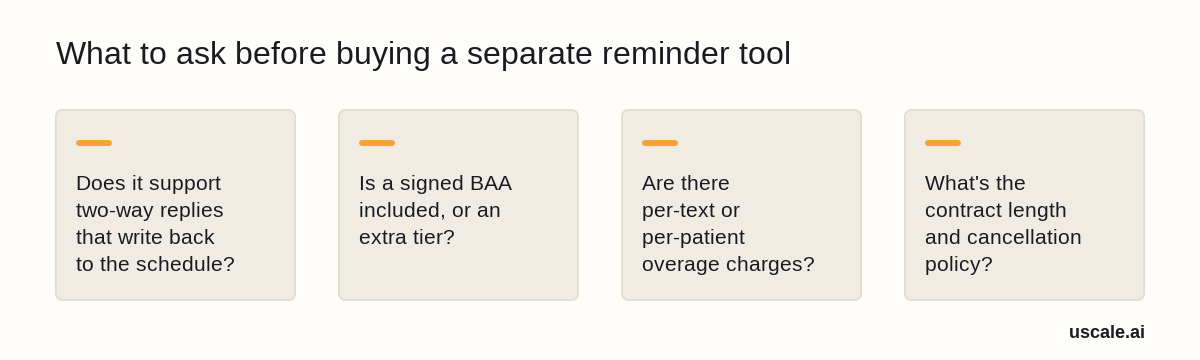
- Two-way replies. A reply of "C" that lands in a shared inbox still needs someone to mark the appointment. A reply that updates the schedule shows your front desk which patients haven't confirmed, and that becomes the call list. The value of a reminder tool is in what happens to the reply, not in the send.
- A signed BAA. If the vendor handles patient information for you, your HIPAA counsel will likely want a business associate agreement. Some vendors include one, and others charge for a higher tier.
- Overage charges. Per-text or per-patient fees grow when you move to two reminders per visit.
- Contract length. Find out how long you're locked in and what cancelling costs.
Get current pricing from the vendor's own pricing page and write down the date you checked it. A blog ranking can be months out of date. Even a strong built-in tool doesn't fit every practice, and the next section covers when this playbook needs adjusting.
When this playbook needs adjusting
The full three-text sequence doesn't fit every practice. A few setups call for a lighter version or a different channel.
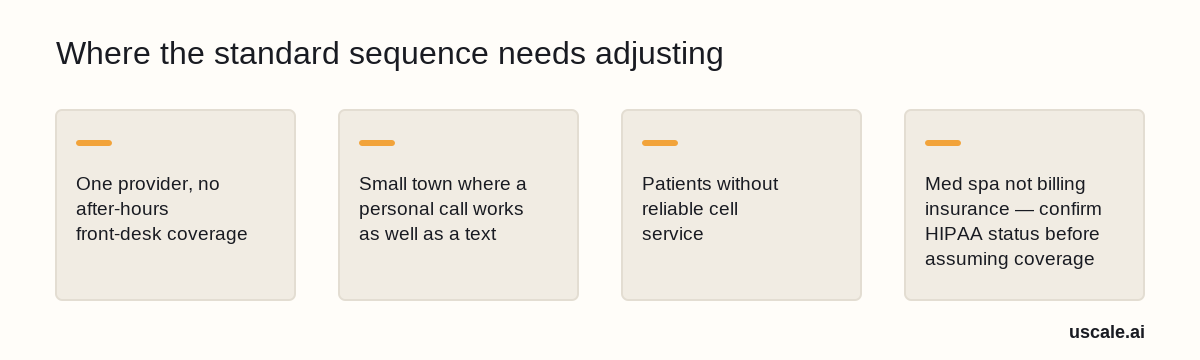
A solo provider with no one at the front desk may not answer replies fast enough for a confirm-or-reschedule text to pay off. One reminder with a clear call-back number can serve better. In a small town where patients pick up when the office calls, a personal call does the same job. Patients without reliable cell service need a phone call, not a text that may never arrive. A med spa that doesn't bill insurance may not be a HIPAA covered entity at all. Confirm that status with your own counsel before assuming the HIPAA rules above apply to you.
These cases argue against texting every patient the same way, not against reminders. A 2018 review of 105 studies found that long lead times and a history of no-shows were the main drivers of missed visits. In the Steiner primary-care trial, most of the two-reminder benefit went to the highest-risk quartile of patients. So put the extra confirm-and-reschedule effort on bookings made far ahead, patients who have missed before, and new patients if your own records show they miss more often. Everyone else can get a single reminder.
Whichever version fits your practice, the work happens in the same order.
What to do this week to cut no-shows
The fastest way to cut no-shows this week is to work in order: measure, write, schedule, put the policy in writing, then cover the replies. You can fit each step below into a working day, and you can finish the first in under an hour.
Pull your real no-show rate. Export last quarter's appointments from your practice software. Divide missed visits plus late cancellations by total booked. This is your quick win: one spreadsheet and a baseline to compare against next month. Note which appointment types miss most, because those get the extra attention.
Write and HIPAA-check your templates. Paste the templates above into a shared doc. Fill in your practice name and phone number, and remove any treatment detail. You're done when every message has a way to reschedule and a STOP line.
Turn on a 3-day and 1-day reminder pair. Most practice software sets this up in its reminder settings. In a large primary-care trial, the pair beat either reminder alone. You're done when a test appointment booked to your own phone gets both texts.
Put your deposit or fee policy on the booking page. Write the policy once, in plain words, and repeat it in the reminder closest to the visit.
Make sure replies and after-hours calls get answered the same evening. No reminder schedule closes this gap on its own. When a patient texts "can I move this?" after closing, the slot stays empty unless someone answers before it's too late to refill. A rotating staff phone covers this at no cost. Another option is uscale, which we make: it answers customer messages, texts back missed calls and books after-hours callers. Confirm your own HIPAA requirements with any tool that handles patient messages.
If you only do one thing, turn on the two-reminder pair.
Here is what success looks like. You know your no-show number. Reminders go out on schedule with clean wording, and the policy is in writing. Patients who want to move their visit hear back the same evening.
Before the next empty chair
Cutting no-shows takes a timed, two-way text sequence with clean wording. A single "send a reminder" switch isn't enough. The schedule decides whether the patient sees the text in time, and the wording decides whether it stays inside HIPAA and TCPA limits.
Three things to do before Friday:
- Pull your real no-show count for last quarter.
- Paste the templates into your software and turn on both reminders.
- Put your cancellation or deposit policy in writing.
Then plan for the reply that lands after closing. Our guide to missed-call text back covers after-hours calls and messages in more depth.
A reminder only fills the chair if someone answers when the patient writes back.
Questions
What is an appointment reminder text?
An appointment reminder text is a short SMS a practice sends a patient before a scheduled visit, giving the practice name, the day, date and time, a way to confirm or reschedule, and an opt-out. In a 2016 meta-analysis of 21 studies, patients who received text notifications were 25% less likely to no-show than those who received none, missing 15% of visits instead of 21%.
Do appointment reminder texts require HIPAA compliance?
Appointment reminder texts from a HIPAA covered entity should carry only what the patient needs to show up: first name, practice name, day, date, time and a number to call, never the treatment, diagnosis or balance. Whether a texting vendor needs a signed business associate agreement, and whether a med spa that does not bill insurance is a covered entity at all, depends on the practice, so confirm both with your own HIPAA counsel.
What's a normal no-show rate for a dental office or med spa?
There is no single normal no-show rate for a dental office or med spa. A 2018 review of 105 studies put the average across healthcare at about 23%. A 2025 academic dental clinic study found 14.3% across 7,379 pediatric visits. An industry blog, not peer-reviewed, puts the average dental practice near 15%, with top practices near 1% and some at 30%. No sourced figure exists for med spas specifically.
How do I fill a slot when a patient cancels last minute?
Filling a last-minute cancellation is easier the earlier the practice learns about it. A confirm-or-reschedule text three days before the visit gives the front desk time to offer the slot to another patient, and a one-day reminder catches the rest. In a trial of 54,066 primary care patients, those reminded both 3 days and 1 day ahead missed 4.4% of visits, against 5.3% to 5.8% with one reminder.
What should I text a patient who no-shows?
A text to a patient who no-shows should be short and neutral: name the practice, say the visit was missed, and offer a way to rebook by reply or phone, with a STOP line. Leave out the treatment and any balance or fee, because billing and debt-collection content falls outside the FCC's no-consent healthcare exemption. That exemption also caps texts at one per day and three calls or texts combined per week.