The text that goes out when you can't pick up
Missed call text back is an automatic text sent to anyone whose call to your business goes unanswered, day or night, so they text you instead of calling the next plumber or dentist. Here is what the caller sees seconds after the ringing stops:
Hi, this is [Business Name]. Sorry we missed your call. Reply with what you need and we'll text back first thing tomorrow. Reply STOP to opt out.
That text is generally legal because it is a plain reply to the person who just called, not a sales offer. Federal rules draw the line at advertising. As of November 2026, 47 CFR 64.1200(a)(2) requires prior express written consent before an automated text that advertises or telemarkets to a mobile number. Put a coupon into the same message and that rule applies.
Below: what to text, whether it's legal, what it costs, and which tool fits a small shop. The sample looks simple. The risk sits in what owners are tempted to add to it.
What is missed call text back and how does it work?
Missed call text back is an automation that sends a text to a caller within seconds of a call your business didn't answer. Many business phone systems, field-service apps and texting platforms include missed call text back, so you may already pay for a version of it.
::visual[How missed call text back works]{caption="The reply goes out on its own, so the caller can text you instead of dialing the next business on the list."}
Before you set it up, answer one question: which number sends the text? There are two common setups.
| Setup | How it works | What the caller sees |
|---|---|---|
| Your existing business number, text-enabled | Your provider turns on texting for the number customers already know | A reply from the number they just dialed, so texting back reaches you |
| Conditional call forwarding to a texting-capable line | Unanswered calls forward to a second line that sends the text | A reply that may come from a number they don't recognize |
The first setup is cleaner, because a caller who texts back reaches the same place they called.
No software fixes one limit: the caller has to be able to receive a text. Someone who called from a landline won't get the reply, even if your number sends it correctly. Those callers still need voicemail or a call back.
The tool is only as good as the number behind it, so check the number before you buy anything. Text your business number from your own cell and see whether the message arrives. Then ask your phone provider whether the number can send texts too. Once the number works, the next decision is what the text should say.
What should a missed call text say?
A missed call text should do four things in two or three short lines: name the business, acknowledge the call, say when a person will reply, and give one next step, such as a booking link or a prompt to describe the problem. Every message should end with "Reply STOP to opt out."
Keep it short because the caller is deciding whether to wait for you or dial the next business on the list. A text that answers "who is this, did they see my call, and when will I hear back" settles that choice. A missed call text has one job: get a reply, not make a sale.
| When to use it | Copy-paste template |
|---|---|
| Business hours | Hi, this is [Business]. Sorry we missed your call, we're with a customer. A person will text you back by [time]. What can we help with? Reply STOP to opt out. |
| After hours | Hi, this is [Business]. We're closed right now and open again at [opening time], when we'll reply. Want to pick a time now? Book here: [link]. Reply STOP to opt out. |
| Booking link | Hi, this is [Business]. Sorry we missed you. Grab a time that suits you here: [link], or reply with what you need and we'll text back today. Reply STOP to opt out. |
| Emergency trade, after hours (HVAC, plumbing, roofing) | Hi, this is [Business]. We missed your call. If it's a leak, no heat or anything that can't wait, call our emergency line at [number]. Otherwise we'll text you when we open at [opening time]. Reply STOP to opt out. |
Fill in a reply time you can keep. Only use the emergency version if someone really answers that line. For the rest of an after-hours setup, see our guide to after-hours answering services.
Do and don't
- Do name the business in the first words, so the text doesn't read like spam.
- Do give one next step: a booking link, a question, or an emergency number.
- Do keep "Reply STOP to opt out" on every version.
- Don't add a discount, a promo or a "join our list" line. That turns a reply into an advertisement, and federal texting rules set a higher bar for advertising.
- Don't link to anything except your own booking page or site.
The next question is why that line between a reply and an ad matters so much: whether texting people who called you is legal in the first place.
Is it legal to text people who called your business?
Texting someone who just called your business is generally legal when the text is a single, prompt, non-promotional reply to that call. The Telephone Consumer Protection Act (TCPA) and the FCC rules under it don't create a missed-call exemption. The safe ground is a text about the call and nothing else. The written-consent rule in 47 CFR 64.1200(a)(2) covers texts that advertise or count as telemarketing.
Here is where the law stands as of November 2026:
- Texts are usually treated as calls. In Campbell-Ewald Co. v. Gomez (2016), the Supreme Court said in dicta that a text "qualifies as a call" under the TCPA. The FCC and most courts treated texts that way for years (Honigman).
- A platform that needs a person to send each text is not an autodialer. FCC Declaratory Ruling DA 20-670 (June 25, 2020) said so. It added that texting many numbers doesn't prove autodialer status by itself (OCC summary).
- "Autodialer" is narrow. In Facebook, Inc. v. Duguid (April 1, 2021), the Supreme Court unanimously held that an autodialer must use a random or sequential number generator. Most text-back tools text a fixed list of numbers, and a tool like that doesn't qualify (Justia).
- Courts still disagree. A 2025 Seventh Circuit decision held that the do-not-call private right of action in section 227(c)(5) covers only voice calls, not texts. That split the appeals courts (Manatt). Treat this area as still changing.
The lesson you can reuse: the law cares less about whether a text went out automatically than about what it says.
The stakes add up per violation. Under 47 U.S.C. § 227(b)(3), a consumer can recover actual losses or $500 per violation, whichever is greater. A court can treble that to up to $1,500 if the conduct was willful or knowing (Wikipedia).
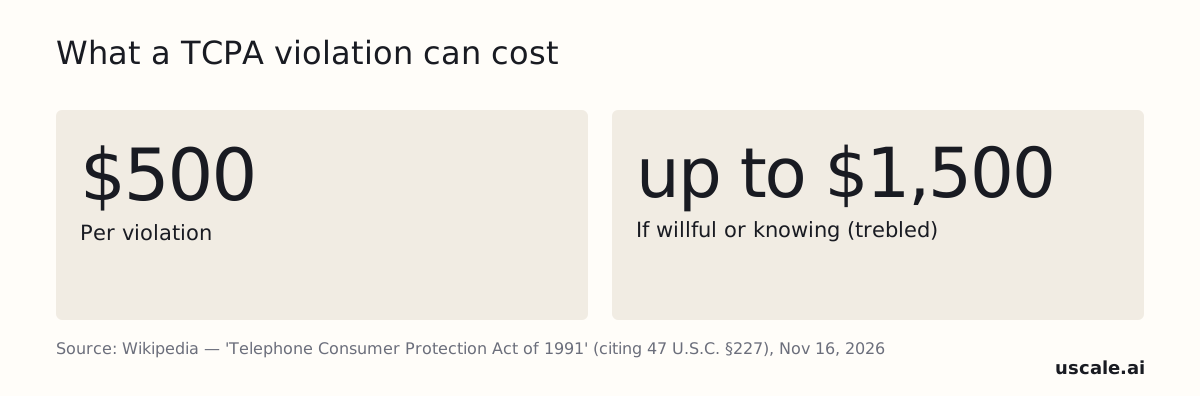
Because damages are counted per violation, the bigger exposure sits in marketing texts sent without consent. That is the next question.
This is general information, not legal advice. Have a lawyer review any text program you run at volume or in a regulated field like dental or med spa care.
Does calling my business count as consent to send marketing texts later?
No. Calling your business does not give you consent to send marketing texts later. A missed call lets you reply about that call and nothing more. Promotional texts need their own permission, called prior express written consent.
Under 47 CFR 64.1200, a business needs prior express written consent before it uses an autodialer or a prerecorded voice to send a call or text to a cell phone that advertises or telemarkets. The rule defines that consent as a signed, written agreement. The agreement must clearly authorize the seller to send those messages and must identify the phone number to be contacted. A missed call meets none of those terms. There is no signature, no agreement and no mention of marketing.
The stricter version that never took hold
In a November 2024 rule, the FCC said consent could cover no more than one identified seller. The consent also had to tie logically and topically to the interaction that prompted it. That rule was due to take effect January 27, 2025. The Eleventh Circuit vacated it on January 24, 2025, holding that the FCC "impermissibly exceeded its statutory authority." The FCC then repealed the rule in its "Delete, Delete, Delete" proceeding. The older, non-one-to-one written-consent standard is the one that governs.
What to do with that
A missed call earns you the right to answer that call, not to start a sales list. If you want missed callers on your promotional texts, ask each one for a separate, explicit opt-in in writing that names your business and their number. Keep a record of every opt-in. A customer who gives written consent can still take it back, so the next thing to get right is how you handle opt-outs.
How do I handle STOP replies and opt-outs?
Treat any plain reply like STOP, quit, cancel or unsubscribe as the caller taking back consent, and stop texting that number right away. As of November 2026, federal rules let a person revoke consent by any reasonable method, so don't wait for one exact keyword.
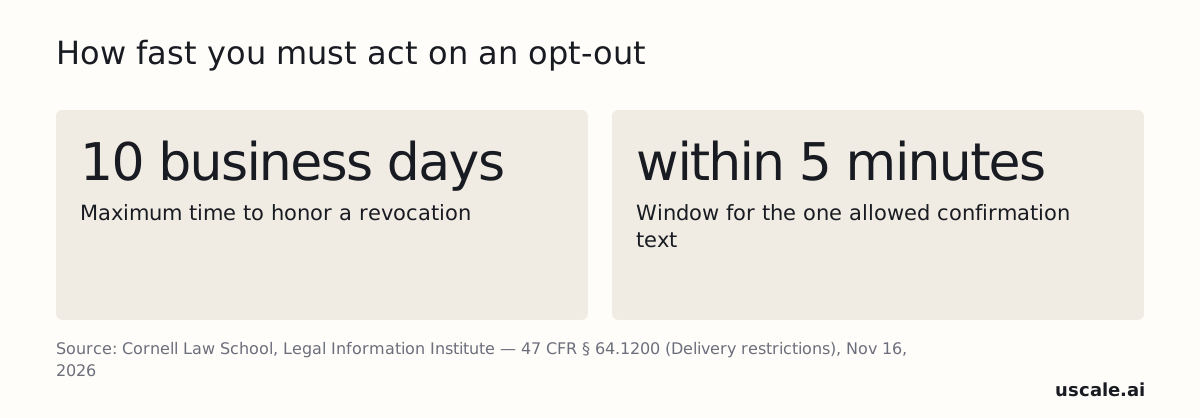
Two numbers matter:
- 10 business days is the ceiling. You must honor a revocation within a reasonable time, and that time can't exceed ten business days. Ten business days is a ceiling, not a target. Blocking the number the same day is safer.
- 5 minutes is the window for one confirmation text. A single text sent within five minutes of the opt-out is presumed to fall within the person's earlier consent. Keep that text to confirming the opt-out, with no offer attached:
You're unsubscribed from [Business Name] texts. You won't get more messages from this number.
Build a suppression list
Every script or tool needs a suppression list that blocks a number the moment it replies STOP. Many owners plan the first text carefully and treat the opt-out as an afterthought. The real risk is a follow-up text sent to someone who already said no. Before you choose a vendor, ask where STOP replies go and how fast the number gets blocked. That question matters as much as the registration question in the next section.
What is A2P 10DLC registration and do I need it?
A2P 10DLC registration is the process for registering business texts sent through software from an ordinary local business number, and a business running missed call text back will most likely need it. As of November 2026, it is common industry practice for US carriers to ask that the sending business and its messaging campaign be registered, and providers commonly warn that unregistered texts may be filtered or blocked. This post has no official carrier source to cite on those rules, so confirm the current requirements with your provider.
Most owners never deal with the registry directly. The texting provider typically files on the business's behalf, along a path like this:
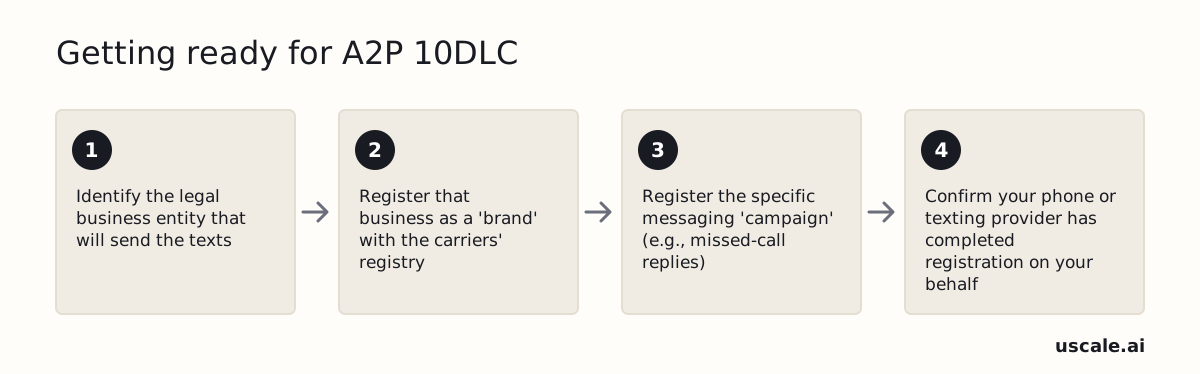
A plain, non-promotional reply to people who just called is easy to describe honestly. Register the campaign as exactly that, and keep your templates matching the description.
Before you sign with any vendor, ask one question:
Do you register my brand and campaign for me, and is that included in the price?
A vague answer is a reason to look closely at price, the next question.
How much does missed call text back cost?
Missed call text back costs anything from a per-user phone app fee to a full monthly service, depending on which of four kinds of tool you pick. The pricing model matters more than the sticker price, because the model decides what your bill does when calls pick up.
| Category | How it's usually billed | What to check before buying |
|---|---|---|
| Phone app that text-enables your number | Per user, per month | Whether texting is included or extra |
| Add-on inside field-service software | Add-on to a plan you may already pay for | Whether your current tier includes it |
| Texting or review-and-messaging platform | Monthly plan | Caps on texts or contacts |
| Managed service that also answers the call | Monthly or usage-based | What counts as a billable call or message |
Exact prices vary by vendor and change often. As of November 2026, the only safe source is each vendor's own pricing page on the day you buy.
Read the limits as closely as the headline price. A plan capped on texts or contacts can look cheap at first and get expensive in your busy season, when missed calls pile up. Ask what happens when you go over the cap: overage charges, a forced upgrade, or texts that simply stop. The last one is the worst, because a silent text-back looks to the caller exactly like no reply at all.
Price the plan at your busiest month, not your quietest one. Which category fits depends mostly on what you already run, which is the next question.
Which missed call text back tool fits a small home-service or dental business?
The right missed call text back tool for a small home-service or dental business is usually the one that fits software you already run. Start from what you pay for now, and add only what is missing.
- You run Jobber, Housecall Pro or Workiz: that software already holds your schedule, jobs and customer records, and that is its strength. Check whether it offers a missed-call text, built in or as an add-on, and turn that on before buying anything else. Replies then sit next to the job.
- You work solo with no field-service software: a phone app that text-enables your existing number is the usual start.
- Your team wants follow-ups after the first reply: look at a texting or automation platform built for multi-step sequences.
- You want the call answered and booked, not a workflow to build: look at managed AI answering. uscale, which we make, is one option. It texts back missed calls and answers calls when the business is closed, booking the caller in.
| What you're deciding | Field-service add-on | Phone app | Texting platform | Managed AI answering |
|---|---|---|---|---|
| Fits best when | You already run the software | You work alone | Several people share follow-up | You'd rather not answer after hours |
| New tool to learn | None | One app | One platform | One service |
| Follow-ups past the first text | Check the vendor | Mostly by hand | Its main job | Check the vendor |
| Who answers the call itself | You | You | You | The service, when you're closed |
Categories, not ranked vendors. Features and prices vary, so check each vendor's own page (as of November 2026).
Whatever you choose, every reply must reach a person or a working booking link, never a dead end.
Rule of thumb: turn on what your current software offers first, and add a tool only when callers still go unanswered.
That holds for most shops. Some owners still wonder whether their size, town or trade changes the picture.
Does any of this change for a one-person shop, a small town, or a dental or med spa practice?
Mostly no. The federal texting rules are the same for a solo plumber, a small-town shop and a dental office, but the right setup changes. A one-person shop with only a few missed calls a day can often skip automation and reply by hand within minutes. The caller gets the same quick answer.
Dental and med spa offices face a different main risk: what goes into the text. There the bigger concern is patient privacy, more than the TCPA, so keep the auto-reply generic:
Hi, this is [Practice Name]. We got your call and will reach out soon. Reply STOP to opt out.
Never name a procedure, a balance or a health detail in that text. Check with a compliance advisor before texting patients at all.
Where you operate matters too. State telemarketing and texting laws can add stricter rules on top of the federal ones. A business texting at volume should ask a local lawyer what applies, not rely on this guide alone.
With those exceptions in mind, the setup itself comes down to a short list.
What should I do this week?
You can set up missed call text back this week by making five decisions in order: your number, your wording, your opt-outs, your registration and your tool. Each step below ends with a clear sign that it is finished.
| Step | What you do | Done when |
|---|---|---|
| 1 | Test your business number. Text it from your cell, then reply from it. | A test text has gone both ways on the business number. |
| 2 | Write two templates, one for business hours and one for after hours, from the ones above. Cut every offer, discount and "join our list" line. | Both sit in a doc, and each ends with "Reply STOP to opt out." |
| 3 | Pick where STOP replies go. | One named person or tool blocks the number the same day, well inside the 10-business-day limit. |
| 4 | Ask each vendor about A2P 10DLC. | Each vendor has answered: "Do you register my brand and campaign, and is that included?" |
| 5 | Choose the tool type that fits what you already run. | The feature is on in your field-service app, or one tool is on your shortlist. |
Steps 1 and 2 need only your phone and a blank doc, so you can finish both within the hour. If you do just one thing, write the after-hours template. It still keeps a caller from dialing the next business, even if you send it by hand.
You know the setup works when every missed call gets a plain reply and every STOP gets honored.
Before the next call goes unanswered
A prompt, plain reply to a missed caller is the low-risk move that keeps that caller from dialing the next business. Missed call text back keeps working only while three things stay true:
- STOP replies block the number right away, not days later.
- The sending number is registered with the carriers, so texts arrive.
This covers the general rule, not your own legal exposure. Ask a lawyer what applies in your state and trade. For the rest of the night shift, read our guide to an after-hours answering service.
Your phone will ring when nobody can answer. The next text decides who they call.
Questions
What is missed call text back?
Missed call text back is an automatic text sent to anyone whose call to a business goes unanswered, so the caller can text the business instead of phoning a competitor. A good message names the business, acknowledges the call, says when a person will reply, offers one next step such as a booking link, and ends with Reply STOP to opt out. It should never include a discount or promotion.
Do callers actually reply to a missed call text?
Reply rates for missed call texts vary by business and trade, and no reliable public figure supports a single number, so measure your own. Track how many missed callers texted back or booked over a few weeks with the text switched on. A short text that names the business, says when a person will reply and asks one clear question gives callers the easiest reason to answer.
Will missed call text back work with my landline or existing business number?
Missed call text back works with an existing business number only if the phone provider can text-enable that number. Otherwise, unanswered calls can forward to a second texting-capable line, which callers may not recognize. Test by texting the business number from a cell phone, then ask the provider whether the number can send texts. Callers who phone from a landline cannot receive the reply, so they still need voicemail or a call back.
Do state telemarketing laws add extra rules for missed call texts?
State telemarketing and texting laws can add stricter rules on top of the federal TCPA rules, and those rules differ from state to state. A single, plain reply to someone who just called carries the least risk, while promotional texts draw the most scrutiny. A business texting at volume, or working in a regulated field like dental or med spa care, should ask a local lawyer which state rules apply.
What should I check before I buy missed call text back software?
Before buying missed call text back software, check four things. Can it send texts from the number customers already call? Where do STOP replies go, and how fast is the number blocked? Does the vendor register the brand and campaign for A2P 10DLC, and is that included in the price? And what happens past a text or contact cap: overage charges, a forced upgrade, or texts that silently stop?