Why is ChatGPT telling my customers $150 an hour?
Customers using ChatGPT to check prices are often seeing a generic hourly figure, not a quote built for their city, their job or the company doing the work. In a public Facebook group for HVAC business owners, read in November 2026, a Northern California owner said ChatGPT was telling his customers he should charge $150 an hour. The 25 owners in that thread who stated their own rate charged anywhere from $90 (Alabama) to $460 (Austin, Texas), with a median of $225.
The $150 figure sits well under the middle of that group and well over its bottom. It fits almost nobody in particular. It still reaches the customer before your estimate does, and it sounds like a fact.
That leaves three open questions for any owner who has heard "but ChatGPT said" on a call. What do you say back to that customer? Why does the assistant land on one generic number in the first place? And what would it take for an AI tool to quote your price instead of its own guess?
Before answering any of them, it helps to know where those 25 rates come from and how far to trust them.
Where these HVAC rate numbers come from
The HVAC rates in this post come from one public Facebook group thread for HVAC business owners, which we read in November 2026. An HVAC owner in Northern California started the thread after saying ChatGPT was telling his customers he should charge $150 an hour.
We read every comment and reply in that thread. When an owner stated their own hourly rate, we counted it once. When an owner gave a range, we used the midpoint. That left 25 owners with a stated rate, from $90 an hour in Alabama to $460 in Austin, Texas. About 12 owners said they price by the job and do not quote an hourly rate to customers, so the hourly figures do not include them.
| Parameter | Detail |
|---|---|
| Source | One public Facebook group thread for HVAC business owners |
| When | Read in November 2026 |
| Sample | 25 owners who stated their own hourly rate |
| Held the same | Each owner counted once, with the midpoint used for a range |
| Left out | About 12 owners who price by the job |
| Limits | One thread, self-selected owners, mixed states, mostly residential, not a survey |
Keep these limits in mind when you read the numbers. This is one thread, not a survey. The owners chose to post, so they may not represent the whole trade. They work in different states, and most quoted residential rates. Each rate is what an owner wrote in a comment, not a figure checked against invoices. Prices also change over time.
With those limits stated, here is what the 25 rates say about ChatGPT's $150 answer.
How does your HVAC company look to people searching nearby?
Type your business name and I check your Google profile, reviews, website and whether AI answers name you, then show what to fix first.
Check my businessWhat do I tell a customer who says ChatGPT quoted $150 an hour?
Tell the customer that ChatGPT's $150 an hour is a generic estimate, not a quote built for their city, their job or your overhead. Then give them your own itemized number. The $150 figure reached the customers of one Northern California owner, and the owners who answered him showed how far real rates sit from it.
As of November 2026, 25 owners in that thread stated their own hourly rate. The lowest was $90 in Alabama and the highest was $460 in Austin, Texas. The median was $225, well above the number ChatGPT gave.
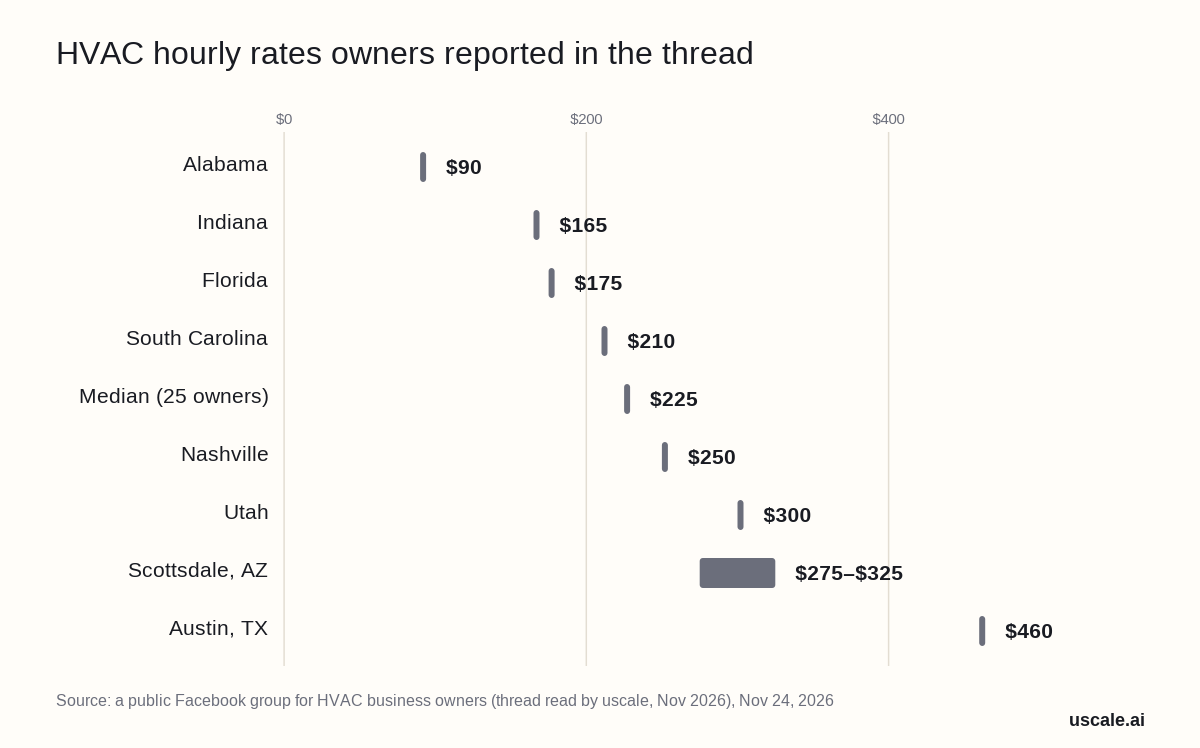
The named rates in between show where you probably fall: $165 in Indiana, $175 in Florida, $210 in South Carolina, $250 in Nashville, $300 in Utah, and $275 to $325 in Scottsdale, Arizona. An hourly rate only makes sense next to the cost of running a truck in a particular place. One figure for every market can't account for that.
Quote the job, not the hourly rate
Most owners get this backwards: they defend the hourly number. A bare hourly rate is rarely what a customer pays. One owner in the thread charges $230 an hour plus a 30% markup on parts and materials. That is a fuller rate structure, and it shows why an hourly figure alone tells a customer very little. If you hand over the total for their job, line by line, they compare your real price with a guess instead of comparing two hourly numbers.
The line to borrow
One owner in the thread said AI assistants such as ChatGPT, Claude and Perplexity give a generic price because they don't know the local market. You can say that back to a customer almost word for word. It is accurate, it doesn't argue with the customer, and it moves the conversation to your number.
A script for the next customer who quotes ChatGPT's number
| If the customer says | You say |
|---|---|
| "ChatGPT says you should charge $150 an hour." | "ChatGPT gives a generic price. It doesn't know our local market or your job." |
| "Why is yours higher?" | "Here's your job line by line: labor, parts, and anything optional." |
| "Can you match it?" | "I'll put the full price for your job in writing, so you're comparing real numbers." |
For a text message:
Thanks for checking around. ChatGPT gives a generic price because it doesn't know our local market, your home or the job. Here is our price for your job, itemized: [labor], [parts], [optional items]. Happy to walk you through any line.
The customer only had ChatGPT's number because yours wasn't anywhere the assistant could find it. The next section covers how to put it there.
Why does ChatGPT give my customers a generic price, and how do I fix it?
ChatGPT gives customers a generic HVAC price when it can't find your actual prices anywhere it can read. The fix is to publish your prices on the pages its search pulls from. One owner in the thread explained the first half: AI assistants such as ChatGPT, Claude and Perplexity give a generic price because they don't know the local market.
What ChatGPT does when it searches
As of November 2026, OpenAI says ChatGPT's search feature pulls current information from the internet directly into the conversation. Answers that used search are marked with a small globe icon. ChatGPT can decide on its own to search based on the question, or the user can turn search on through the + icon or the / menu. OpenAI's own guidance tells users to always review the linked sources before making decisions based on a search-enabled answer.
That guidance matters to you. If a customer clicks the source behind a price, you want that source to be your page. Search isn't always available, though. An admin of an OpenAI Enterprise or Edu workspace can turn off web search for the whole workspace, and ChatGPT then can't browse even when a user asks. That is one reason a customer might still see a generic figure. You can't control that setting, but you can control what search finds when it runs.
Where to put your price
Start with your Google Business Profile. On the Edit services screen, you can add a price and a description to each listed service. Google suggests service names for your industry and also lets you add your own. For a plumbing business, its examples are "Install tap" and "Repair toilet." Match the list to the jobs your customers actually ask about.
Then add structured data to your website. Schema.org's Offer type defines "price" as the property for stating the price of a product or service in a page's structured data. Search tools can then read the number directly from the markup. If you once used Google's PriceList data, note that Google has deprecated it and replaced it with its newer Services data.
The thread's version
The owners in the thread gave the simplest version of this advice: itemize your costs, label what is required and what is optional, and publish a transparent pricing article with a video. A price that an assistant can find and a customer can check beats a national guess.
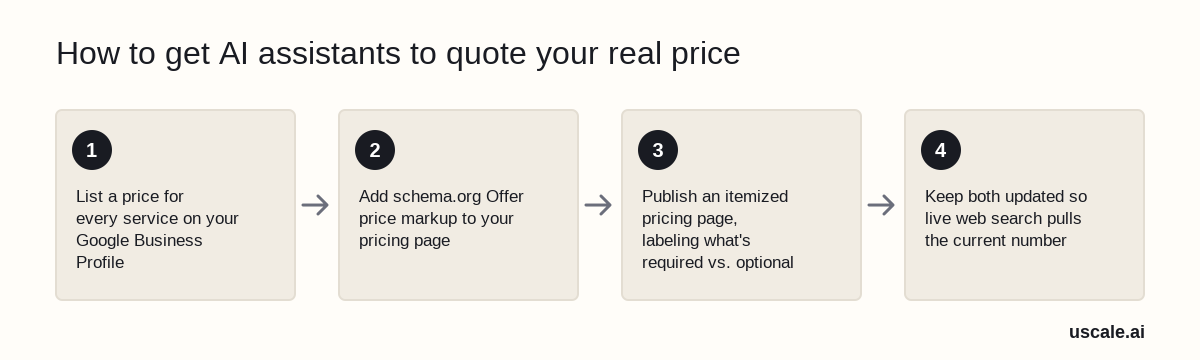
How to get AI assistants to quote your real price. Sources: OpenAI, Google Business Profile Help, Schema.org and the HVAC owners' Facebook thread we read in November 2026.
That leaves one decision before you publish: whether the number on the page is an hourly rate or a price per job.
Should I quote HVAC work by the hour or by the job?
Price predictable HVAC repairs and installs by the job, and bill diagnostics and complex troubleshooting by the hour. Housecall Pro's 2026 pricing guide recommends that split. Many owners already work this way: about 12 owners in the Facebook thread said they price by the job and never give customers an hourly number. Most shops end up using both, with a flat price for a capacitor swap and an hourly rate for chasing an intermittent fault.
The hourly numbers to plan with
If you bill by the hour, know what that hour has to cover. John C. Flood's guide puts an hourly rate at $150 to $275 once labor, overhead, gas and insurance are rolled in. Parts are typically marked up 25% to 50% on top of that. FieldCamp's 2026 guide puts plain hourly or time-and-materials labor closer to $75 to $150. The two ranges measure different things. ChatGPT's $150 can look cheap or expensive depending on what the hour is assumed to include.
Sources: John C. Flood / "Benefits Of A Flat-Rate HVAC Company", Nov 24, 2026; FieldCamp / "HVAC Pricing Guide", Nov 24, 2026
How a flat rate is built
A flat rate still starts from your hourly number. Jobber gives the formula: estimated labor hours times your hourly rate, plus estimated material cost times your markup. FieldCamp calls flat rate the fastest-growing HVAC pricing model in 2026. It says contractors report increases of 100% or more in average ticket size after adopting it. That figure comes from contractors quoted in the guide, not from a controlled study.
The part most owners get backwards
Hourly pricing feels like the safer, more honest choice. Wexford Insurance points out the catch. Under hourly pricing, a faster, better-equipped crew doesn't automatically earn more. Under a flat rate, the customer pays one fixed price however long the job takes, so the time you save stays with you. An hourly rate pays you for the time. A flat rate pays you for knowing the job.
| Model | Best suited to | How the price is built | Numbers from trade guides (as of November 2026) |
|---|---|---|---|
| Hourly, fully loaded | Diagnostics, troubleshooting, complex work | Labor, overhead, gas and insurance in one rate | $150–$275 an hour, plus 25%–50% on parts |
| Hourly / time-and-materials only | Diagnostics, troubleshooting, complex work | Labor rate, materials billed separately | About $75–$150 an hour |
| Flat rate | Predictable repairs and installs | (Labor hours × hourly rate) + (materials × markup) | Fixed price per job, whatever the time |
Pick the model that fits each kind of job. That price, not ChatGPT's placeholder, is the number to put on your Google Business Profile and pricing page. The next question is when an exact number is the wrong thing to publish.
Should every HVAC company post an exact hourly rate online?
No HVAC company is required to post an exact hourly rate online, and some have good reasons not to. Commercial jobs and emergency calls vary too much to price before anyone has seen the equipment. A one-truck shop in a small town may not want every competitor nearby reading its rate and pricing just under it.
The law doesn't force the issue either. The FTC's Rule on Unfair or Deceptive Fees took effect on May 12, 2025. Its final version is narrower than first proposed. As of November 2026, it covers businesses selling live-event tickets or short-term lodging, not local service trades like HVAC.
Those are fair reasons to hold back one exact number. They are not reasons to publish nothing. With nothing published, ChatGPT falls back on a national guess, like the $150 an hour that one Northern California owner's customers were quoted. A starting price or a range, with a plain list of what's included, gives the customer and the AI assistant a real local anchor. You aren't locked into one figure.
| Situation | Why an exact rate is hard | What to publish instead |
|---|---|---|
| Commercial jobs | Equipment, access and scope differ every time | A starting price for the diagnostic visit and what it includes |
| Emergency and after-hours calls | Time of day and parts on hand change the cost | An after-hours starting price and what it covers |
| One-truck shop in a small town | Every local competitor can read the rate | A range for common jobs, itemized as required and optional |
The owners in the thread suggested the same move: itemize costs and label what is required and what is optional. A range you chose beats a number ChatGPT made up.
Whether you post an exact rate or a range, the work is the same. The checklist below covers it.
What to do this week so ChatGPT stops guessing your price
The fix for customers using ChatGPT to check prices is to publish your own prices where customers and AI tools can read them, starting with your Google Business Profile. Here are four steps, in order, each small enough for this week's calendar.
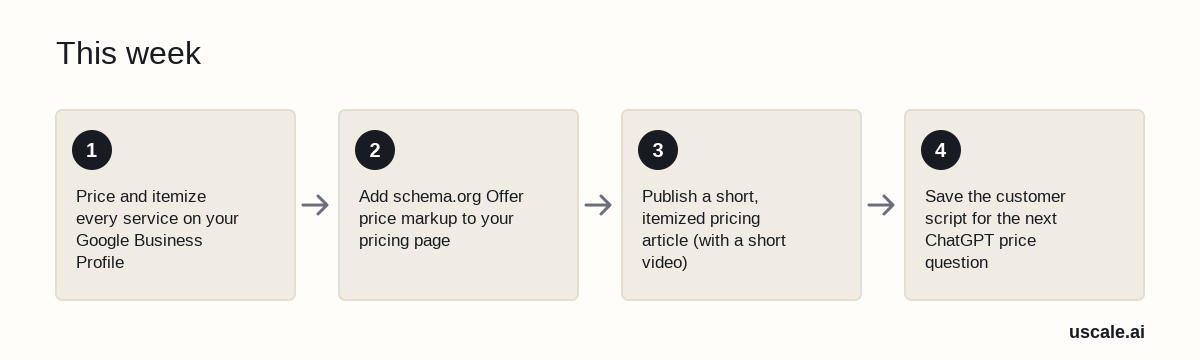
This week: four steps, in order, from your Google profile to your phone.
Price every service on your Google Business Profile. This is the quick win. On the Edit services screen, Google lets you add a price and a description to each service. Use the description to say what's included and what costs extra. You're done when every service shows a price or a starting price. Our free Google Business Profile audit shows what's missing.
Add price markup to your pricing page, if you have one. Ask whoever runs your website to add schema.org Offer markup. Its "price" property states what a service costs in a form search tools can read. You're done when each service on the page carries its price in that markup. If you have no pricing page, skip to the next step.
Publish a short pricing article with a video. Owners in the thread suggested exactly this: itemize costs, label what's required and what's optional, and add a video. A phone video of you walking through a typical service call is enough. You're done when the article is live and linked from your site.
Save the customer script. Put the script from earlier in this post into your phone's text templates. Then the next customer who quotes ChatGPT's number gets your number back.
If you do only one thing, do the first step today.
You can keep this current by hand, through an agency, or with uscale, which we make. It keeps your Google Business Profile up to date, and you approve each change in chat (see what it does).
Success looks like this: your profile lists your prices, your site explains them, and a customer's national guess gets a local, itemized answer.
Questions
What does it mean when a customer says ChatGPT checked your price?
When a customer says ChatGPT checked your price, it means they asked an AI assistant what an HVAC job or hourly rate should cost and got a generic figure back, not a quote for their home, city or job. In one HVAC owners' Facebook thread read in November 2026, a Northern California owner said ChatGPT told his customers he should charge $150 an hour. The best reply is your own itemized price.
Why does ChatGPT give a generic hourly rate instead of a local one?
ChatGPT gives a generic hourly rate when it cannot find a local business's actual prices in a source it can read. One HVAC owner noted that assistants such as ChatGPT, Claude and Perplexity do not know the local market. ChatGPT's search feature can pull web information into an answer, but if no local price is published, or an Enterprise or Edu admin has turned web search off, the assistant falls back on a broad estimate.
What is a typical HVAC hourly rate in the US?
There is no single typical HVAC hourly rate in the US; it depends on the market and on what the hour includes. Among 25 HVAC owners in one Facebook thread read in November 2026, rates ran from $90 in Alabama to $460 in Austin, Texas, with a median of $225. Trade guides put a fully loaded rate at $150 to $275 an hour, and plain time-and-materials labor at about $75 to $150.
Should an HVAC company charge by the hour or a flat rate?
An HVAC company usually does best using both: a flat rate for predictable repairs and installs, and an hourly or time-and-materials rate for diagnostics, troubleshooting and complex work, as Housecall Pro's 2026 guide recommends. A flat rate is built as estimated labor hours times the hourly rate, plus materials times markup. Under a flat rate the customer pays one fixed price, so time saved by an efficient crew stays with the company.
How do I get my real prices to show up in ChatGPT or Google's AI answers?
Real HVAC prices can show up in ChatGPT or Google's AI answers only if they are published somewhere those tools can read. Start by adding a price and description to each service on your Google Business Profile through the Edit services screen. Then add schema.org Offer markup with a price property to your website's pricing page, and publish an itemized pricing article that labels required and optional costs. No step guarantees an AI tool will quote you.