Podium's listed price and what owners actually pay
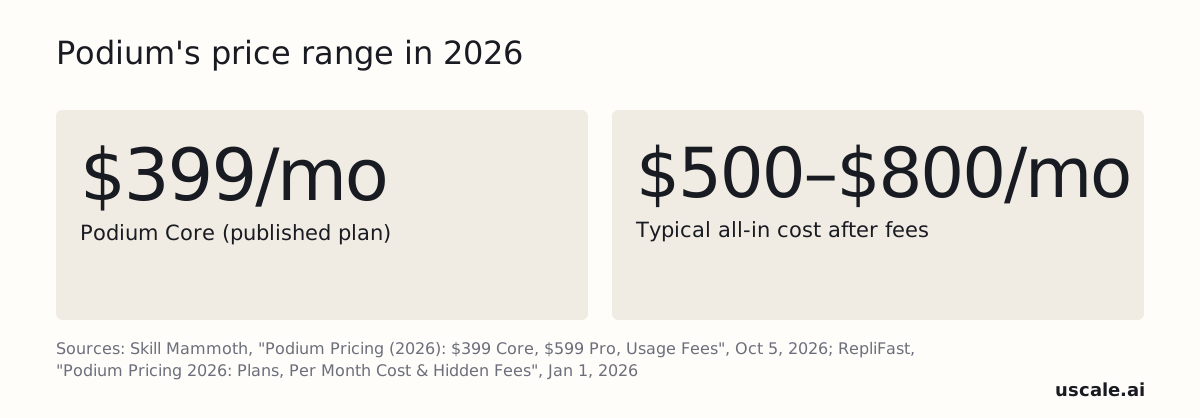
Most owners comparing Podium alternatives are reacting to one gap. Podium's plans are listed at $399 a month for Core and $599 a month for Pro, but most single-location businesses end up paying $500–$800 a month once add-ons like extra users, SMS overages and the AI reply module are counted. The two plan prices come from a capture of Podium's pricing page dated October 5, 2026, and a second pricing tracker reports the same two flat plans.
That spread changes the question. It is less "what replaces Podium" and more "which cheaper, narrower tool covers the one job I bought Podium for," whether that job is review requests, two-way texting or catching missed calls. This post covers real 2026 pricing, the fees that never appear on the pricing page, the contract terms, a verdict for HVAC companies and dental offices, and a named list of alternatives sorted by job. Most of the distance between $399 and $800 sits in charges that are not printed next to the plan names.
Start with the plans themselves, because even the sticker price depends on where you look.
How much does Podium actually cost per month in 2026?
Podium's published plans cost $399 a month for Core and $599 a month for Pro, with a third tier, Signature, priced by custom quote, as captured on October 5, 2026. Those figures come from Skill Mammoth's capture of Podium's pricing page. Reviewshake's 2026 pricing tracker reports the same two flat plans and the same quote-only Signature tier.
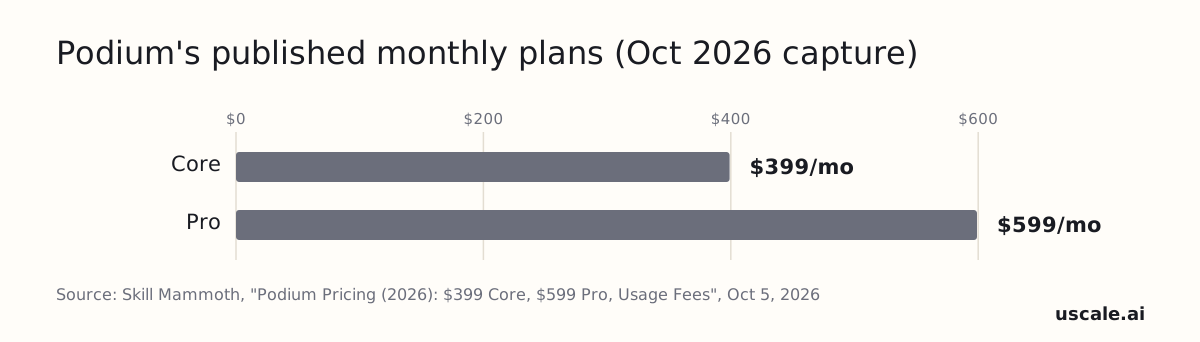
Source: Skill Mammoth, capture of Podium's pricing page, October 5, 2026.
Not every source sees those numbers. Wiserreview's 2026 review reports that podium.com/pricing shows no dollar figures at all and sends every plan to a sales conversation. Emitrr's 2026 overview says all Podium pricing is quote-based. Each business has to contact sales for a price based on its location and team size. The Skill Mammoth capture that shows $399 and $599 also notes that HVAC businesses "should contact sales for applicable pricing." Whether you see a number may depend on when you look and what trade you are in.
Treat the published plans as a floor. A Podium plan price is where your quote starts, not where it ends. If you can't confirm the sticker price on the day you buy, treat it as an opening position. The plan offered to your trade may also differ from the one on the page.
Budget around a higher number. RepliFast's 2026 pricing review found that most single-location businesses end up paying $500 to $800 a month once add-ons are included, such as extra users, texting overages and the AI reply module. Compare any Podium quote against that range, not against $399.
Specific line items make up the gap between the sticker price and the typical bill. The next section lists each fee and what it costs, so you can total your own quote before a sales call.
What fees does Podium charge on top of the base plan?
Podium charges at least five fees on top of its base plan. Those fees explain most of the gap between the $399 Core price and the $500–$800 a month that most single-location businesses end up paying. Each fee below comes from a 2026 third-party pricing review. Podium's own page does not list all of them.
- Texting compliance (10DLC): 10DLC is the carrier registration US phone companies require before a business can send texts from a regular local number. Podium charges $5/month per US location for it. You need it to send texts, and Podium does not waive it.
- Extra phone numbers: $5/month for each additional number on the account.
- Podium Phones seats: $30/user/month for 1–4 users, dropping to $25/user/month at 5 or more.
- Phones network setup: a one-time $500 per location before the seat fees start. A competitor roundup reports the same fee.
- Extra team members on Core: $25/month for every user past the plan's included count. A 10-person team on Core would pay $399 + $25×6 = $549/month before any texting or phone fees.
The AI Employee add-on is a sixth cost to ask about. Podium lists it as an add-on for any plan with no published price. A 2026 third-party review estimates it at roughly $99–$399/month, depending on scale and setup. Treat that range as a question for the sales call, not a quote.
The pattern most owners miss
The base plan is one flat number. Almost every fee on top of it is multiplied by something: locations, phone numbers or people. Podium's quote grows with your headcount, not with the work the tool does for you. Count your locations, numbers and users before you talk to sales, then fill in the table below.
| Item | One-time or monthly | Cost (2026 reports) | Your count | Your total |
|---|---|---|---|---|
| Core base plan | Monthly | $399 | 1 | |
| 10DLC texting compliance | Monthly | $5 per US location | ||
| Extra phone numbers | Monthly | $5 per number | ||
| Podium Phones seats | Monthly | $30/user (1–4 users), $25/user (5+) | ||
| Phones network optimization | One-time | $500 per location | ||
| Extra users on Core | Monthly | $25 per user past the included count | ||
| AI Employee add-on | Monthly | Not published; estimated $99–$399 |
The table gives you a monthly bill. The contract decides how long you keep paying it, and the contract terms come next.
Can you cancel a Podium contract early, and how does auto-renewal work?
Standard Podium terms are described as 12-month annual contracts with automatic renewal, and a second independent review says the same. Signing Podium means committing to a year, and that year starts over by default unless you act.
The date that matters is the day the term renews, not the day you sign. Auto-renewal puts the work on you. If you do nothing, you are in for another year. The decision has to be made before the renewal date, not after the next invoice arrives.
An auto-renewing contract turns doing nothing into a decision.
The sources behind this post don't spell out an early-termination fee or how much notice Podium needs before renewal. Treat both as open questions. Get the answers in writing during the sales call:
Before I sign: what is the notice period to cancel before renewal, how must notice be given, and what do I owe if I end the contract before the term is up?
On the day you sign, put the renewal date in your calendar. Set a reminder well ahead of the notice deadline, so you have time to compare options instead of rushing.
A one-year commitment also changes the math on whether Podium pays for itself. That math is the real question for a small HVAC or home-service shop.
Is Podium worth it for a small HVAC or home-service company?
Podium is usually worth it for a higher-volume HVAC or home-service shop, where a typical all-in cost of $500–$800 a month is easy to recover. For a 1–3 truck owner-operator who mainly wants review requests and texting, Podium is a harder sell. That owner pays for a full platform and uses two parts of it.
Run the break-even in two steps
- Multiply the monthly cost by 12 to get a rough annual cost.
- Divide that by your average gross profit per job.
The result is the number of extra jobs a year Podium has to bring in just to pay for itself.
| Low end | High end | |
|---|---|---|
| Typical monthly all-in cost (2026) | $500 | $800 |
| Rough annual cost (× 12) | $6,000 | $9,600 |
| Extra jobs needed per year | $6,000 ÷ your gross profit per job | $9,600 ÷ your gross profit per job |
You supply the gross profit per job. This post does not source a typical HVAC job value, and another shop's average says little about your own margins. Use profit after parts and labor, not the invoice total. The invoice total makes any tool look cheaper than it is. If you already have a written quote from Podium, use that monthly figure in place of the $500–$800 range.
Reading the result
Say the answer is only a handful of jobs a year, and you already lose leads to slow replies or thin reviews. In that case Podium likely pays for itself. Now say the answer is more jobs than you could honestly trace back to review requests and texts. In that case a narrower, cheaper tool fits better.
The real question is not whether Podium is good software. It is whether Podium can win back its own cost in jobs you would otherwise lose.
The same math works for a dental office, but dental adds a compliance question that no price sheet answers.
Is Podium a good fit for a dental office, and is it HIPAA compliant?
Podium's pricing works the same way for a dental office as for any other business. The plans, the per-location texting fee, the Phones add-on and the 12-month auto-renewing contract are the same ones itemized above. The sources behind this post do not confirm whether Podium is HIPAA compliant for a dental practice or whether it will sign a business associate agreement (BAA). They also do not show how deeply Podium connects to practice-management software like Dentrix or Open Dental.
| Question for a dental office | What the sources say | What to do |
|---|---|---|
| Plan price | Core $399/month, Pro $599/month (Oct 5, 2026 capture) | Get your quote in writing |
| Texting compliance | $5/month 10DLC per US location | Count every location |
| Phone seats | $30/user (1–4 users), $25/user (5+) | Count front-desk users |
| Contract | 12 months, auto-renews | Note the renewal date |
| HIPAA / BAA | Not confirmed by these sources | Get it confirmed in writing |
| Dentrix or Open Dental sync | Not confirmed by these sources | Ask what syncs, in writing |
A promise on a sales call is not a signed BAA. Send this before you sign:
Will Podium sign a business associate agreement with our practice, and can you send it with the quote? What data syncs with our practice-management software, in which direction, and on which plan?
Compare that written answer with dental-native scheduling and reminder tools, which may already cover what your front desk needs. If you still want one platform for everything, the closest like-for-like option is next.
Is Birdeye a better all-in-one replacement for Podium?
Birdeye is the closest like-for-like replacement for Podium, and it costs modestly less. A 2026 head-to-head comparison puts Birdeye's published pricing at about $299–$449/month per location on an annual contract, against roughly $399–$599/month for Podium. Both are annual-contract, all-in-one platforms. This comparison only matters if you already want reviews and messaging in one tool. If you need just one of those jobs, the next section covers narrower options.
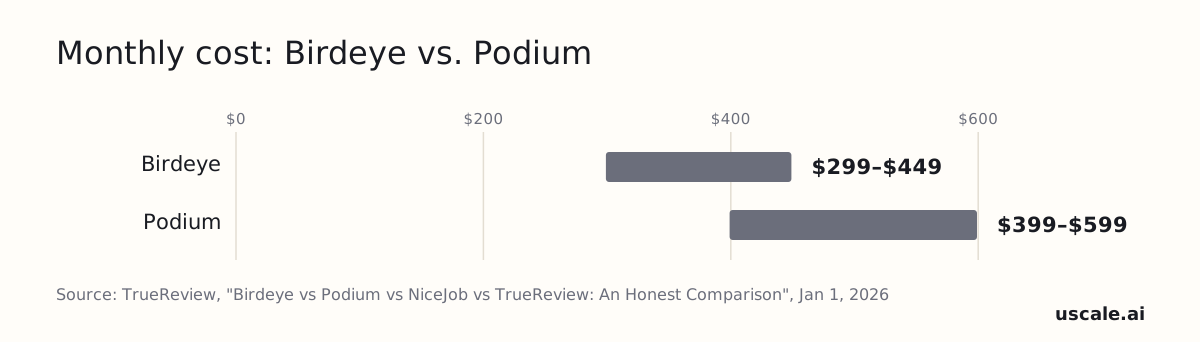
Chart source: TrueReview, "Birdeye vs Podium vs NiceJob vs TrueReview: An Honest Comparison" (2026).
Four criteria decide this choice:
- Published price range: the floor you pay before any add-on.
- Contract: how long you are tied in if the tool is a bad fit.
- Free plan or trial: whether you can test the tool before you commit.
- Documented add-on fees: whether the quote will match the bill.
| Criterion | Birdeye | Podium |
|---|---|---|
| Published monthly range | About $299–$449 per location | About $399–$599 |
| Contract | Annual | 12 months, auto-renews |
| Free plan or trial | Not covered in our sources (2026) | None listed on its pricing page |
| Add-on fees documented by third parties | Not covered in our sources (2026) | Yes: texting compliance, extra numbers, Phones seats and setup (see the fee table above) |
Sources, all 2026:
- TrueReview, for both price ranges and Birdeye's contract.
- TrueReview and FieldCamp, for Podium's contract.
- Reviewshake, for Podium's trial.
Other trackers report that Podium's own page shows no prices at all, so get both quotes in writing.
Choose Birdeye if you run a single location, you use reviews and messaging together every week, and the lower entry price matters most.
Choose Podium if you also want phone seats from the same vendor. Its add-on costs are documented well enough that you can total a realistic quote before the sales call.
Choose neither if your real need is one job, such as review requests or missed calls.
Rule of thumb: if you would use reviews and messaging every week, ask both vendors for written annual totals. If you would not, skip the all-in-one tier.
What are the best Podium alternatives for a small business?
The best Podium alternative for a small business is not one tool. It is the tool that matches the one job you actually use Podium for: review requests, two-way texting, missed-call coverage, a full all-in-one platform, or something your existing software may already do.
Most owners shop for this backwards. They look for a cheaper Podium. The better question is which single Podium feature they would miss on day one. Name that feature first and the shortlist gets short. A platform built for five jobs is expensive if you only use one of them.
| Your main need | Example tools | Best for |
|---|---|---|
| Reviews only | NiceJob, GatherUp, HiFiveStar | Owners who mainly want more Google reviews and replies to them, without a phone or inbox system |
| Two-way texting | SimpleTexting, Textedly, MessageDesk, Heymarket, Emitrr | Teams that text customers about appointments, quotes and follow-ups |
| All-in-one | Birdeye | Businesses that want reviews and messaging bundled in one tool, as compared in the section above |
| Missed calls / after-hours | Covered in the next section | Shops losing jobs to calls nobody picks up |
| Software you may already pay for | Home services: Jobber, Housecall Pro, ServiceTitan. Dental: Weave, NexHealth, RevenueWell | Owners already running one of these tools, who should check their plan before buying anything new |
How to compare these Podium alternatives
The reviews-only and texting rows carry no prices on purpose. This post has no dated, sourced figures for those tools, and plans change. Open each vendor's current pricing page on the day you compare, and note whether the price is month-to-month or tied to an annual term. Birdeye, like Podium, is sold on an annual contract, so that detail matters for every row.
The last row is the one owners skip. If you already run jobs or appointments through a field-service or practice tool, check your current plan for review requests or two-way texting before adding a second login and a second bill. Paying twice for the same feature is the easiest cost to avoid.
If reviews are the main job, our guide to keeping up your Google review response rate covers what to do once the requests start working. Unanswered calls are a different problem with a different price tag, so they get their own section next.
What if missed calls, not reviews, are my biggest problem?
If missed calls are your biggest problem, pay for call coverage on its own, not for a full review-and-texting bundle that only fixes calls as a side feature. Buy the fix for the problem you have, not the bundle it happens to come in.
What call coverage costs inside Podium
Podium's phone product is an add-on. Skill Mammoth's October 2026 capture of Podium's pricing lists Podium Phones seats at $30/user/month for 1–4 users and $25/user/month for 5 or more. Before those seat fees start, Wiserreview reports a one-time $500 network-optimization charge per location, and Vendasta's competitor roundup reports the same $500 fee. Those costs sit on top of a Podium plan that runs on a 12-month, auto-renewing contract.
A narrower option
uscale, which we make, answers your phone when the business is closed, texts back people whose calls you missed, and books them into your calendar. You approve its work in chat. Plans start at $29.99/month, paid monthly with cancel-any-time terms, and the first 7 days on any plan cost $1 with a card required. Calling back people who asked for a call starts on the $99.99/month Growth plan, so check which plan covers the jobs you need. The product page lists everything it does today.
| Podium Phones | uscale, which we make | |
|---|---|---|
| Upfront | $500 one-time per location | $1 for the first 7 days |
| Monthly | $30/user (1–4 users), $25/user (5+) | From $29.99 (Starter); $99.99 (Growth); $299.99 (Pro) |
| Term | Podium's 12-month auto-renewing contract | Monthly, cancel any time |
Owners comparing call tools also look at Rosie and CallRail. Check each vendor's current pricing page, because this post has no sourced price for either.
Before you pick any tool, decide which job matters more. If you mainly lose calls during the workday, start with how missed-call text-back works. If you mainly lose calls at night and on weekends, read what an after-hours answering service covers. The right tool is the one that covers the hours when your phone actually goes unanswered.
All of this assumes you need a paid tool in the first place. Some owners don't.
When doesn't this Podium comparison apply to you?
This Podium comparison doesn't apply to a true one-person shop. An owner who finishes a handful of jobs a week may not need a paid review or texting tool at all. Texting the business's free Google review link by hand after each job does the core work a review platform automates.
That objection holds. A personal text from an owner who knows every customer may land better than an automated one, and it costs nothing. Most single-location businesses end up paying $500–$800 a month as of 2026, according to RepliFast. Skip the paid tool until the habit breaks, when you forget to send the link or jobs come in faster than you can text.
Two limits apply whichever tool you pick, including none:
| If you are... | What this post doesn't settle | What to do |
|---|---|---|
| A one-person shop | Whether you need software at all | Text your review link after each job. Look at tools once customers slip through. |
| A dental office or med spa | HIPAA and BAA terms, for Podium or any alternative | Get BAA terms in writing from every vendor before patient details go in. |
| Any business texting from software | Registration and consent | Expect registration with any vendor and keep a record of consent. |
The texting row isn't only about Podium. Podium describes its 10DLC fee as a carrier-compliance charge required to send text messages. That is a rule of the channel, so expect a version of it from any texting vendor. The fee table above shows Podium's version. If you haven't outgrown a phone and a habit, the cheapest Podium alternative is the one you already have.
If you have outgrown it, the next step is a quote you can hold the vendor to.
What to get in writing before signing Podium or any alternative
Before signing Podium or any alternative, get five things in writing: the exact monthly price, the total 12-month commitment, setup and phone fees, texting and overage fees, and the auto-renewal and cancellation terms. Then put the renewal date in your calendar on the day you sign.
Bring the checklist below to the sales call. The amounts are what third-party trackers reported in 2026. Ask the rep to confirm or correct each one on the written quote.
| Item | Reported amount (2026) | Why it matters |
|---|---|---|
| Podium Phones setup | $500 one-time per location | Charged before any phone seat fees start |
| Phone seats | $30/user/month for 1–4 users, $25/user/month for 5+ | Grows with every person who answers calls |
| 10DLC texting fee | $5/month per US location | Required to send texts and not waivable |
| Extra phone numbers | $5/month each | Adds up if you use separate numbers for trucks or ads |
| Extra users on Core | $25/month per user past the included count | A 10-person team on Core works out to $549/month |
| Texting overages | Ask for the per-message rate | Overages are one reason bills rise past the base plan |
| Contract term | 12 months, auto-renews | Missing the date commits you to another year |
| Dental only: HIPAA/BAA | Written confirmation from the vendor | This post's sources don't settle it either way |
To ask for the quote, you can copy this:
Please send a written quote with the monthly price, the total for the first 12 months, every one-time fee, texting and phone-number fees, the overage rate, and the renewal and cancellation terms.
Total your own quote within the hour. Fill in the table for your headcount and number of locations. You're done when you have one monthly figure and one annual figure.
Set the renewal reminder. A free calendar alert works. Put it well before the renewal date so you have time to cancel or renegotiate. You're done when the alert is saved.
If you do only one thing, get the auto-renewal and cancellation terms in writing. Success is a signed quote with no surprise line items, and a renewal date you choose to act on.
With the quote in hand, the decision itself gets simpler.
Before you sign a 12-month term
Podium's published plans, $399 Core and $599 Pro as captured in October 2026, are the starting point, not the bill. Most single-location owners end up paying $500–$800 a month once fees and add-ons are counted. Standard Podium terms are 12-month contracts that auto-renew, so a poor fit costs a full year rather than one month.
- Name your one biggest gap. Pick one: reviews, two-way texting, missed calls, or a real need for everything in one platform.
- Get the quote in writing. Take the checklist from the previous section to the sales call and fill in every line.
- Read the contract terms. Find the renewal date and the cancellation window, then put the renewal date in your calendar the same day.
- Decide. Choose Podium if you'll use the whole platform, Birdeye for a similar bundle at a lower published price, or a narrower tool if one gap is the whole problem.
The cheapest tool is the one that fixes the gap you actually have.
Questions
What are Podium alternatives?
Podium alternatives are other software tools that do one or more of Podium's jobs, such as review requests, two-way texting with customers, missed-call coverage, or an all-in-one platform. Owners look at them because Podium's published plans of $399 and $599 a month often grow to $500 to $800 a month with add-ons. Birdeye is the closest all-in-one option, while narrower tools cover a single job.
Does my field service or dental software already do what Podium does?
Field service and dental software may already cover part of what Podium does. Home-service tools like Jobber, Housecall Pro and ServiceTitan, and dental tools like Weave, NexHealth and RevenueWell, are worth checking first. Look at your current plan for review requests and two-way texting before buying a second tool. Features vary by plan and change often, so confirm with your vendor in writing rather than assuming.
Which Podium alternative is best for two-way texting with customers?
The best Podium alternative for two-way texting depends on your message volume and how your team works. Dedicated texting tools such as SimpleTexting, Textedly, MessageDesk, Heymarket and Emitrr are built for appointment, quote and follow-up messages. Compare their current pricing pages on the same day, check whether terms are monthly or annual, and expect a carrier registration step with any vendor, similar to Podium's $5 per location 10DLC fee.
How do I calculate whether Podium pays for itself?
To calculate whether Podium pays for itself, multiply your monthly cost by 12, then divide by your average gross profit per job. The result is how many extra jobs a year Podium must win to break even. At a typical $500 to $800 a month, that is $6,000 to $9,600 a year. Use profit after parts and labor, and use your written quote if you have one.
What if missed calls, not reviews, are my biggest problem?
If missed calls are your biggest problem, pay for call coverage on its own rather than a full review-and-texting platform. Inside Podium, phone coverage is an add-on: Podium Phones seats cost $30 per user per month for one to four users and $25 for five or more, after a reported one-time $500 setup fee per location, on a 12-month auto-renewing contract. Compare dedicated missed-call and after-hours tools.