What are the best HVAC marketing ideas for a small shop in 2026?
The best HVAC marketing ideas for a small shop in 2026 cost nothing: a complete Google Business Profile and a steady flow of recent reviews. Google says it ranks local results mainly on relevance, distance and prominence. Prominence reflects how well-known a business is, based on signals like inbound links and review volume. That ranking is earned with a free listing, not a budget.
Paid leads are the other route. One marketing vendor reports that Google Local Services Ads leads for HVAC companies average near $51 each in many markets in 2026. That is a vendor figure, not a rate Google publishes.
Below you'll find a prioritized checklist, a cost table, and two scripts you can copy. So when cash is short, which comes first: the free listing or the $51 lead?
Where do I start with hvac marketing ideas on a tight budget?
On a tight budget, start with free HVAC marketing ideas: a complete Google Business Profile and a steady flow of reviews come before any ad spend. Think of it as the HVAC marketing priority stack. It has five levers, pulled from the top down, and each one makes the next pay off.
- Fix the free stuff. This means your Google profile, your primary category and your reviews. Google says local ranking rests mainly on relevance, distance and prominence, and prominence comes partly from review volume and inbound links (Google Business Profile Help). Free work builds that ranking. An ad budget doesn't.
- Answer every call, day or night. A better ranking brings more calls, and every missed call wastes visibility you already earned.
- Add paid leads. Start with Local Services Ads, then search ads. Buying leads before calls get answered means paying for voicemails.
- Pick software that fits your truck count. Choose for the size of your shop, not the longest feature list.
- Turn one-time jobs into repeat revenue. Use maintenance agreements and referrals.
Tracking sits under all five levers. Log where each booked job came from, so you can see which lever is earning its keep.
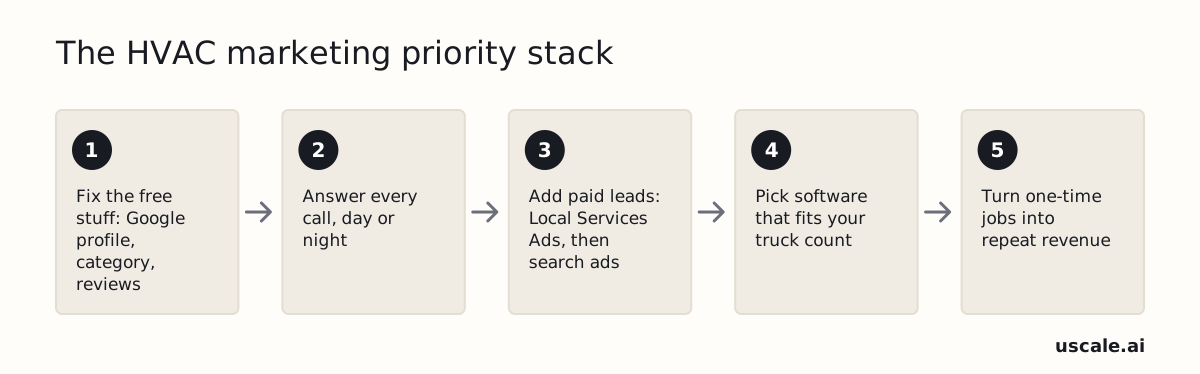
Each lever gets its own section below, with the figures behind it. Work the stack in order this week, starting at the top with your Google profile.
How do I get my HVAC company into the Google Maps 3-pack and get more reviews?
To get an HVAC company into the Google Maps 3-pack, set "HVAC contractor" as your primary category and keep recent reviews coming in. Google ranks local results mainly on relevance, distance and prominence. Prominence comes from signals like inbound web links and review volume (Google).
You can't change distance, so work on the other two. "HVAC contractor" is a selectable primary category in Google's current US list (Afraz Alam), and that choice handles relevance. Reviews handle prominence.
The review math
97% of consumers read reviews for local businesses, and the average consumer checks six review sites before choosing one (BrightLocal). 31% will only use businesses rated 4.5 stars or higher, up from 17% a year earlier. 74% look for reviews from the last three months (PinMeTo, summarizing BrightLocal).
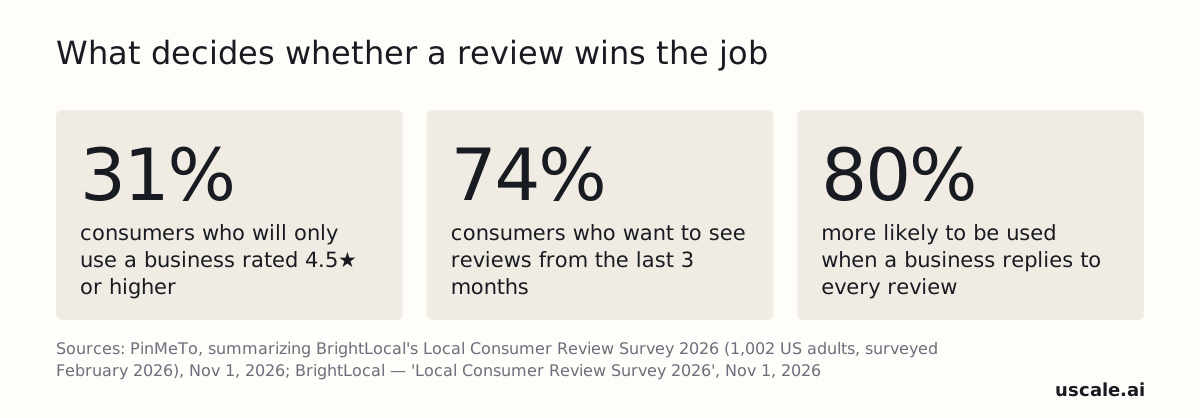
Many owners treat reviews as a pile you build once, but buyers look for recent ones. A review from last month does more to win a homeowner than a review from 2023. Replies count too. Businesses that respond to every review are more likely to be used by 80% of consumers (BrightLocal). The full data on reply habits is in our post on Google review response rates.
The line you must not cross
Ask for reviews, and never pay for them. As of November 2026, Google strictly prohibits offering free or discounted goods or services in exchange for posting, changing or removing reviews (Google). The FTC's final rule, announced August 14, 2024, bans buying or selling fake reviews and allows civil penalties against knowing violators. The rule also bars staff from writing reviews without disclosing their connection to the business (FTC). So a tune-up discount in exchange for a review is out.
Picking a review tool
A one-to-five truck shop can compare NiceJob and Broadly first. Birdeye is another common name on shortlists. Check each vendor's own features and pricing pages before you sign up. uscale, which we make, is one more option. It keeps your Google profile up to date and drafts a reply to every review in your voice for you to approve.
Review-request text to copy
Hi [Name], thanks for choosing [Company] today. If [Tech] took good care of your [furnace/AC], would you leave us a quick Google review? It helps your neighbors find a contractor they can trust: [review link]. Thank you, [Your name]
A strong listing only pays off if the next customer can reach you when they call.
How many customers am I losing to missed calls, and what's the cheapest fix?
An HVAC company that lets calls ring out is losing real jobs, and the cheapest fix is an automatic text sent the moment a call is missed. Ignore the "85% never call back" figure in a lot of HVAC marketing content. It doesn't trace to a verifiable CallRail study. CallRail's own 2025 survey found that 78% of consumers have abandoned a business after an unanswered call, 82% said they'd call a competitor, and only about 42% leave a voicemail.
Most owners get the voicemail number backwards. When fewer than half of callers leave a message, voicemail isn't a safety net. It's where most lost jobs disappear without a trace. A no-cool call in July comes from someone ready to book today, and that caller books with whoever responds first.
What answering every call costs
A text-back is the minimum. The next step up is a receptionist who actually picks up. As of November 2026, Smith.ai's published rates show the gap between AI and live answering:
Monthly plan ranges from Smith.ai's published rates, as reported by CloudTalk, November 2026.
| AI Receptionist | Human Virtual Receptionist | |
|---|---|---|
| Monthly plans | Free for 25 calls, up to $500 for 300 | About $300 for 30 calls, up to $2,100 for 300 |
| Calls over the allowance | $3 each on the free tier | $8.50–$11.50 each |
At similar call volumes, the AI option costs roughly a fifth to a third of the live-agent price. Your choices include live answering services, other AI receptionists, and our own after-hours answering, which texts back missed calls, answers the phone when you're closed, and books the caller in. You approve its work in chat. Our after-hours answering service comparison puts the options side by side.
Missed-call text-back script
Hi, this is [Name] at [Company]. Sorry we missed your call. Are you without heat or AC right now, or looking to book a tune-up or estimate? Reply here and we'll get you a time today.
Once every call gets an answer or a text, money spent on more leads stops leaking away and starts paying off.
Are Google Local Services Ads worth it, and how does paid hvac advertising cost compare?
Google Local Services Ads are worth testing for a small HVAC company. In many markets in 2026, HVAC leads from Local Services Ads cost less than leads from standard Google Ads. Vendor tracking puts HVAC Local Services Ads leads at about $42–$75, averaging near $51. Standard Google Ads leads typically run $50–$150 for HVAC, depending on market and season. Both ranges come from the marketing vendor L3ad Solutions, not from Google, so treat them as a starting estimate rather than a price list.
Why the ranges matter more than the averages
The Local Services Ads range sits mostly inside the low end of the standard-ads range. Standard search ads also swing harder with season and local competition. The useful reading is not that one ad type always wins. Local Services Ads give a small shop a narrower, more predictable cost per lead to test against. A predictable cost is easier to budget when cash is tight in the shoulder months.
The benchmark to check before you budget
HVAC marketing content often repeats a figure of "$90.92 average home-services cost-per-lead" and credits it to WordStream and LocaliQ's 2025 benchmarks. That number could not be confirmed on WordStream's own page. A different source citing the same LocaliQ 2025 benchmark puts average non-branded HVAC cost-per-lead at about $127–$130. Check that figure against WordStream's benchmark PDF before you build a budget on it.
When to turn the ads on
Start Local Services Ads only after calls are answered live, and keep the first test short and capped. Run it for a few weeks of real calls, then decide whether to scale. Paying for a lead that rings out to voicemail turns a $51 lead into a $51 loss.
A cheap lead only stays cheap if someone picks up the phone.
Once the ads and the phone are both working, the next limit is how fast the office can schedule and dispatch the jobs those calls create.
What software does a 1–5 truck HVAC company actually need?
A 1–5 truck HVAC company needs software that runs the calendar, quotes and online booking, not an enterprise suite built for a multi-location operation. Match the software to your truck count, not to the longest feature list. Features you won't use still cost money and setup time.
Names you'll come across include Jobber, Housecall Pro, Service Fusion, FieldEdge, Workiz and ServiceTitan. Don't take any feature list on trust. Write down what your shop needs at its size, then check each vendor's own pricing page as of November 2026 and ask two questions. Does the base plan cover everything on my list? Are call tracking, marketing tools and payments included, or priced separately? Then price the setup you would actually run.
| Trucks on the road | What the software must do for you | Ask the vendor |
|---|---|---|
| 1–2 | Calendar, quotes, invoices, online booking | Is online booking in the base plan? |
| 3–5 | All of the above, plus one view of every tech's day | What does each added tech or user cost? |
| Several locations, a dispatch team | Reporting across branches and office roles | Is this plan built for my size or a bigger company? |
Which jobs belong on online booking
Put non-emergency work online: tune-ups, replacement estimates and second opinions. These customers are planning ahead and are happy to pick a slot at night.
Keep no-heat and no-cool calls on the phone, or run them through a few triage questions before they get a time. Ask whether the system is fully off and whether anyone in the home is elderly, an infant or medically at risk. An emergency needs a person to set expectations and send the right tech, and a calendar slot two days out can lose that job.
Once routine bookings fill the calendar without phone time, the cheapest new jobs come from customers already in your system.
How do I get more jobs from customers I already have?
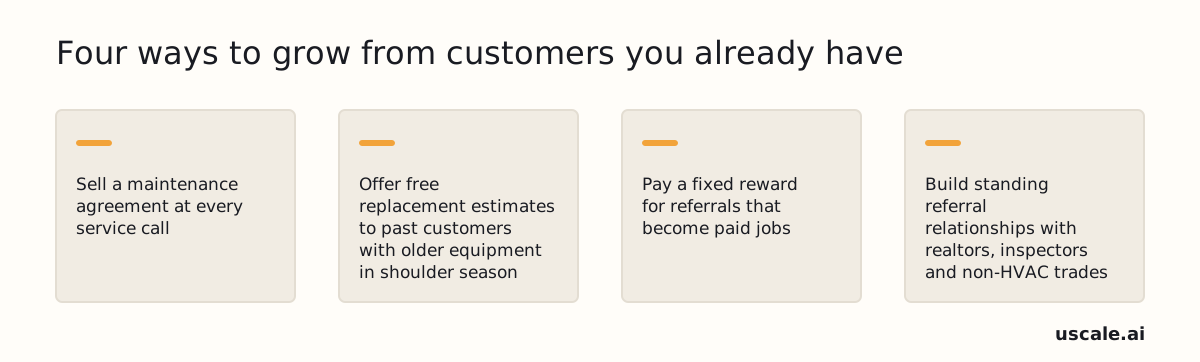
The cheapest new job for an HVAC company comes from a customer who already trusts the shop. Two habits do most of the work: sell a yearly maintenance agreement at the end of every completed service call, and pay a fixed reward for referrals that turn into paid jobs.
Make every service call sell the next one
Offer the agreement while the tech is still in the house and the customer has just watched the problem get fixed. That is when the value is easiest to see. Agreement customers give you booked tune-ups in slow months. When something breaks, they call you first instead of searching.
In shoulder season, go back through past jobs and contact customers with older equipment. Offer a free replacement estimate before the first heat wave or cold snap, while your crews have open days.
No verified industry benchmark exists for how many service calls should end in a maintenance agreement. Ignore any figure you see quoted and track your own rate month to month instead. Your own trend is the only target that means anything.
Turn customers and local trades into referral sources
Set a fixed reward for every referral that becomes a paying job, not for every name passed along. Paying only on closed jobs keeps the offer simple to explain and cheap to run. Keep it separate from review requests, because rewarding reviews breaks the rules covered earlier.
Then build standing relationships with realtors, property managers, home inspectors and non-competing trades like plumbers and electricians. They are inside homes every week and get asked who to call.
Each of these is a separate channel, so each one has to be measured like one.
How do I know which HVAC marketing is actually booking jobs?
You can tell which HVAC marketing is booking jobs only when each channel has its own label and you compare channels on sold jobs and revenue, not on lead counts. Give your Google profile, Local Services Ads, search ads, referrals and repeat-customer outreach each a way to be identified. That can be a separate tracking number per channel, or simply asking every caller, "How did you find us?"
Start a call log this week. A shared spreadsheet or a notebook by the phone both work, as long as every call gets a line:
| Date | Channel | Caller name | Job booked (yes/no) | Job value |
|---|---|---|---|---|
| Google profile | ||||
| Local Services Ads | ||||
| Search ads | ||||
| Referral | ||||
| Past customer |
After 90 days, add up booked jobs and total job value for each channel. Divide what you spent on that channel by the jobs it sold, not by the calls it produced.
Don't judge a channel by lead count alone. A cheap lead that never closes costs more than an expensive lead that does. The per-lead ranges in the Local Services Ads section above are a starting point for budgeting. After 90 days, your own log replaces them, and some channels will turn out to work less well than you thought.
For some shops, the log will say something bigger: that the whole order needs a tweak.
When does this playbook not apply?
The HVAC marketing playbook in this post needs adjusting for two kinds of shop: a one- or two-truck operation in a small town, and a shop where only one or two people answer the phone.
In a small town, local search volume may be too thin to give Local Services Ads a fair test. Referral partners such as realtors, property managers, home inspectors and other trades, plus a phone that always gets answered, will likely book more jobs than paid leads.
Where one or two people handle the phone, fix missed calls before paying for any channel. When the owner is also the tech in the attic, each missed call is a bigger share of the week's revenue. Paid leads that ring out only make that worse.
Two things hold at every size. The Google and FTC review rules covered in the reviews section apply to every shop. Review-request and follow-up texts should go only to customers who gave the business their number through a job, a quote or a call, never to a purchased list.
Small town or large market, the free fixes still come first.
What should I do in my first 30 days of HVAC marketing?
Your first 30 days of HVAC marketing should fix the free basics in order. Week 1 is the Google Business Profile, week 2 is reviews, and weeks 3 and 4 are missed calls plus a small Local Services Ads test. Repeat work and tracking start in month 2. Every step below works with whatever tool you pick, or with no tool at all.
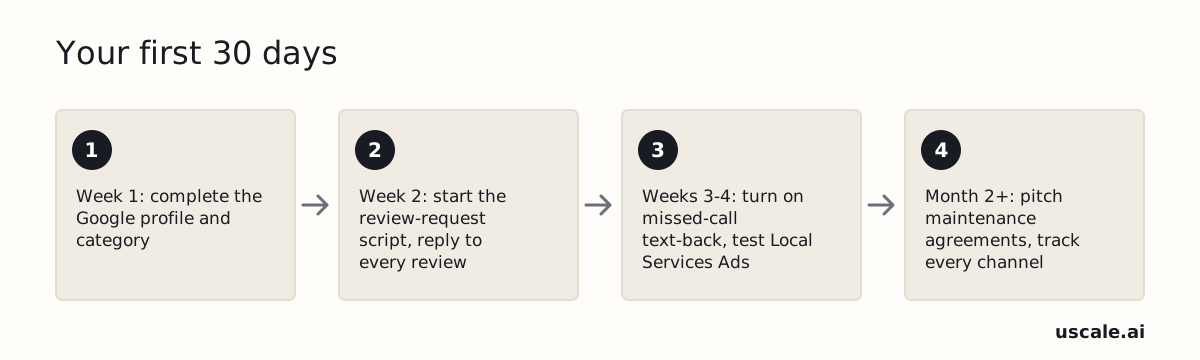
Week 1: Complete your Google Business Profile. Set "HVAC contractor" as the primary category. Then add every service you sell, every town you cover and photos from real jobs. You're done when no field on the profile is blank. This is also your quick win: the category and service areas take less than an hour. If you do only one thing this month, do this.
Week 2: Ask for reviews and answer the ones you have. Send the review-request text after every completed job. Your own phone and a saved message are enough to start. Reply to every review already on the profile, oldest unanswered first. You're done when no review sits without a reply. For more on reply habits, see how review response rate affects local customers.
Weeks 3–4: Catch missed calls, then test paid leads. Turn on a missed-call text-back using the script from the missed-calls section. You can use any tool or send it by hand. Once calls get answered live, start a Local Services Ads test and judge it against the cost-per-lead ranges in the paid-ads section. You're done when a test call placed after hours gets a text back.
Month 2 onward: Sell agreements and track every channel. Add the maintenance-agreement pitch to every service call and start the call log. You're done when every booked job has a channel written next to it.
After 30 days you'll have a complete listing, recent reviews with replies, and no call that goes unanswered. You'll also have the start of a log showing which channel books which jobs.
That's a lot of steps. Here's the whole plan in one line.
The one-sentence version of this HVAC marketing plan
The one-sentence HVAC marketing plan is this: complete the free Google Business Profile, keep recent reviews coming in, and answer every call before paying for a single lead. Those three fixes do one job together. A ready-to-buy customer who finds a half-empty listing, or calls a phone nobody picks up, goes to the next shop. No ad budget wins that customer back on its own.
Pick one gap from this post and fix it before the next slow week hits. If that gap is the phone, the guide to after-hours answering services lays out your options.
Ads can buy attention. Only a good listing and an answered phone turn it into booked jobs.
Questions
What is HVAC marketing?
HVAC marketing is everything a heating and cooling company does to get found, chosen and called by homeowners who need service. That includes its Google Business Profile, reviews, answering calls, paid ads and repeat-customer programs. Google says local ranking rests mainly on relevance, distance and prominence. For a small shop, a complete free profile and recent reviews usually come before spending money on paid leads.
Should I let customers book HVAC appointments online?
Online booking works well for an HVAC company when it covers non-emergency jobs such as tune-ups, replacement estimates and second opinions. Those customers plan ahead and are happy to pick a slot at night. No-heat and no-cool calls should stay on the phone or pass through a few triage questions first. An emergency needs a person to set expectations and send the right tech.
Is Facebook or Instagram advertising worth it for a small HVAC company?
Facebook and Instagram advertising is best treated as a later test for a small HVAC company. Run it only after the Google profile is complete, reviews are recent and every call gets answered. No verified cost-per-lead benchmark for HVAC ads on Meta is available here. Run a short, capped test with its own tracking number, and judge it on sold jobs and revenue, not on clicks or lead counts.
Can I use the refrigerant change and heat pump incentives to sell more replacements?
Refrigerant changes and heat pump incentives may help sell replacements, but check the details first. These rules and programs change and vary by location, and no verified figures for them are included here. Confirm current terms with your distributor, utility and official program pages before quoting any amount to a customer. A safe move is contacting past customers with older equipment in shoulder season to offer a free replacement estimate.
How do I get my HVAC company recommended when people ask ChatGPT or Google AI?
BrightLocal's 2026 Local Consumer Review Survey lists AI tools like ChatGPT among the platforms consumers commonly use for local business recommendations, alongside Google and Facebook. Nobody can guarantee an HVAC company gets named. The signals Google uses for local prominence still help: a complete Google Business Profile, recent reviews with replies, and links from local sites. Check now and then by asking these tools who to call for HVAC in your town.