How many Google reviews is enough?
How many Google reviews do I need? No single number of Google reviews fits every business, but most need at least 20 to clear the trust floor. BrightLocal's 2026 Local Consumer Review Survey found 47% of consumers won't use a business with fewer than 20. Above that floor, the real target is roughly as many reviews as the top three businesses in your own Google Maps pack.
Plenty of businesses haven't reached the floor. We read Google Maps listings across six US metros in November 2026. The median home-service business had 40 reviews, yet 37% of home-service listings had fewer than 20.
This guide covers per-trade benchmarks, a formula for raising your rating, a 1-star offset table and how to ask for reviews within Google's rules. First, where those benchmarks come from.
Where do these Google review numbers come from?
The Google review benchmarks in this post come from our own read of Google Maps listings in six US metros: Charlotte, Raleigh, Nashville, Columbus, Tampa and Indianapolis. We recorded the review count and star rating on each listing in November 2026.
The sample covers three kinds of local business: 4,187 home-service listings, 1,064 med spas and 1,569 dental practices, or 6,820 listings in all. For each group we calculated the median review count (the middle listing), the 75th and 90th percentiles, the share of listings under 20 reviews and the median rating. Every listing was counted the same way in the same month.
The data has limits. It covers six metros, not the whole country. It is one month of data, and review counts change every day. It includes three trade groups, so a niche trade may sit higher or lower. uscale, which we make, ran the analysis, so we are not neutral.
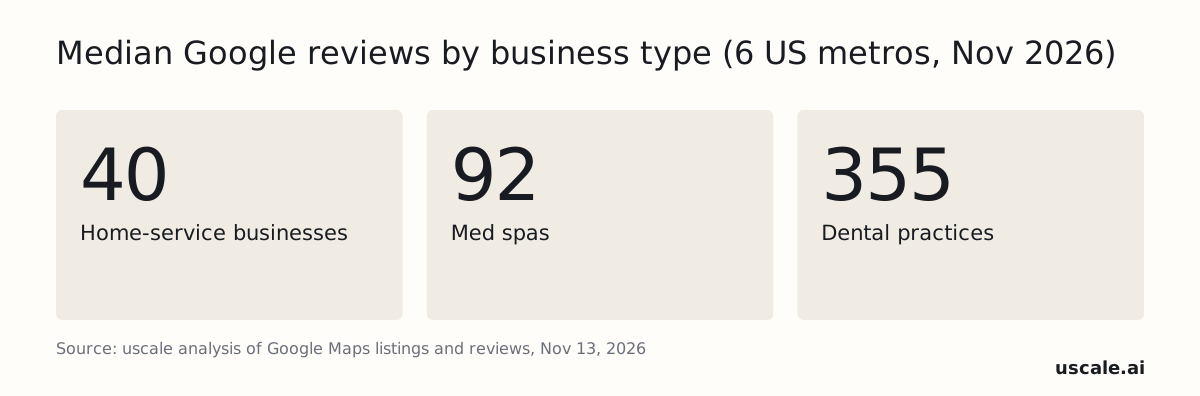
Those three medians land far apart, starting with home services.
How many Google reviews do I need for my trade?
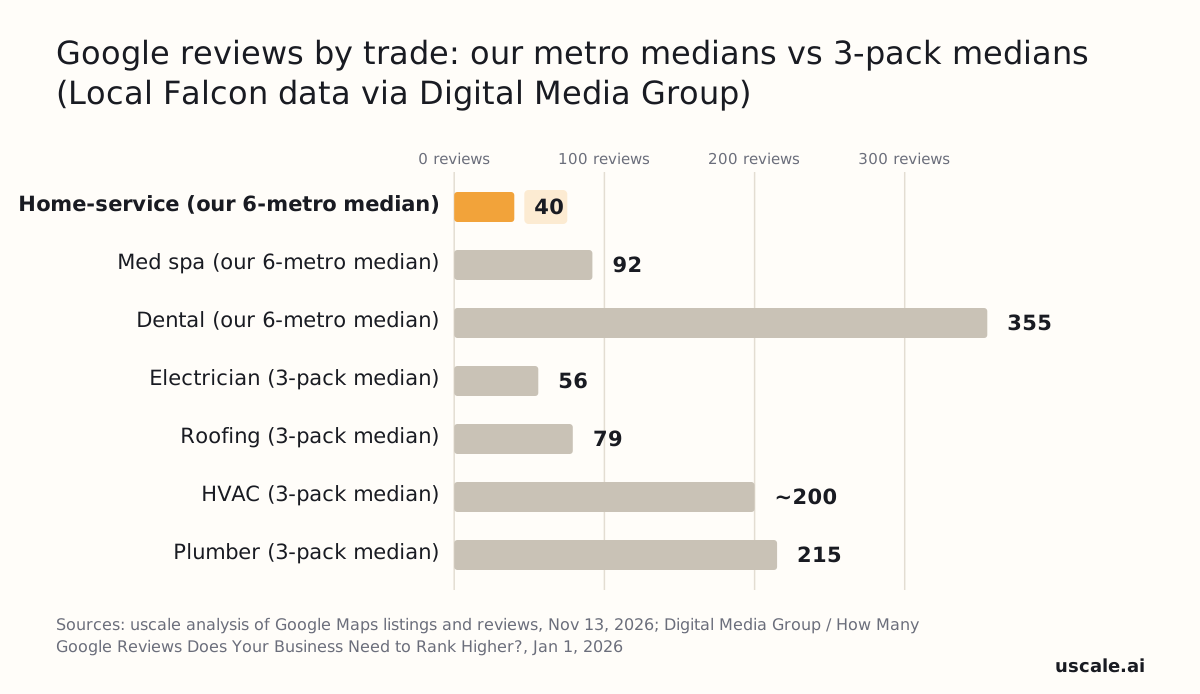
The number of Google reviews you need depends first on your trade. In our read of Google Maps listings across six US metros in November 2026, the median home-service business had 40 reviews, the median med spa had 92 and the median dental practice had 355. A dentist with 100 reviews sits below the middle of the pack. A roofer with 100 sits above it.
The top quarter sets a higher bar
A median shows the middle of all listings, not the businesses customers see first. In the same data, the 75th percentile was 166 reviews for home-service, 232 for med spas and 616 for dental practices. The 90th percentile reached 630, 442 and 981. Home-service has the widest spread. Most of its listings are small, but the top tenth sits far above the rest.
What map-pack winners carry
A second dataset counts only businesses that made the local 3-pack, the three map results Google shows first. Digital Media Group cites a Local Falcon whitepaper covering 50.4 million US listings. It puts the 3-pack median at 215 reviews for plumbers, about 200 for HVAC contractors, 79 for roofing contractors and 56 for electricians. These figures are vendor-cited, and we have not checked them against Local Falcon's own site.
Read the gap, not the exact number
The two datasets measure different things. Ours counts listings in six metros. The 3-pack figures count only the winners, nationwide. So don't adopt 40 or 215 as your goal. Use the signal both agree on: the bar differs by trade, by hundreds of reviews. A plumber competes against several times the review count an electrician does.
Your trade's average is not your target. Your target is the review count your trade's winners already have in your own map.
Below every one of these targets sits a floor that customers set for themselves. That floor is the next question.
Is 20 Google reviews enough?
No, 20 Google reviews is not enough to compete. Twenty reviews is the floor customers won't go below, not a target that wins the map pack. BrightLocal's 2026 Local Consumer Review Survey found 47% of consumers won't use a business with fewer than 20 reviews. Its 2026 research also found 68% won't use a business rated below four stars, up from 55% a year earlier.
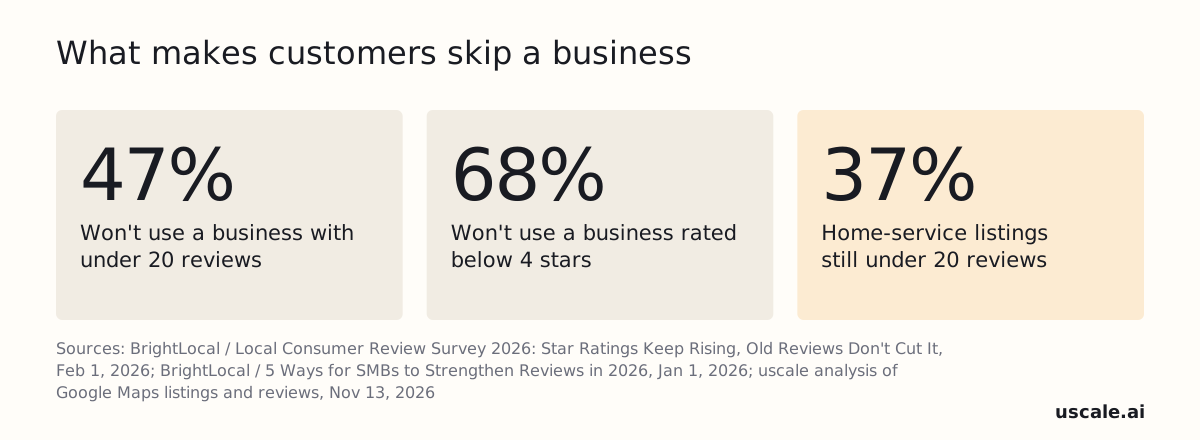
Our own read of Google Maps listings found that 37% of home-service businesses still had fewer than 20 reviews, compared with 17% of med spas and 7% of dental practices. More than a third of home-service businesses are below the trust floor their own customers set.
Treat 20 as a floor because passing it only stops customers from ruling you out. It doesn't make them pick you over the three businesses above you. That is why the next step is finding out what those three already have.
What do your Google reviews tell people searching nearby?
Type your business name and I check your Google profile, reviews, website and whether AI answers name you, then show what to fix first.
Check my businessHow do I figure out my own target review count?
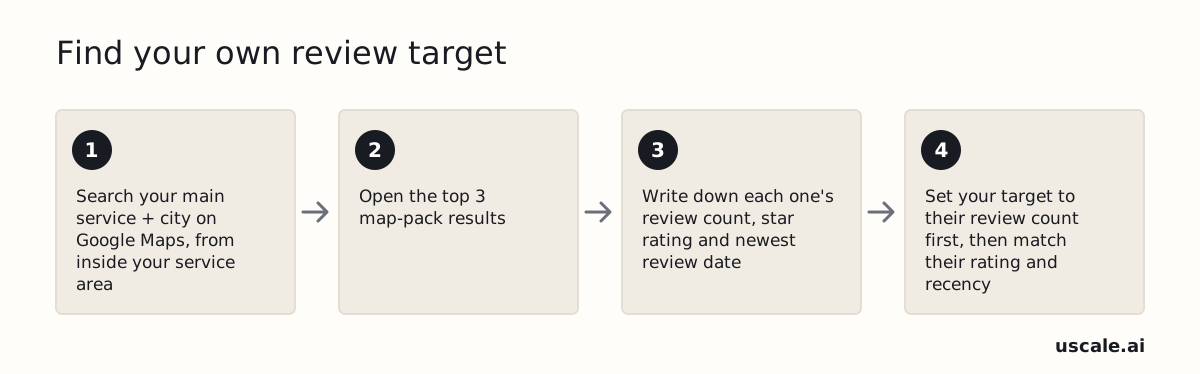
Your own target review count is whatever the top three Google Maps results for your main service already have. Match their review count first, then their star rating and how recent their newest reviews are. This is a rule you apply yourself, not a published formula, and you can run it from your phone.
Search from where your customers are
Run the search from inside your service area, such as a job site or a customer's neighborhood, not from your office. That way the businesses you write down are the ones your customers actually see.
Why count comes first
Review count is the slowest gap to close. A few good reviews can move a rating, but catching a competitor with years of reviews is a long climb. Their count tells you how big the job is.
Most owners measure themselves against the best-known name in town or a national average. The only bar that matters is set by the businesses showing up ahead of you, for your service, where your customers search. For what else decides who shows up, read how to rank higher on Google Maps.
Once you have a count target, the next question is how many good reviews it takes to move your rating.
How many 5-star reviews do I need to go from 4.3 to 4.7 stars?
Going from a 4.3 to a 4.7 Google rating takes about 1.33 new 5-star reviews for every review you already have. A business with 100 reviews needs roughly 134 more, all of them 5 stars. The formula works for any starting and target rating:
New 5-star reviews needed = current reviews × (target rating − current rating) ÷ (5 − target rating)
For 4.3 to 4.7: (4.7 − 4.3) ÷ (5 − 4.7) = 0.4 ÷ 0.3 ≈ 1.33. Multiply that by your review count and round up.
Most owners expect a bigger review count to make the rating easier to move. It does the opposite. Every existing review is weight the new ones have to pull, so a business with 500 reviews needs 25 times as many new reviews as one with 20 for the same jump. Each new 5-star also lifts you only by the gap between 5 and your target, which is why the last few tenths take the longest.
Display rating vs. true rating
Your listing shows the rating to one decimal place, so the honest answer has two versions. The true rating is the exact average. The display rating is what customers see. A shown 4.3 could really be anywhere from about 4.25 to 4.35, and a listing shows 4.7 once the true average reaches about 4.65.
| Current reviews | True rating: 4.30 → 4.70 | Display rating: shows 4.3 → shows 4.7 (worst case) |
|---|---|---|
| 20 | 27 new 5-star reviews | 23 new 5-star reviews |
| 50 | 67 | 58 |
| 100 | 134 | 115 |
| 200 | 267 | 229 |
| 500 | 667 | 572 |
Display column assumes the worst-case start: a true average of 4.25 that shows as 4.3, rising to a true 4.65 that shows as 4.7. Between rows, multiply your count by 1.33 (true) or about 1.14 (display) and round up.
The move is worth planning for. BrightLocal found that nearly a third (31%) of consumers will only use businesses rated 4.5 stars or higher, so climbing from 4.3 past 4.5 puts you inside a cut-off many customers now apply. The same formula, run backward, shows what a single 1-star review costs you.
How many 5-star reviews cancel out one 1-star review?
The number of 5-star reviews it takes to cancel out one 1-star review depends on the rating you are protecting. You need about 7 to hold a 4.5, 13 to hold a 4.7 and 19 to hold a 4.8. The math is the formula from the last section run backward:
5-star reviews needed = (target rating − 1) ÷ (5 − target rating), rounded up to a whole review.
The cost climbs fast because each 5-star review lifts your average by the gap between 5 and where you already sit. At 4.5 that gap is half a star. At 4.9 it is a tenth. The better your rating, the less each good review can lift it, and the more one bad review costs.
Find your number in the table. It assumes your average sits right at the target, so if you are a little above it, you need fewer. There is also a 2-star column, since not every bad review is a 1 (the 2-star formula swaps the 1 for a 2).
| Rating you want to hold | 5-star reviews to offset one 1-star | 5-star reviews to offset one 2-star |
|---|---|---|
| 4.5 | 7 | 5 |
| 4.6 | 9 | 7 |
| 4.7 | 13 | 9 |
| 4.8 | 19 | 14 |
| 4.9 | 39 | 29 |
Two things follow from the table. A 4.9 business cannot outrun bad reviews with a burst of asks after a bad week. At 39 per 1-star, a steady habit of asking every customer does more. The 1-star also still needs a calm public reply, because future customers read that reply long before the math catches up. Our guide on how to respond to negative Google reviews covers what to write.
Rating is only part of what Google looks at, which brings up the next question: whether more reviews move your map ranking at all.
Do more Google reviews help my Google Maps ranking?
Yes, more Google reviews help your Google Maps ranking, but reviews are only part of one of the three things Google weighs. In BrightLocal's survey of local SEO experts, reviews rank as the second most important factor for Local Pack and AI ranking.
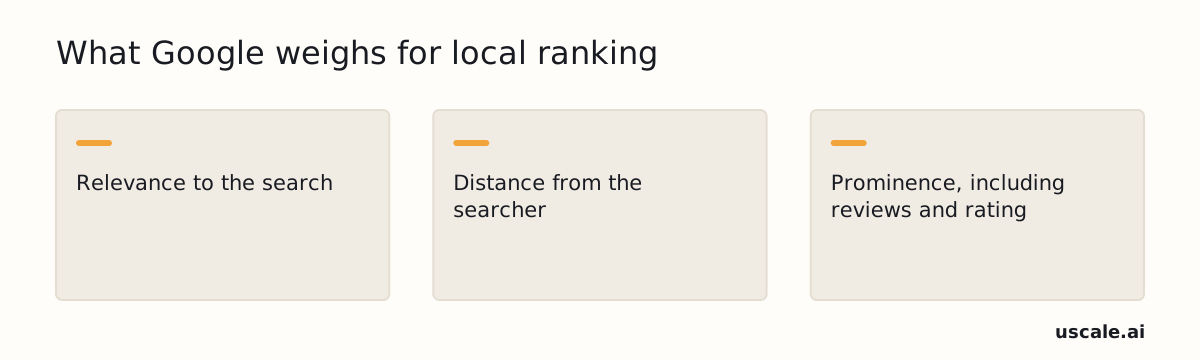
Google sorts local results by three things:
- relevance to the search
- distance from the searcher
- prominence
Reviews and rating sit inside prominence. That split tells you what reviews can and can't do.
Say a competitor offers the same services and sits about as close to the searcher as you. A stronger review count and rating can close that gap. If the competitor is much closer to the person searching, more reviews won't make up the distance.
Reviews win the close races; they don't move your address. The other levers are in our guide to ranking higher on Google Maps.
Which leaves a fair question for owners who are already level with their rivals.
Do I still need more reviews if I already match the competition?
Once you've matched the review count of the top three businesses in your map pack, or you work in a small town where the whole pack has fewer than 20 reviews, more reviews stop being your top priority. In both cases, piling on more of the same is not the best use of your effort. That objection is fair.
Say you run a one-person shop in a small town where every competitor has about a dozen reviews. Pushing toward 300 won't win you more calls than being the business with recent reviews that you've answered. The same goes for a business that already matches its top three on count.
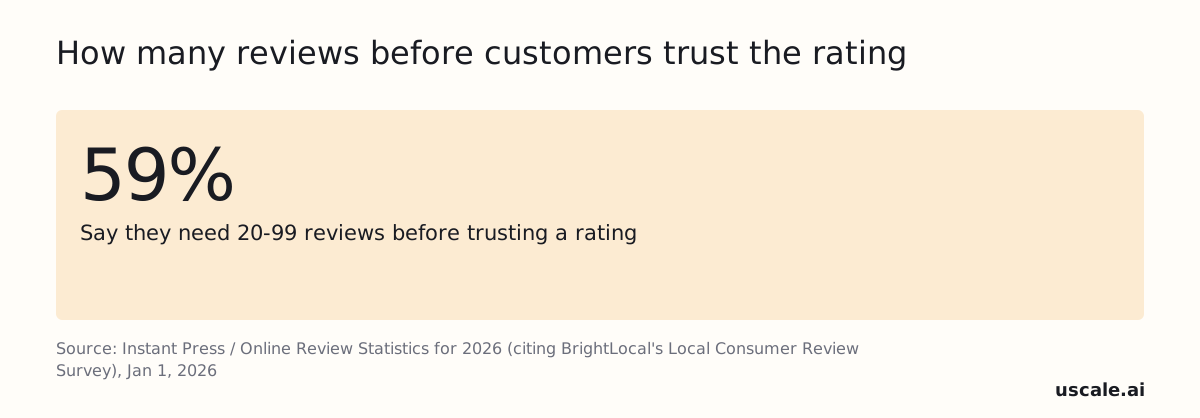
One thing holds in both cases. 59% of consumers say a business needs somewhere between 20 and 99 reviews before they trust its star rating at all, according to BrightLocal's survey as cited by Instant Press. If you're under 20, keep asking even if your rivals are under 20 too. Getting past that floor first is a cheap way to stand out.
Once you're inside or past that range, three things matter more than raw count:
- A better rating. Use the formula above to see how many 5-star reviews lift you to the next tenth of a star.
- Recent reviews. A steady trickle shows you're still busy. An old pile doesn't.
- Replies. Answer every review, good or bad. Our guide to Google review response rate covers how.
The count gets you trusted. Your rating, recent reviews and replies decide who gets the call.
A better rating and fresh reviews both come down to how, and when, you ask.
What's the fastest way to get more Google reviews after a job?
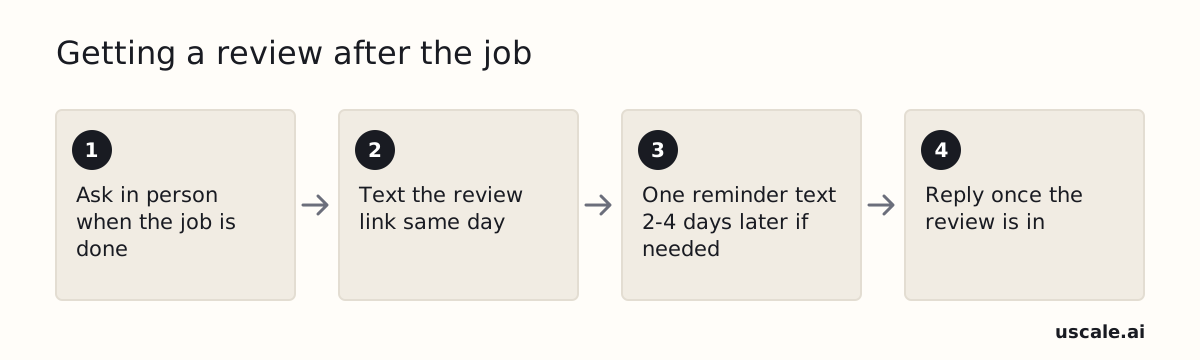
The fastest way to get more Google reviews after a job is to ask in person as soon as the work is done, then text the customer your Google review link the same day. The link is free. In your Google Business Profile, find the option to ask for reviews, then copy the short link or download the QR code.
Ask in person, then text
The person who did the work should ask: the tech in the driveway or the front desk at checkout. A customer who has just seen the job finished is as willing as they will ever be. Keep the ask short, and use the same words with everyone:
"Thanks for having us out today. We're a local business, and Google reviews are how new customers find us. Could I text you a link to leave a quick one?"
Send the text before the day ends:
"Hi [Name], thanks for choosing [Business] today. If you have a moment, a Google review helps people near you find us: [review link]. Thank you, [Your name]"
Text usually works better than email because most customers are already signed in to Google on their phone, so the link opens without a login step. If no review comes in, send one reminder a few days later, then stop. One reminder is polite. A third message reads as pressure.
When the review comes in, reply to it. The reviewer sees the thanks, and so does the next person reading your profile. Our guide to your Google review response rate covers how to keep up with replies.
Can I offer a discount for reviews?
No. As of November 2026, Google's review policies prohibit paying for reviews or offering a discount or gift in exchange for one. They also prohibit review gating, which means asking only the customers you expect to be happy. Either practice can get reviews removed or the profile restricted, and that costs more than the reviews were worth.
The safest rule is also the simplest: ask every customer the same way. A business that asks everyone can't be accused of choosing who gets to review it. Once the ask is routine, the next step is to turn it into a steady weekly habit.
What should I do this week to get more Google reviews?
To get more Google reviews this week, take five steps in order: find your target, get your link, teach the ask, set a weekly rhythm, and reply to everything. Each step fits in a calendar slot.
- Write down your top-3 numbers. Run the Maps check from earlier in this post. You are done when you have three review counts, three ratings and a target of your own.
- Copy your review link into everyone's phone. This is the quick win you can finish within the hour. Get the link from the Google Business Profile app, save it as a text shortcut, and send it to each tech and front-desk person.
- Teach the ask in one meeting. Go over the in-person line and the text script from the section above. You are done when every person has said the line out loud once.
- Set a weekly review check instead of a one-time push. Flento, a review vendor, recommends a steady 4-8 new reviews a month to keep a healthy recency signal (Flento). Treat that as an industry rule of thumb, not a Google rule. You are done when a 15-minute check is on your calendar every week.
- Reply to every review, good or bad. 97% of consumers read reviews before choosing a local business (BrightLocal), so they also read your replies. The free option is to reply from the Business Profile app, using our guides to your review response rate and negative reviews. Another option is uscale, which we make. It answers Google reviews and keeps your Business Profile up to date, and you approve the work in chat.
If you only do one thing this week, ask every customer for a review and text the link the same day.
Success looks like this: every tech has the link on their phone, your count is moving toward your top-3 number, and no review sits without a reply.
All five steps point back to the same number you wrote down in step one.
Your number is already on the map
The number of Google reviews you need is whatever the top three businesses in your own map pack already have, with a rating to match. No trade-wide figure replaces that check, and the gap between you and them closes one real customer at a time.
This week:
- Search your main service plus your city on Google Maps. Write down the top three's review counts, ratings and newest review dates.
- Match their count first, then their rating and recency.
- Ask every customer the same way, in person and by text, as a weekly habit.
- Reply to every review, good or bad, and watch that your rating holds as new ones arrive.
Once reviews are steady, our guide to ranking higher on Google Maps covers the rest of your profile.
A review target you looked up beats one you guessed.
Questions
How many Google reviews do I need?
The number of Google reviews a business needs is roughly as many as the top three businesses in its own Google Maps pack, with a rating to match. Whatever that number is, 20 is the floor: BrightLocal's 2026 survey found 47% of consumers won't use a business with fewer than 20 reviews. In a November 2026 analysis of six US metros, median counts were 40 for home services, 92 for med spas and 355 for dental practices.
How many 5 star Google reviews do I need to raise my rating?
The number of 5-star Google reviews needed to raise a rating is current reviews times (target rating minus current rating), divided by (5 minus target rating). Going from 4.3 to 4.7 takes about 1.33 new 5-star reviews per existing review, so a business with 100 reviews needs roughly 134. The more reviews a business already has, the more new ones it takes to move the average.
How many more Google reviews do I need to reach 4.7 stars?
Reaching 4.7 stars on Google depends on the starting rating and review count. From a true 4.3, a business needs about 1.33 new 5-star reviews for each review it has: 27 at 20 reviews, 134 at 100, 667 at 500. Because Google shows the rating to one decimal, the listing displays 4.7 once the true average reaches about 4.65, which can cut the count to roughly 1.14 per existing review.
How many reviews do I need on Google to show up in the map pack?
The reviews needed to show up in the Google map pack depend on trade and market. Digital Media Group, citing a Local Falcon whitepaper, puts the 3-pack median at 215 reviews for plumbers, about 200 for HVAC contractors, 79 for roofing contractors and 56 for electricians; these are vendor-cited figures. Reviews are only part of prominence, alongside relevance and distance, so the practical target is the review count of the top three results in your own map.
Is 20 Google reviews enough for a new business?
Twenty Google reviews is the minimum for a new business, not the finish line. BrightLocal's 2026 survey found 47% of consumers won't use a business with fewer than 20 reviews, and BrightLocal research cited by Instant Press says 59% want between 20 and 99 reviews before they trust a star rating at all. Past 20, the target is the review count and rating of the top three businesses in the local Google Maps pack.