Lawn care marketing: where your next lawns come from
Most lawn care marketing money gets spent too early. The fastest, cheapest way to add lawn care customers is four free or near-free moves done in order: claim and complete your Google Business Profile, ask every happy customer for a review and a referral, hang door hangers on the houses around lawns you already mow, and post in your local Nextdoor and Facebook groups. Paid lead platforms come after those, not before.
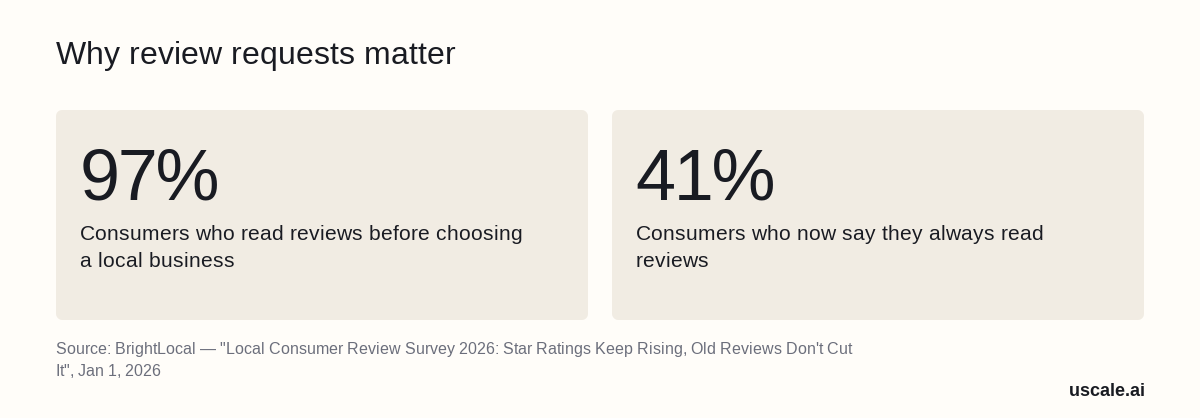
The order matters because of what a homeowner does before calling. BrightLocal's 2026 survey found that 97% of consumers read reviews for local businesses. If you pay for a lead and that homeowner lands on a thin profile with few reviews and no photos, you have paid for the lead and lost the job.
This guide covers free tactics first, then paid channels and software. It includes scripts to copy and a checklist for your first month.
First, the question owners ask most: does paper on a doorstep still bring in calls?
Do door hangers and flyers still work for lawn care?
Door hangers still work for lawn care when they go on the houses right around a lawn you just finished, not across the whole city. The neighbors can see the result from their driveway, so the hanger only has to point at it.
Hi, we just mowed your neighbor's lawn at [address]. Want yours to look the same? Your first mow is $[X] off. Call or text [number], or scan the code to read our Google reviews.
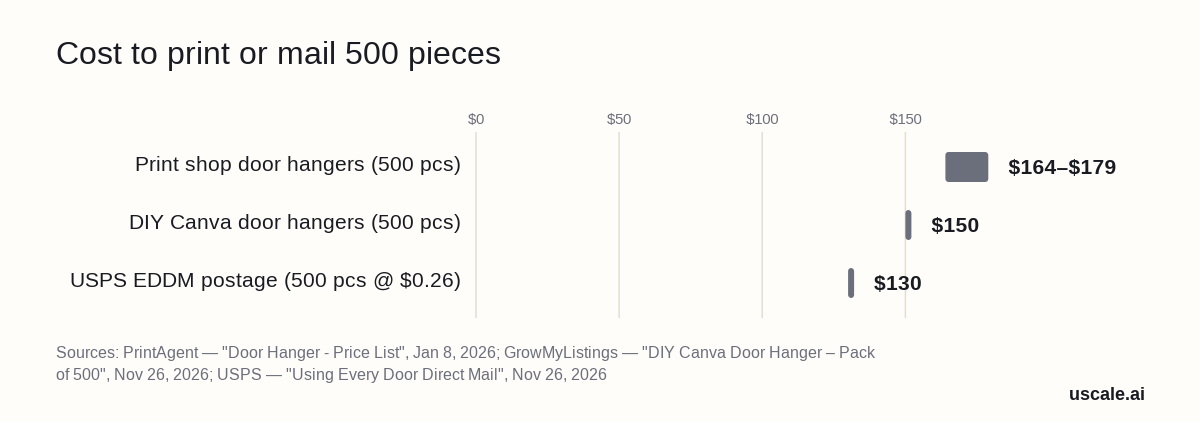
There are two ways to do more of this. The first is to print your own hangers for the streets you already service. One print shop quotes about $164–$179 for 500 standard 4.25x11 hangers with a business-card slit, and a DIY Canva run of 500 costs $150.
The second is USPS Every Door Direct Mail (EDDM), which reaches every address on a carrier route you choose, with no mailing list needed. As of November 2026, EDDM Retail postage for Marketing Mail flats is $0.26 per piece, and an order in USPS's mapping tool must be more than 200 pieces. Printing the pieces is a separate cost.
When you drop hangers by hand, put them on the door handle. Federal law allows only postage-paid U.S. Mail in a mailbox, and a flyer left there without postage breaks that law.
A hanger that sends people to your reviews works only if your Google profile is ready when they look.
How do I set up my Google Business Profile for lawn care marketing as a service-area business?
To set up a lawn care Google Business Profile, claim the free profile, hide your home address, and set a service area made up of the towns or ZIP codes you mow. Google tells service-area businesses that don't meet customers at a verified address to hide that address, and that describes most lawn care crews.
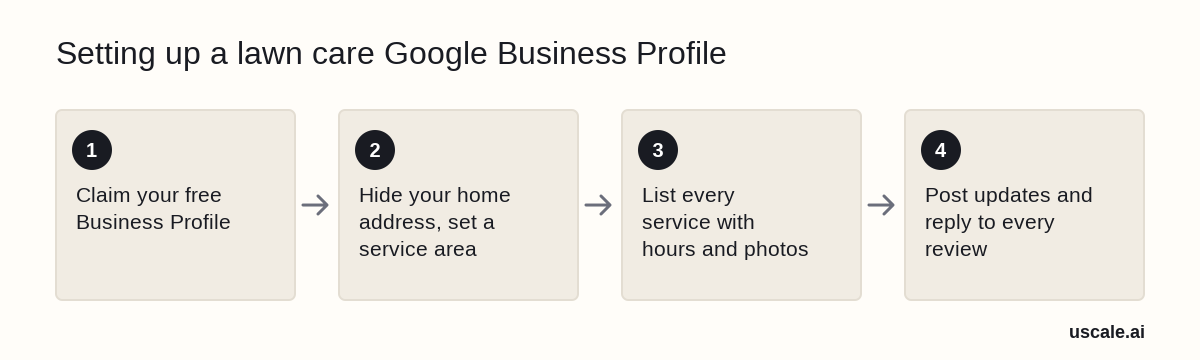
To hide the address (as of November 2026):
- Open your profile and go to Business location.
- Turn off Show business address to customers.
Then fill in what a homeowner checks before calling:
- A category that matches the work.
- Every service on its own line: mowing, cleanups, aeration.
- Your hours and a phone number you actually answer.
- Real before/after photos from your own jobs, not stock shots.
Why add all that detail if the address is hidden? Google says local ranking comes down mainly to relevance, distance and prominence. You can't change distance. Relevance comes from categories and services that match what people type. Prominence builds through photos, posts and reviews. Hiding your address changes what customers see. It doesn't change the work Google rewards, and a thin profile holds you back.
For more, see how to rank higher on Google Maps, or run a free Google profile audit to see what's missing. Reviews feed prominence most directly, and they come next.
How do I get more Google reviews for my lawn care business, and what should I text customers?
To get more Google reviews for a lawn care business, text each customer a direct Google review link right after a job they are visibly happy with: the first mow, a spring cleanup, or a compliment at the curb. Then reply to every review, good or bad.
Timing matters more than wording. Ask while the lawn still looks freshly cut, not in a batch weeks later when the visit is forgotten.
The stakes are high because almost every homeowner checks. BrightLocal's Local Consumer Review Survey 2026 found that 97% of consumers read reviews for local businesses. It also found that 41% now say they "always" read them, up from 29% the year before. A thin review page costs you calls before the phone rings.
Hi [Name], thanks for having us out today. If you're happy with how the lawn looks, a quick Google review helps your neighbors find us: [review link]. Thanks, [Your name], [Business name]
Our free Google review link and QR code tool builds the link for you.
Replying to every review takes only a few minutes a week, and it is worth doing even if you do no other marketing. A calm reply to a bad review shows the next homeowner how you handle problems.
For more depth, see how many Google reviews you need and how to respond to negative Google reviews. Reviews make people want to call. The next step is answering them fast.
How fast do I need to answer a lawn care quote request?
Answer a lawn care quote request within minutes if you can, and the same day at the latest. Homeowners often book whoever replies first, so a slow reply hands the job to a faster competitor. Reply by text with a clear price and a start date. Don't ask them to wait for a callback.
Hi [name], thanks for reaching out. Can you send your address and two or three photos of the front and back yard? Weekly mowing for a yard like that usually runs $[price] per visit, and I'll confirm once I see the photos. I have an opening on [day]. Want me to hold it for you?
A price and a day in the first reply make the decision easy. A reply that only says "I'll call you later" gives the homeowner a reason to keep shopping.
The real problem is that you spend most of the day on the mower and can't hear the phone. The fix is making sure a missed call still gets an answer. An answering service or a phone app with automatic text replies can cover that gap, and so can an AI assistant. uscale, which we make, picks up the calls you miss during the day and texts back callers who hang up, so the lead doesn't go cold while you finish a yard.
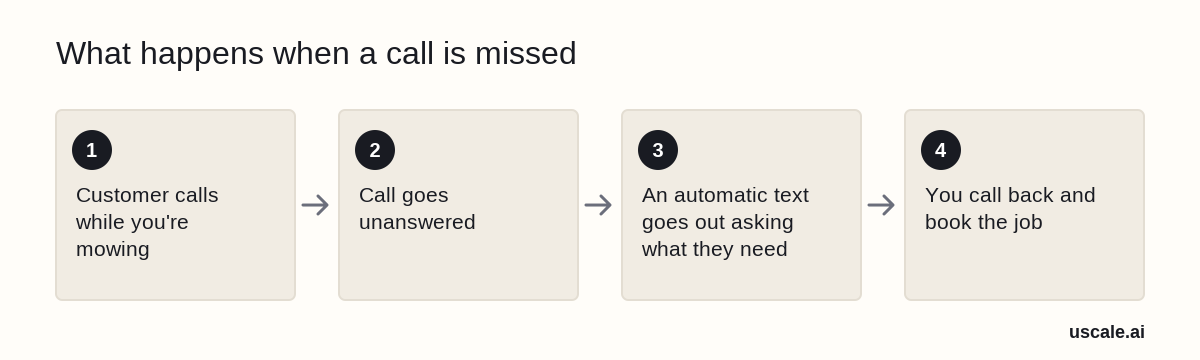
A fast first reply wins the job. The next step is turning that happy customer into a referral for the house next door.
How does your lawn care company look to people searching nearby?
Type your business name and I check your Google profile, reviews, website and whether AI answers name you, then show what to fix first.
Check my businessWhat referral reward should I offer lawn care customers?
The usual lawn care referral reward is a modest account credit or one free mow. Give it only when the referred neighbor signs up for recurring service. Ask for the referral in person or by text right after a job the customer is happy with.
Treat the reward amount as common practice that you check against other crews in your area. It is not a set rule. Tie the reward to recurring service so that it pays for itself.
Thanks again, [Name]. I'm trying to add a few more lawns on [Street] so I can be out here the same day every week. If a neighbor signs up for regular mowing and mentions you, I'll take [a credit / a free mow] off your next bill.
| Part of the ask | What to do |
|---|---|
| When | Right after a job they compliment |
| Reward | A credit or a free mow (check what's normal locally) |
| Condition | The neighbor signs up for recurring service |
Naming the street tells customers why you're asking. It also builds the dense routes covered later in this guide.
A referral reaches one neighbor at a time. Local online groups put your name in front of the whole street at once.
How do I get lawn care customers from Nextdoor and Facebook groups without spamming?
To get lawn care customers from Nextdoor and Facebook groups without spamming, act like a helpful neighbor. Set up a free Nextdoor Business Page, answer "who do you use for lawn care?" threads fast, and post before-and-after photos with a short note about openings in that area. As of November 2026, a Nextdoor Business Page can be claimed or created for free. Ads and opportunity alerts cost extra and are optional.
Copy this post:
Just finished a spring cleanup on [street name]. Before and after photos below. I have a few openings for weekly mowing in [neighborhood] starting [day]. Message me here or text [number] for a quote.
Neighbors trust a name they've already seen help someone else. One useful reply in a thread does more than a week of promo posts.
| Do | Don't |
|---|---|
| Answer recommendation threads the same day | Post the same promo every day |
| Share real photos from local jobs | Paste one generic reply into every thread |
| Follow each group's rules on business posts | Post where advertising is banned |
Once these free channels bring in steady calls, paid lead platforms become worth a look.
Should I pay for Google Local Services Ads, Angi, Thumbtack or lawn apps like GreenPal and LawnStarter?
Pay for Google Local Services Ads, Angi, Thumbtack, GreenPal or LawnStarter only after your free Google profile and reviews are solid. Say a homeowner finds you through a paid listing, then sees a thin profile with few reviews. That homeowner can call the next pro on the list, so every customer you do win costs more. If you're not sure your basics are ready, run a free Google Business Profile audit first.
Each of these platforms charges in its own way, and the terms can change. Before you commit, check how each one bills on its own page. Read what counts as a billable lead or job.
USPS Every Door Direct Mail is the one paid channel here with a published rate. You pay postage per piece: $0.26 per Marketing Mail flat, as of November 2026. An order placed through USPS's own mapping tool needs more than 200 pieces to go through.
| Channel | How it charges | Current price |
|---|---|---|
| Google Local Services Ads | Check Google's own page | Verify current price on Google's page |
| GreenPal | Check GreenPal's own page | Verify current price on their page |
| LawnStarter | Check LawnStarter's own page | Verify current price on their page |
| Angi | Check Angi's own page | Verify current price on their page |
| Thumbtack | Check Thumbtack's own page | Verify current price on their page |
| USPS EDDM | Postage per piece | $0.26 per flat, orders over 200 pieces in USPS's tool (as of November 2026) |
Before you commit a budget, ask every new caller "How did you find us?" and write the answer down. After a month, keep the channel whose leads became paying lawns, not the one that sent the most messages. A cheap lead that never books is the most expensive kind. The lawns you do win are worth the most when they stay for the whole season.
How do I turn one-time mows into recurring customers who stay all season?
The way to turn one-time mows into recurring lawn care customers is to price weekly or biweekly service lower per visit than a single mow, put each customer on autopay with a card on file, and send a renewal reminder before every new season. Those three moves make staying the easy default. Leaving becomes something the customer has to decide to do.
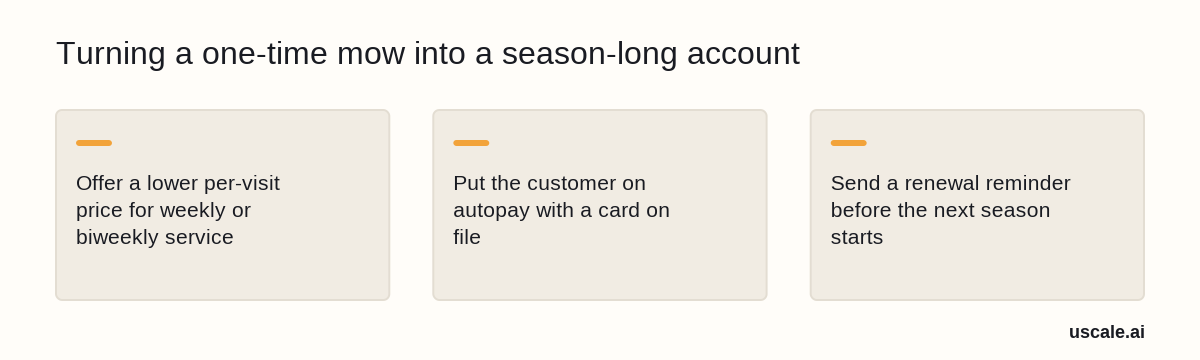
The per-visit discount gives a homeowner a reason to commit instead of calling only when the grass gets out of hand. Autopay removes the monthly moment when a customer weighs whether to keep paying. The renewal reminder matters most. Recurring accounts rarely cancel loudly. They lapse quietly over winter, and a competitor's door hanger fills the gap in spring.
For a small crew, a recurring account is worth more than any single job. A fixed list of weekly lawns lets you plan routes and staff days ahead instead of rebuilding the schedule every week. A one-off mow pays once; a season-long account pays every visit until the grass stops growing.
Once most of your base is recurring, the next question is which tools keep those schedules, routes and invoices straight.
What software does a small lawn care business actually need?
A solo lawn care operator needs little more than one mobile app that handles quotes, the day's route and invoices. A business running one to three crews needs a system with a client portal and online payments. A route-heavy or treatment-focused operation needs software built for recurring chemical applications and the records that come with them.
| Business size | Common tool category | What it should handle | What you can skip for now |
|---|---|---|---|
| Solo operator | Mobile quoting and invoicing app | Quotes by text, a daily stop list, invoices sent from the truck | Crew scheduling, dispatch boards |
| 1–3 crews | Field service management software | Crew schedules, a client portal, online and recurring payments | Chemical tracking, if you only mow |
| Route-heavy or treatment-focused | Lawn care and treatment software | Recurring application schedules, product and application records, dense route planning | Little, at this size |
Buy software for the bottleneck you have today, not the company you hope to run in three years. A solo owner paying for dispatch tools spends money on screens nobody opens. A three-crew business still invoicing from a notebook loses evenings to paperwork and lets payments slip.
This guide quotes no prices for any of these tools because vendors change their plans and tiers often. Check current pricing on each vendor's own page before you choose, and use a free trial on a real week of jobs, not a demo account.
Once quotes, routes and payments run without you chasing them, you have time for the next source of growth: the customers already on your schedule.
What else grows revenue from customers I already have?
A lawn care business can grow revenue from its current customers in three ways: seasonal upsells, referral partners, and route density. None of the three requires paying for a new lead.
| Lever | What to do | When |
|---|---|---|
| Seasonal upsells | Offer aeration, fertilization, cleanups, mulching, and snow removal in cold markets | A few weeks before each season |
| Local partners | Trade referrals with realtors, property managers, HOAs, house cleaners and pest control companies | Any time, because they already serve your homeowners |
| Route density | Win more lawns on the streets you already mow, with a neighbor price | Every time you quote |
Route density is the lever most owners get backwards. A one-off job across town looks like extra money, but the drive eats the margin. A full street is worth more than the same number of lawns scattered across town.
Before you sell fertilizer or weed treatments, check whether your state requires a license to apply them. Some tactics in this guide won't fit every shop, and the next section covers those cases.
When does this advice not fit?
The lawn care playbook in this guide needs adjusting in three cases: a solo operator with a full route, a business in a small town, and anyone planning a texting push. In all three, a complete Google profile and steady reviews still come first.
A one-person shop with a full route. If you mow from seven to dusk, you won't also keep up with Nextdoor threads and partner outreach. Pick one or two tactics, usually review requests and door hangers around current jobs. Do them every week instead of starting everything at once.
A small town. Where the local Nextdoor and Facebook groups are quiet, posting there brings little back. Door hangers and referrals from customers who know their neighbors are the better bet.
Texting and flyers. Send review requests, missed-call text-backs and promo texts only to customers who gave you their number for that kind of message. Keep hand-delivered door hangers on the door. Placing flyers or other items without postage in a mailbox violates federal law, according to the USPS.
None of these cases changes the order of the work. They change how much of it you take on at once. So what does that order look like on an actual calendar?
What should I do this week to get more lawn care customers?
The fastest way to get more lawn care customers is to start the free tactics one week at a time over 30 days, in order, instead of all at once. Each week feeds the next: reviews make your profile convincing before neighbors look you up.
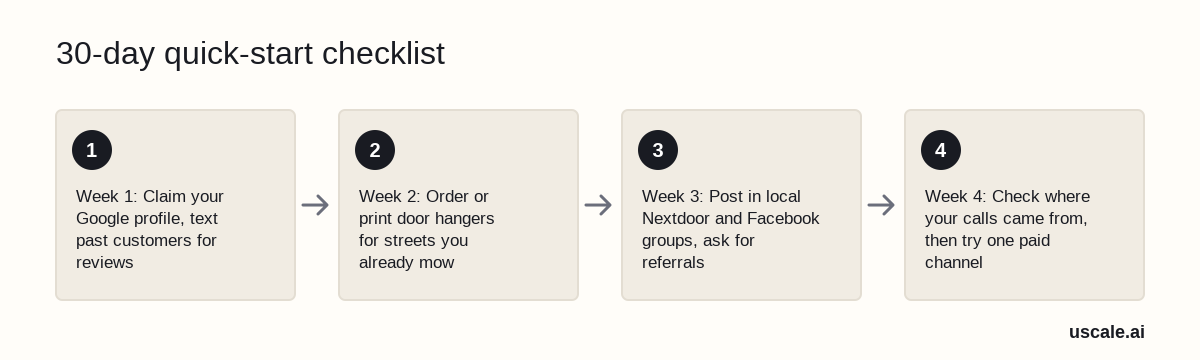
Week 1: Finish your Google profile and ask for reviews. The profile is free, so fill in services, service area, hours and photos, then text past customers a direct review link. Done when no field is blank and the texts are sent.
Week 2: Hang door hangers on streets you already mow. Print your own or order a run. Done when every street on this week's route is covered.
Week 3: Post in one Nextdoor or Facebook group and ask two customers for referrals. Done when the before/after post is up and both asks are made.
Week 4: Check where your calls came from. Ask each new caller how they found you, then test one paid channel. Done when you can name your best source.
If you only do one thing, text your happiest customers a review link tonight. The free Google review link and QR code tool makes the link. Success looks like a fuller profile, new lawns on streets you already drive, and knowing where each call came from.
Four weeks is enough to see which of these pulls its weight on your route.
Start with the lawns you already mow
Most of a small lawn care business's new customers come from four free moves: a complete Google profile, a steady stream of reviews, door hangers on the streets around jobs you already have, and helpful posts in local groups. The Google profile itself costs nothing to create. Paid lead platforms are a top-up once those basics are bringing in calls. They are not the place to start.
Your next customer is probably standing in the yard next door to one you mowed today. For the day-to-day side of running the business, read our guide to running and growing a lawn care business.
Go back to the checklist, pick the one tactic you haven't tried yet, and do it this week. A full route gets built one street at a time.
Questions
What is lawn care marketing?
Lawn care marketing is everything a mowing or landscaping business does to get homeowners to call and book: a complete Google Business Profile, a steady stream of Google reviews, door hangers on streets it already services, referrals, and helpful posts in local Nextdoor and Facebook groups. Paid lead platforms and ads come later, once those free basics bring in steady calls, because most homeowners read reviews before they call anyone.
How do I market my lawn care business with no budget?
A lawn care business with no budget can start with free tactics in order. Claim and complete a Google Business Profile, which is free to create. Text every happy customer a direct Google review link right after the job. Ask satisfied customers to refer neighbors for recurring service. Answer recommendation threads on a free Nextdoor Business Page and in local Facebook groups. Door hangers cost little: one DIY run of 500 is priced at $150.
Do door hangers and flyers still work for lawn care marketing?
Door hangers still work for lawn care when they go on the houses around a lawn the crew just finished, because neighbors can see the result from their driveway. One print shop quotes about $164 to $179 for 500 standard hangers. USPS Every Door Direct Mail reaches every address on a chosen route at $0.26 postage per piece, with orders over 200 pieces. Hand-delivered flyers belong on the door handle, since unstamped items in a mailbox violate federal law.
Should I pay for Google Local Services Ads, Angi or Thumbtack for lawn care leads?
Google Local Services Ads, Angi and Thumbtack are worth paying for only after a lawn care business has a complete Google profile and solid reviews. A homeowner who finds a paid listing and then sees a thin profile can call the next pro, so every won customer costs more. Each platform bills differently and terms change, so check what counts as a billable lead on its own page, then track where each paying customer came from.
How do I get lawn care customers from Nextdoor and Facebook groups?
Lawn care customers come from Nextdoor and Facebook groups when the owner acts like a helpful neighbor rather than an advertiser. A Nextdoor Business Page can be claimed or created for free, with ads optional at extra cost. Answer recommendation threads the same day, share real before-and-after photos from local jobs, mention openings in that neighborhood, and follow each group's rules on business posts. One useful reply does more than daily promo posts.