How to grow an HVAC business after the first five months
The fastest way to grow an HVAC business at five months in is to do three things in order. First, lock down the Google Business Profile. Second, turn word of mouth into a deliberate referral and repeat-customer habit. Third, test exactly one paid-lead channel before you spend money on a second.
A residential HVAC owner five months in told a public Facebook group of HVAC business owners that word of mouth and social media were working, and asked how to grow. The thread drew 27 comments and replies. One reply came from a seven-month-old company that said Thumbtack and home warranty work helped it reach about $100k a month. Another came from a 40-year-old business that said word of mouth still brings most of its customers.
Those two answers seem to pull in opposite directions. Below is what the owners said worked, the real lead costs, and the texting and email consent rules to check first.
So which of those two shops should a five-month-old business copy? Start with who else answered and what they said.
What HVAC owners who've been there actually said
HVAC owners who answered a new owner's growth question didn't name one trick. Their advice landed on three things: set up the Google Business Profile, turn word of mouth into a habit, and use a paid lead source that someone had actually made pay.
The people answering ranged from a few months old to four decades old. A company only seven months old said Thumbtack and home warranty work had carried it to about $100k a month, with two partners and two technicians. An owner nine years in described a base of 800 yearly repeat customers, built by treating customers like family. A business 40 years old said word of mouth still brings in most of its customers.
| Who answered | Time in business | What they said brought the work |
|---|---|---|
| Two-partner, two-technician shop | Seven months | Thumbtack and home warranty work, about $100k a month |
| Owner-operator | Nine years | 800 yearly repeat customers, treated like family |
| Established company | 40 years | Word of mouth, still most of its customers |
How we read it: we read one public Facebook group thread for HVAC business owners in November 2026. We left out comments from vendors pitching their own services. Every number above is what an owner said about their own shop, not something we checked.
The newest shop leaned on paid leads and the oldest on referrals. Paid leads bought the young shop speed, and word of mouth bought the old one staying power. A new owner needs both, and the cheapest place to start is the Google profile.
Is a Google Business Profile enough for a new HVAC business?
A Google Business Profile is not enough on its own for a new HVAC business. It is the base, not the whole plan. In a public Facebook thread where a residential HVAC owner five months in asked how to grow, the owners who answered paired "set up your Google Business Profile" with networking through the chamber of commerce and local groups, and with signing up as a vendor with property management companies. Nobody treated the profile as the finish line.
What a complete profile looks like
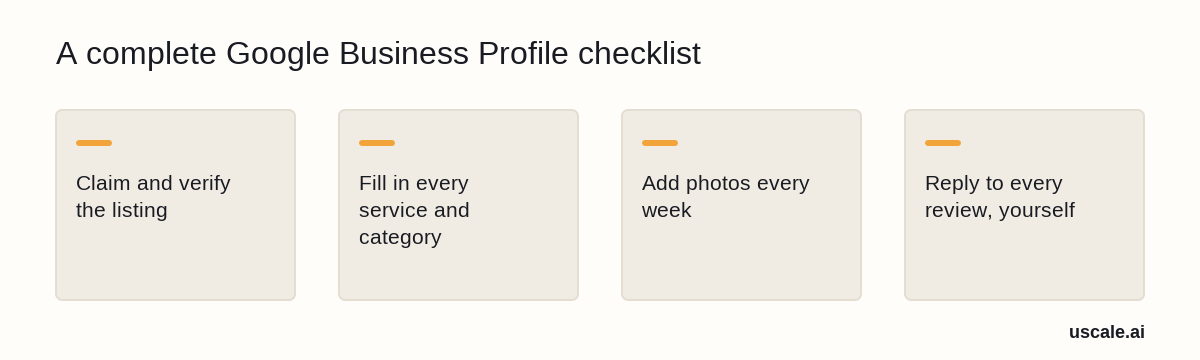
A profile is complete when a homeowner with a dead AC late at night can tell from the listing alone whether you cover their area and when you answer. That takes four things:
- Claimed and verified, so you control every edit.
- Every service and category filled in, such as furnace repair, AC tune-ups and heat pump installs, so the listing matches what people search.
- Hours that are true this week, not the ones you set at launch.
- Photos of real jobs, trucks and crew, added often.
The first setup takes an afternoon. Keeping the profile current is the part most owners drop. You can run your listing through a free Google Business Profile audit to see what is missing.
The wrong way to fix a thin profile
A new listing with few reviews tempts owners toward shortcuts. The FTC's final rule on consumer reviews, published in August 2024, prohibits businesses from creating, selling or buying fake reviews, and from buying reviews conditioned on whether they are positive or negative. The FTC's proposed version of the rule also barred officers and managers from reviewing their own company without clearly disclosing the relationship. So skip reviews from family accounts and skip discounts in exchange for good reviews.
Honest reviews from real customers grow slower and last longer than any shortcut.
Asking real customers for reviews also starts the referral habit, and that habit is where the thread's longest-running businesses said most of their work still comes from.
How does your HVAC company look to people searching nearby?
Type your business name and I check your Google profile, reviews, website and whether AI answers name you, then show what to fix first.
Check my businessHow do you build word-of-mouth referrals as a new HVAC business?
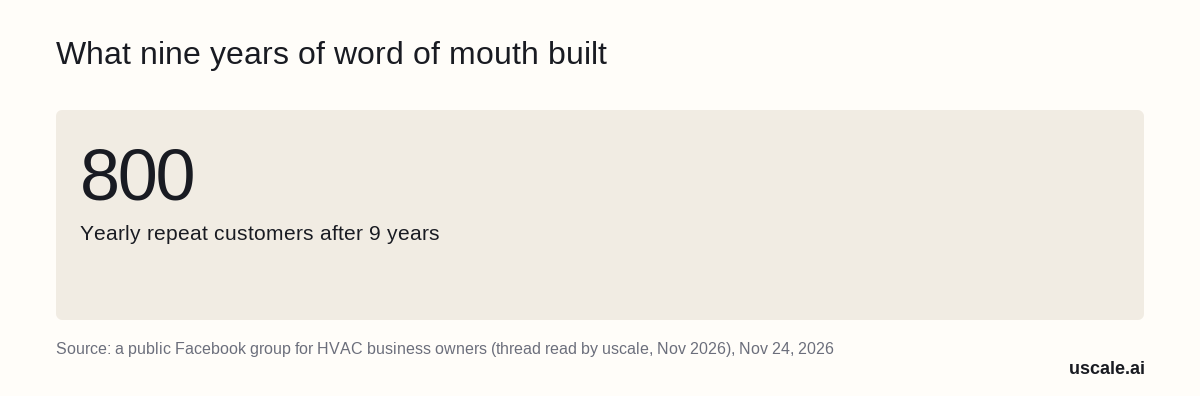
Word-of-mouth referrals for a new HVAC business come from a habit, not a campaign: treat every repeat customer like family and make the referral ask a routine part of closing out each job. In a public thread of HVAC owners, one said he built a base of 800 yearly repeat customers over nine years that way. A 40-year-old business in the same thread said word of mouth still brings most of its customers.
Why the habit has to start with your first customers
Neither owner described a quick result. Both described something that took years to build, and the reasoning is simple. A referral only happens after a customer has had a good job and a reason to mention you. A repeat customer only happens after a first visit and a reason to call you back. Both take time, and the clock starts at the first job you handle this way, not the day you decide to "do referrals."
A business that waits until it feels established has already spent its early customers without letting them compound. A new shop has one advantage here: with fewer customers, each one can get real attention.
What "like family" looks like on a job
- Keep notes on each household's equipment and past work, so the next call starts with context.
- Check in after the job to make sure everything is running right, with no sales pitch attached.
- Reach out to repeat customers before the season changes, not after the system breaks.
A referral ask you can say at every close-out
"Thanks for having us out today. Most of our work comes from neighbors and friends of our customers. If anyone you know needs heating or cooling help, we'd be glad to take care of them the same way."
Referrals build slowly, so the next question is how to bring in work while they do. That is where paid leads come in.
Should a new HVAC business pay for leads, and what do they cost?
Yes, a new HVAC business should pay for leads, but on one channel at a time and only once it can compare what a lead costs with what a job pays. In the owners' thread, a seven-month-old company said Thumbtack and home warranty work helped it reach about $100k a month with two partners and two technicians.
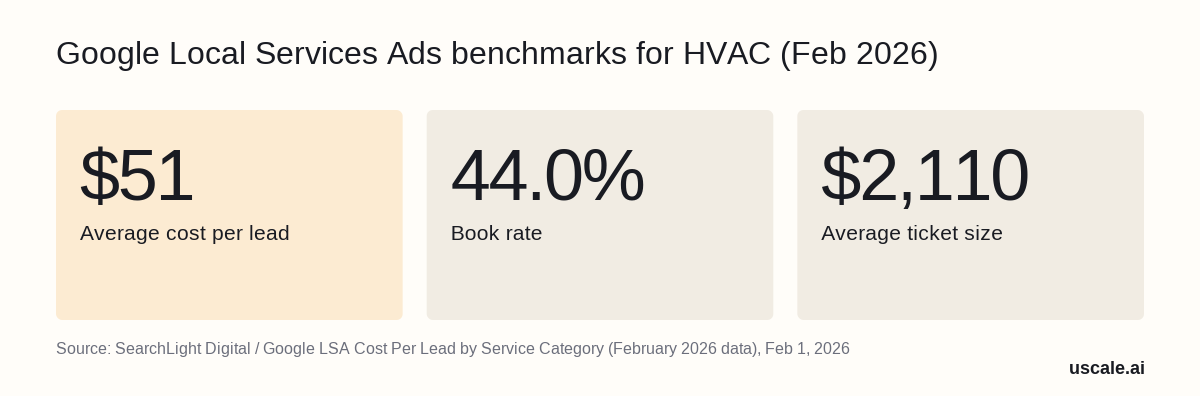
For a benchmark, SearchLight Digital's February 2026 data put the average HVAC cost per lead on Google Local Services Ads at about $51. The same data showed a 44.0% book rate and a roughly $2,110 average ticket.
Two low-commitment ways to test demand
Thumbtack. Thumbtack's pro page, as checked in October 2026, says there is no charge to join and no annual or membership fees. Pros pay per lead and set their own pricing and lead budget. You can turn the budget down or off after a month without being locked in.
Nextdoor. A Nextdoor Business Page is free and includes two free posts a month to the local neighborhood feed. Paid Business Page ads bill at about $5 a day, roughly $150 for a 30-day subscription. That pricing is from Nextdoor's own pages as summarized by KeyGrow in October 2026.
The decision rule
Most owners compare channels by cost per lead, and that gets the comparison backwards. A lead is not a job, so judge a channel by what a booked job costs you, not what a lead costs.
Before you commit a monthly budget, run one channel for 30 days and track your own numbers:
Channel: ___ | Spent: $___ | Leads: ___ | Booked: ___ | Average ticket: $___
Divide your cost per lead by your book rate to get the cost of a booked job. Then compare that cost with your average ticket.
- If the booked-job cost is a small slice of the ticket, add budget.
- If it isn't, check whether slow answers are losing leads before you blame the channel. For example, texting back missed calls can save leads you already paid for. If that isn't the problem, switch channels.
Paid leads are the one channel where you pay for every lead, which is why the next tactics owners recommended cost little beyond time.
What other local marketing worked for new HVAC businesses?
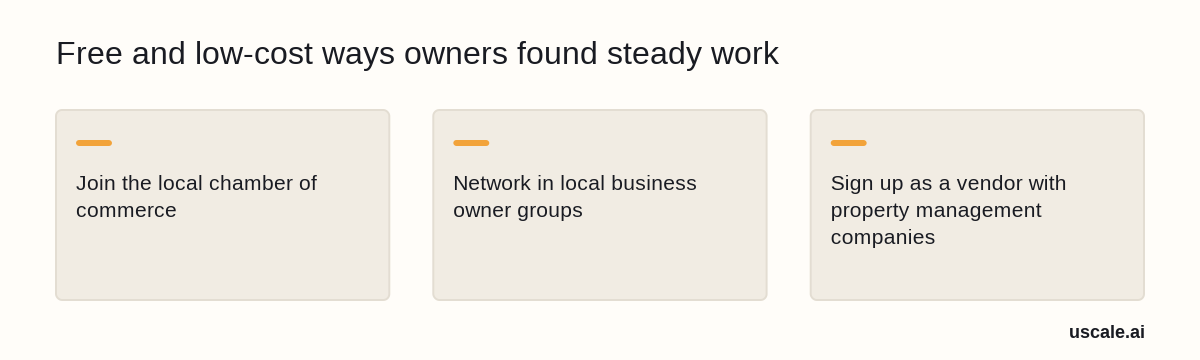
Beyond the Google Business Profile and referrals, the HVAC owners in the thread pointed a new business to two more places: networking through the chamber of commerce and local business groups, and signing up as a vendor with property management companies. Neither one charges by the lead. Both cost the owner time and follow-through, and in return they can bring the same work back again and again.
Why property management vendor lists suit a new shop
A property manager looks after many units and needs someone to call when a system fails or a unit turns over. Once your company is on that manager's vendor list, the next job comes through the relationship, not through a lead you paid for. That matters for a new business with open slots on the calendar. One manager can mean repeat service across several buildings, and that work tends to come in during the week, when a small crew can plan around it.
The catch is that a manager judges you on response time and paperwork more than on price. Have your license and insurance papers ready before you ask, and answer the first few calls fast. Those first calls decide whether you stay on the list.
Why the chamber and owner groups pay off slowly
Chamber events and local owner groups put you in front of the people who get asked "know a good HVAC company?": realtors, property managers, builders and other trades. The return is slow and hard to track. That makes networking a partner to referrals and a tested paid channel, not a replacement for either.
All of this assumes a market with enough buildings and businesses to network with, and not every HVAC owner works in one.
When this advice doesn't fit: small towns, one-person shops, and texting rules
The thread's growth advice assumes a small crew and a market dense enough for referrals and vendor contracts to compound. A solo HVAC owner in a small town should lean harder on word of mouth and the Google Business Profile and put less into paid leads. There are fewer households to spread each lead's cost across, and fewer property managers to sign with.
That changes how much weight each step gets, but the order stays the same. A one-person shop still needs a complete profile and a referral habit first. It may never need the paid-lead step at all. A 40-year-old business in the thread said word of mouth still brings most of its customers.
Check the rules before you text or email customers
Once the repeat list grows, seasonal tune-up reminders are the obvious next move. Email and texts follow different rules, as of November 2026:
| Channel | Rule | What you need first |
|---|---|---|
| Marketing email | CAN-SPAM (FTC) | No opt-in required. Include a valid postal address, a working opt-out and honest subject lines. |
| Marketing texts and calls | FCC TCPA | The customer's prior written consent for your business specifically. Since January 27, 2025, one consent can't cover several sellers. |
| Texts to numbers on the Do-Not-Call Registry | FCC 2023 order | The customer's prior express invitation or permission. |
A consent collected for a bundle of sellers no longer covers your marketing texts. For how these rules apply when you text back a caller, see our missed-call text-back guide. The rules don't block a small shop from growing. They decide which customers can get a reminder by text and which get it by email.
So back to the five-month-old owner from the top. Here is the order to work in, starting this week.
What to do this week to grow your HVAC business
To grow a new HVAC business this week, finish your Google Business Profile, build a review-and-referral ask into every job close-out, and pick exactly one paid-lead channel to test for 30 days before adding a second. Chamber and property-management sign-ups come after the first two run on their own.
Finish your Google Business Profile today. This is the quick win, and you can do it from your phone within the hour. Fill in hours, every service you offer, your categories and real photos of your trucks and work, then start verification if Google asks. You're done when no field is blank.
Make the ask part of closing every job. The owners in the thread who lived on word of mouth got there by treating customers well every time, not through one campaign. Write the ask down so you and your techs say the same thing:
"Thanks for having us out. If we did right by you, a Google review helps a small shop like ours a lot. And if a neighbor needs heating or cooling work, we'd be glad to help them too."
You're done when it's said at every close-out, without you there to remind anyone.
Test one paid channel for 30 days. Choose Thumbtack, Google Local Services Ads or Nextdoor, not all three. A free spreadsheet is enough: money spent, leads, jobs booked, what those jobs paid. You're done when you can say whether a lead from that channel costs less than your ticket size justifies.
Add chamber and vendor sign-ups next. Join your local chamber and apply to the vendor lists of property management companies nearby. You're done when the applications are sent.
If you do only one thing, finish the profile.
Keeping up while you're on jobs is the hard part. A weekly calendar reminder covers the profile for free. Another option is uscale, which we make: it drafts review replies and profile fixes and picks up missed calls during the day, and nothing goes out without your OK.
Success looks like a complete profile with replied-to reviews, a close-out ask your techs repeat by habit, and one channel whose numbers you know. For the next layer, see these HVAC marketing ideas and this guide on how to rank higher on Google Maps.
Questions
What's the best way to grow a new HVAC business?
Growing a new HVAC business means adding steady work beyond the first word-of-mouth customers, and the most reliable order is three steps. First, complete the Google Business Profile. Second, make a review and referral ask part of every job close-out so repeat customers build up. Third, test one paid-lead channel for 30 days and judge it by the cost of a booked job against your average ticket before adding a second channel.
Is a Google Business Profile enough for a new HVAC business?
A Google Business Profile is not enough on its own for a new HVAC business, but it is the base. HVAC owners in a public Facebook group thread paired it with word of mouth, networking through the chamber of commerce and local groups, and signing up as a vendor with property management companies. A complete profile is claimed and verified, lists every service and category, shows current hours and includes photos of real jobs.
How do new HVAC companies get customers without buying shared leads?
New HVAC companies can get customers without shared leads through referrals, a complete Google Business Profile and local relationships. HVAC owners in a public Facebook thread recommended networking through the chamber of commerce and local groups and signing up as a vendor with property management companies. One owner said he built 800 yearly repeat customers over nine years by treating customers like family, and a 40-year-old business said word of mouth still brings most of its customers.
How do you grow an HVAC business during slow season?
Growing an HVAC business during slow season works best with the tasks that cost time rather than money. Use quiet weeks to finish the Google Business Profile, apply to property management vendor lists and attend chamber of commerce events. Contact repeat customers about tune-ups before the season turns. Under CAN-SPAM, marketing email needs no opt-in, but marketing texts under the FCC's TCPA rules need each customer's prior written consent for your business.
How much do HVAC leads cost on Thumbtack, Google, and Nextdoor?
HVAC lead costs vary by platform. SearchLight Digital's benchmark data put the average HVAC cost per lead on Google Local Services Ads at about $51 in February 2026, with a 44.0% book rate. Thumbtack charges no joining, annual or membership fees; pros pay per lead and set their own budget. A Nextdoor Business Page is free, and paid Business Page ads bill at about $5 a day, roughly $150 for 30 days.