The patients you're already losing
The best dental marketing ideas for 2026 start with fixing what's already costing you patients, not buying more ads. Apsteq's 2026 dental marketing trends guide says about 60% of new patients still come from referral plus organic channels combined, not paid advertising. In MouthWatch's 2026 survey of 448 dental professionals, only 25.0% described their own marketing as "strong": ranking well on Google, solid reviews and consistent posting.
Most practices depend on channels that cost little, and most of them run those channels below what they could deliver. The gaps tend to sit in ordinary places. A call rings out over lunch. The Google profile still shows last year's holiday hours. A review has gone unanswered.
This guide covers those places in order: where new patients really come from, missed calls, your Google Business Profile and reviews, your website, after-hours calls and software, and budget. Start with the first one, because where your patients come from decides where every other hour and dollar should go.
Where Do New Dental Patients Actually Come From in 2026?
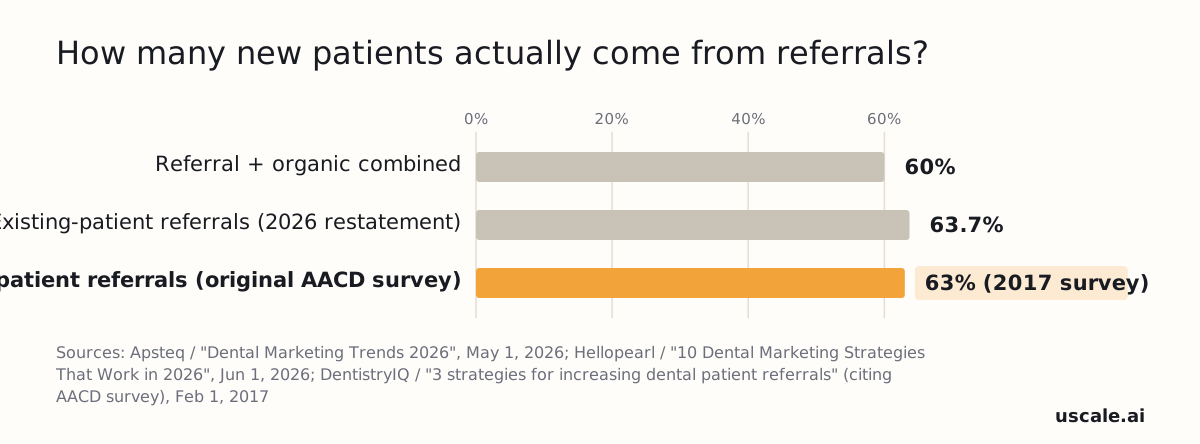
Most new dental patients in 2026 still come from referrals and free search, not paid ads. Apsteq's 2026 trends guide puts referral plus organic channels at 60% of new patients. A second figure you'll see everywhere is 63.7% of new patients from existing-patient referrals (Hellopearl, 2026). That figure is older than it looks.
The 63.7% traces back to a 63% figure that DentistryIQ reported in 2017 from an American Academy of Cosmetic Dentistry survey. Treat it as a rounded restatement of an older survey, not a fresh 2026 study. The direction holds, but the decimal point adds no real precision.
Turn word of mouth into a program
Word of mouth happens on its own. A referral program makes it happen on purpose. Hellopearl says a well-run referral program can bring in three to four times more new patients than casual word of mouth. DigitalSMB says a systematic program can generate 20% to 40% of a practice's new patients from its existing base.
Expect two different timelines
Hellopearl also gives the timing. Digital marketing and online-booking updates can produce new appointments in as little as 2 to 4 weeks. Referral programs typically take 1 to 3 months to build momentum. Start both this week. The Google and booking fixes pay off first. The referral program pays off later, and it is the one most practices drop too soon. Both depend on someone answering when the new patient calls, which is where the next section starts.
How Many New-Patient Calls Is My Dental Office Missing?
No one can tell a dental office how many new-patient calls it misses until the office counts them. The American Dental Association's practice-management guidance says every practice loses some prospective patients through poor handling of incoming calls. The ADA recommends tracking new-patient calls each week for a month to work out your own lost-call rate.
A weekly call log the front desk can keep
For each new-patient call, mark one of three outcomes on a sheet by the phone:
- Reached a person
- Went to voicemail or rang out
- Turned into a booked visit
Total each column at the end of every week. After four weeks, divide the voicemail calls by all new-patient calls to get the share you are missing. Then divide booked visits by calls that reached a person to see how well the desk converts.
Why the count matters
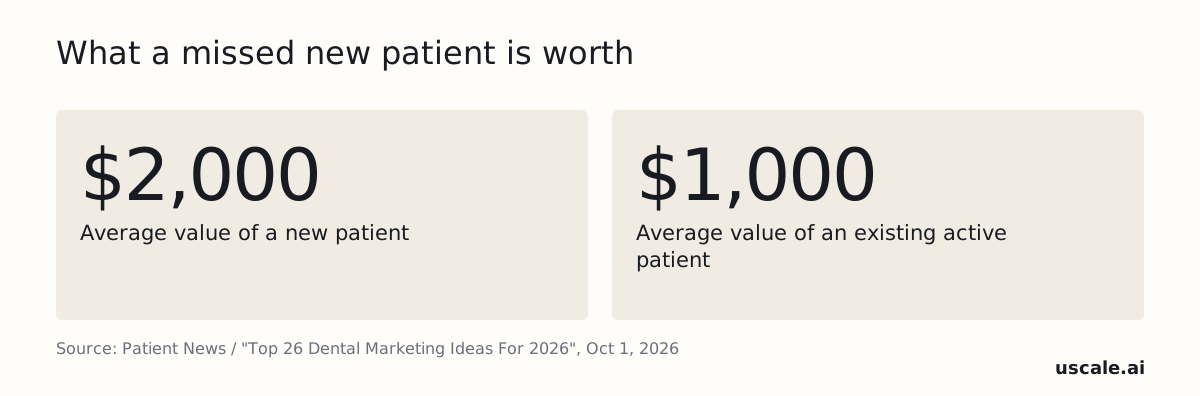
Patient News puts the average new dental patient at about $2,000 in 2026, against about $1,000 for an existing active patient. That gap comes before counting the referrals a happy new patient brings. Each voicemail on the log is a caller worth roughly twice an existing patient, deciding whether to call back or try someone else. Many of those callers look you up on Google first, which is where the next fix starts.
What Should a Dentist Put on Their Google Business Profile?
A dentist's Google Business Profile should have every field filled in and kept current: exact name, address and phone, regular and holiday hours, every service you offer, and a working "Book Online" button. Google's 2026 Business Profile playbook recommends keeping your category, description and hours, holiday hours included, accurate and up to date. A profile with wrong holiday hours sends a patient to a locked door.
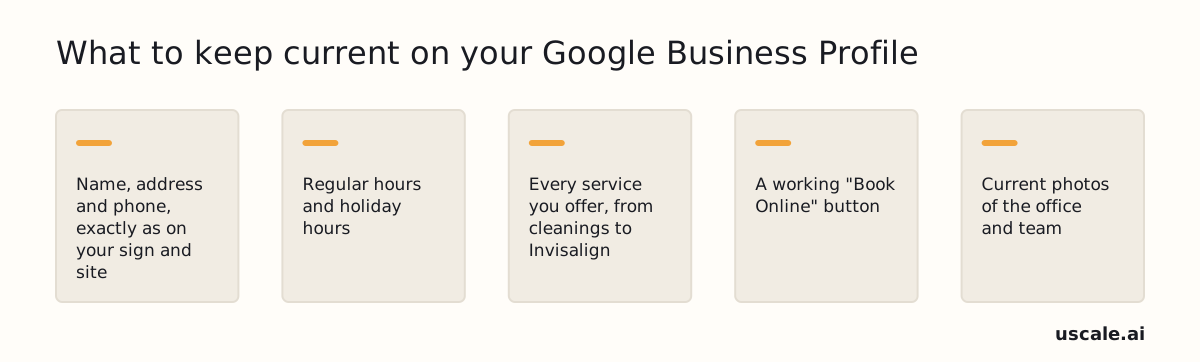
The booking button is easy to overlook. Google lets eligible businesses turn on a prominent "Book Online" button that sends searchers straight to the practice's booking page. A patient comparing offices at night can pick a time instead of meaning to call tomorrow. Test the link on a phone before you trust it.
If you run more than one office, give each location its own profile with its own phone number, hours and booking link.
The same playbook recommends actively monitoring and responding to reviews to build trust. Treat replies as part of the profile, not a separate chore. The next two sections cover how to get more reviews and how to reply to them safely.
How Do I Get More Google Reviews Without Breaking the Rules?
The way to get more Google reviews is to ask every patient, every time. Ask at checkout, then text your review link right after the visit. A QR code at the front desk works for patients who would rather leave a review on the spot.
Hi [Name], thanks for visiting [Practice] today. If you have a minute, a short Google review helps other families find us: [link]
Asking everyone matters more than asking cleverly. In a MouthWatch survey of 448 practices, only 25.0% called their own marketing "strong," and that label included solid reviews.
Avoid two shortcuts entirely. Don't offer discounts or gift cards for reviews. Don't use review gating, which means sending the link only to patients you expect to be happy. Both go against the spirit of Google's review rules and those of most other platforms.
| Do | Don't |
|---|---|
| Ask every patient | Ask only happy patients |
| Text the link the same day | Trade gifts or discounts for reviews |
| Reply to each review, as Google's playbook advises | Let new reviews sit unanswered |
Skip the fixed monthly target. Track your own review rate instead: new reviews divided by patients seen. Check it alongside where you show up on Google Maps. The next section covers what your replies can safely say.
How does your dental practice look to people searching nearby?
Type your business name and I check your Google profile, reviews, website and whether AI answers name you, then show what to fix first.
Check my businessHow Should a Dentist Reply to Reviews Without Violating HIPAA?
A dentist should reply to every review without confirming that the reviewer was a patient. The reply should never mention treatment, dates or billing, even if the reviewer did. Google's 2026 Business Profile playbook recommends responding to reviews to build trust, so staying silent isn't the safe choice.
Say a review reads: "Waited forever past my appointment time and nobody explained why." The tempting reply confirms the visit. The safe reply doesn't.
| Risky reply | Safe reply |
|---|---|
| "Sorry your cleaning ran late on Tuesday." | "We're sorry to hear about this experience." |
| "We checked your chart." | "Long waits aren't our standard." |
| "We'll adjust your bill." | "Please call our office manager at [phone]." |
For a negative review
We're sorry to hear this. Long waits aren't our standard, and we take every concern seriously. Please call our office manager at [phone] so we can make it right.
For a positive review
Thank you for the kind words. We're glad we could help, and we look forward to seeing you again.
Answer in public and resolve in private. A phone call lets your team confirm who they're speaking with before discussing any detail. A patient who trusts what they read in your reviews goes to your website next.
What Does a Dental Website Need to Turn Visitors Into Booked Patients?
A dental website that books patients needs a click-to-call button and a clear "Book appointment" button on every page. Both buttons should be visible on a phone without scrolling. About 70% of dental website traffic comes from mobile devices, according to a 2026 statistics roundup, so check the site on a phone first.
| Page or element | The patient's question it answers |
|---|---|
| Insurance and financing | "Can I afford this?" |
| New-patient page | "What happens at my first visit?" |
| Emergency page | "Can someone see me today?" |
| Real team photos | "Who will treat me?" |
| Map | "How do I get there?" |
Then add one page for each high-intent search, such as "emergency dentist in [city]." A page written for one exact search is easier to match to that search than a general services list. Our local SEO guide for small businesses covers how to build these pages.
Every page should end in a call or a booking. Those buttons only pay off if someone answers, including after the front desk goes home.
Should My Dental Office Use an AI Receptionist for After-Hours Calls?
An AI receptionist is worth it for a dental office when a real share of new-patient calls arrive at lunch, in the evening or on weekends, and only if the tool books the appointment instead of taking a message. A message left at 7 p.m. still waits for a callback the next morning, and the caller may have booked somewhere else by then.
The evidence so far is early and case-level. Apsteq's 2026 trends guide cites Dental Economics on two results. AI-based automated patient screening has been associated with a 58% increase in qualified leads (2025 data). One practice saw a 28% increase in new-patient bookings within six months of adopting AI-driven appointment and reminder tools (2024 data).
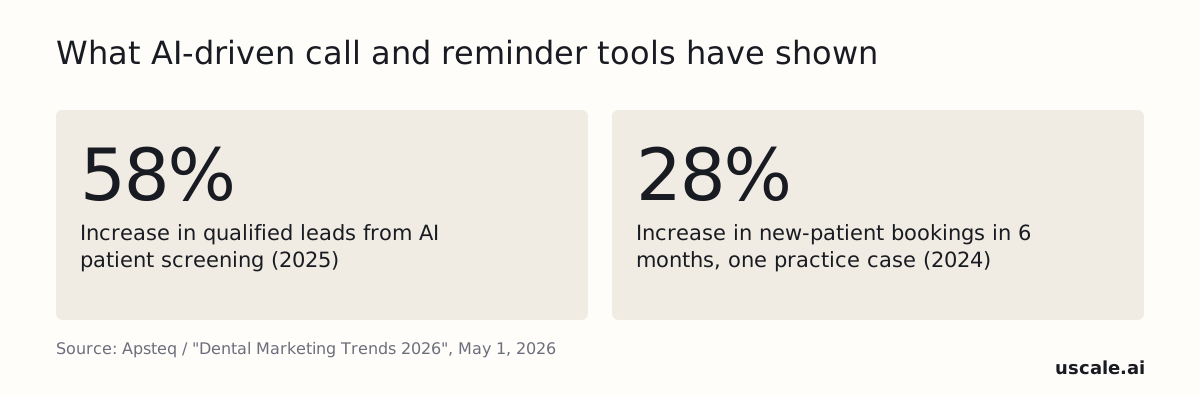
Treat those as signs, not promises, because one practice is not your practice. Judge any tool on two tests:
- It books into your calendar. A transcript in your inbox is a voicemail with better grammar.
- It routes true emergencies to a human. A patient in pain needs a person, not a booking slot.
Keep the missed-call log from earlier running for a month after you switch the tool on. Your own before-and-after count should decide whether it stays. For setup options, see our guide to after-hours answering services. The next question is which software handles these calls alongside reviews and texts.
Which Software Handles Reviews, Patient Texts and After-Hours Calls in One Place?
No single piece of dental front-office software is the right pick for every practice. Sort vendors into groups by what each one's own page says it is built for. Then buy for the gap your call log and reviews show.
Names you will hear include Weave, Adit, NexHealth, RevenueWell, Podium, Arini, Hello Patient and Smith.ai. This post has not checked their pages, so no feature comparison appears here. Ask each vendor directly whether it handles phones, patient texts, reviews and booking into your practice system, and get its full monthly price in writing before you compare.
uscale, which we make, answers Google reviews and patient messages, texts back missed calls, answers calls when you're closed and books people into your calendar, and keeps your Google Business Profile current, for $29.99, $99.99 or $299.99 a month depending on plan (pricing page, as of November 2026). It has no independent review-site track record and does not book into a dental practice system, so treat it as a general assistant rather than a full dental system.
Buy for the gap your call log and reviews show, and make any demo prove the fit before you sign.
What Should I Ask in a Demo Before Buying Dental Front-Office Software?
Before you buy dental front-office software, ask every vendor the same seven questions and compare the answers side by side. A demo shows each tool at its best. The same questions, asked every time, show how it handles an ordinary day.
| Ask | Good answer | Red flag |
|---|---|---|
| Does it book into our practice system? | The booking lands in your schedule | "We email a summary" |
| Can it reschedule safely? | No double-booking | Staff fix it by hand |
| How are emergencies routed? | To a named on-call person | Voicemail only |
| Can staff approve AI review replies first? | Every reply waits for approval | Posts automatically |
| Will you sign a HIPAA Business Associate Agreement? | Yes, before go-live | "Not needed" |
| Do texts come from our number, with opt-outs handled? | Yes to both | A shared number |
| What is the full monthly price, with setup and contract length? | One written total | "It depends" |
Ask the vendor to show each answer, not just describe it. Use that written total for the cost-per-patient math in the next section.
Budgeting Dental Marketing Ideas: How Much Should a Small Practice Spend?
There is no reliable percentage-of-revenue rule for a dental marketing budget. A small practice should set its spending by what a booked new patient is worth and what each channel costs to produce one. A new patient is worth roughly twice as much as keeping an existing patient active, as covered earlier. Ask every expense the same question: what does it cost per booked new patient?
| Spend | Judge it by |
|---|---|
| Google Ads | Booked new patients per month, not clicks |
| Front-office software | Missed calls that became booked visits |
| Referral push | New patients who name a referrer |
Is Google Ads worth it for a dentist?
Google Ads is worth it once the basics already convert: calls get answered, reviews are current and the website books on a phone. Until then, paid clicks fall into the same gaps that are already losing you patients. The cheapest ad is the one that sends callers to a front desk that picks up. Target high-intent searches like "emergency dentist near me" rather than broad terms such as "dentist," and track booked patients, not clicks.
Some of the cheapest patients to win are already in your chart.
How Do I Bring Back Patients Who Haven't Been in for 18+ Months?
To bring back lapsed dental patients, pull a list of them every month and text them first instead of waiting for them to call. Patients already in your chart know your office and your team, so winning one back usually costs a text and a staff minute rather than an ad click.
| List to pull each month | Who is on it | What the text offers |
|---|---|---|
| Overdue hygiene | Patients past their recall date | A cleaning time this week or next |
| Unscheduled treatment | Patients with a diagnosed plan they never booked | A time to finish the plan |
| Unused insurance benefits | Patients with benefits left this plan year | A visit before benefits reset |
Copy this script and change the brackets:
Hi [Name], this is [Practice]. You're due for your visit and we have openings this week and next. Want us to help schedule?
Send it from the practice number, and only to patients who agreed to receive texts. Book every reply the same day. The cheapest new appointment usually comes from a patient who already chose you once.
All of this assumes a practice with room to grow on every front. Not every office is in that position.
When Does This Advice Not Apply?
Most dental practices do not need every idea in this guide at once, and some genuinely need only part of it. A single-dentist practice in a small town with little competition can usually skip paid ads and spend its time on referrals, the Google Business Profile and reviews. Ads return the least where few people search and few rivals bid.
Staffing limits the plan too. A one-person front desk rarely has the hours to put several vendors through a full demo checklist. Pick one category, fix it, and come back to the rest later.
| Your situation | What you can skip for now | What to fix first |
|---|---|---|
| Solo dentist, small town, few competitors | Paid ads | Referrals, Google profile, reviews |
| One person on the front desk | Demos with several vendors | One category: reviews, after-hours calls or booking |
| Most calls arrive during open hours | An after-hours answering tool | Review requests and the Google profile |
| Busy area, many competitors nearby | Nothing on this list | Phones and profile, then ads |
One step applies to every practice. Any text to a patient, including recall and review-request texts, needs the patient's consent and an easy way to opt out. Treat consent and opt-out as a compliance basic to confirm with a HIPAA-aware vendor or attorney. This guide is not legal advice.
The order of the work stays the same at every size: measure your calls and fix the free channels before paying for new ones. Here is what that looks like in a single week.
Your Dental Marketing Action Plan for This Week
The best dental marketing plan for this week is to measure first and spend last: count what you're losing, fix what's free, then decide what's worth paying for. Work through these four steps in order, smallest effort first.
- Pull last month's numbers. Count missed new-patient calls and log where each new patient came from. Without that log, every later decision is a guess.
- Fix every field on your Google Business Profile. Check hours, holiday hours, services and categories, and turn on the Book Online button if you're eligible. The guide to ranking higher on Google Maps goes deeper.
- Text recent patients a review link and start your recall list. Reply to every review that comes in. Here is why your review response rate matters.
- Decide whether after-hours calls need an answering tool before you put money into ads. To compare tools, start with Podium alternatives.
uscale, which we make, covers two of these pieces: it texts back missed calls and answers reviews, with you approving each reply in chat. It doesn't connect to your practice software or sign a HIPAA BAA.
If you fix one thing this week, start with how missed-call text-back works.
Referrals and free Google visibility still bring in more new patients than ads do, so fix those two before you buy the third.
Questions
What are the best dental marketing ideas for 2026?
Dental marketing ideas are the practical steps a dental practice takes to attract and book new patients. The strongest ideas for 2026 fix free channels first: answer every new-patient call, keep the Google Business Profile accurate, ask every patient for a review, make the website book on a phone, and run a referral program. Apsteq's 2026 guide says about 60% of new patients come from referral plus organic channels, not paid advertising.
Are Google Ads worth it for a small dental practice?
Google Ads can be worth it for a small dental practice once the basics already convert: calls get answered, reviews are current and the website books on a phone. Before that, paid clicks fall into the same gaps that already lose patients. Target high-intent searches such as emergency dentist near me, and judge the spend by booked new patients per month, not clicks. In a small town with few competitors, ads often return the least.
How do I track where my new dental patients come from?
A dental practice tracks where new patients come from by logging two things for every new patient: the source they name, such as a referral, Google or an ad, and how their first call was handled. The ADA recommends counting new-patient calls each week for a month to calculate a lost-call rate. Mark each call as reached a person, went to voicemail, or booked, then total the columns weekly.
Do social media and short videos actually bring in new dental patients?
Social media and short videos are not where most new dental patients come from. Apsteq's 2026 guide says about 60% of new patients come from referral plus organic channels, and no sourced 2026 figure shows posts or Reels reliably driving bookings for dentists. Posts can support trust, but a practice should fix calls, its Google profile and reviews first, then ask new patients how they found the office before spending more time on video.
How many Google reviews should a dental practice aim for each month?
There is no reliable monthly review target for a dental practice. A better measure is the practice's own review rate: new Google reviews divided by patients seen. Ask every patient at checkout and text the review link the same day, without discounts, gifts or review gating. Google's 2026 Business Profile playbook also recommends responding to reviews, so reply to each one and watch whether the rate climbs month over month.