Plumbing Leads: The Fastest Way to Get More Without Renting Them
Plumbing leads bought from Angi go to as many as five plumbers at once. Angi's own help center says each project request is matched with no more than five pros, and a standard lead commonly lands with 3 to 5. That sharing shows up in the math. A September 2026 ResultCalls analysis compared sources by cost per booked job rather than cost per lead. It put Angi at roughly $600 to $1,000 per booked job, against about $168 for Google Local Services Ads.
So the cheapest plumbing lead is rarely the one with the lowest sticker price. It is the one three other trucks aren't calling back at the same minute. This guide covers the channels that work that way: Google Maps ranking, reviews, the paid ads worth paying for, referrals, repeat business, and not losing the calls you already pay to get.
First, though, the number marketplaces would rather you didn't work out: what a shared lead really costs once you count the jobs it turns into.
How Much Do Plumbing Leads Cost, and Which Source Is Worth It?
Plumbing leads from Angi and HomeAdvisor cost roughly $15 to $100 or more each, plus an annual membership fee, and each lead is shared with roughly 4 to 5 contractors. Contractors report paying about $40 to $85 per plumbing lead on Angi, plus a membership of around $300 a year. One breakdown puts non-exclusive emergency leads at $15 to $50.
Those prices look cheap until you count booked jobs. ResultCalls' 2026 analysis puts Google Local Services Ads at about $168 per booked job and Angi at roughly $600 to $1,000. The same source tracked 927 plumbing leads and found a blended cost per lead of $190. Broader industry ranges put plumbing leads at $25 to $75, with a 30% to 45% close rate. ResultCalls sells plumbing leads itself, so treat its rankings as one vendor's view.
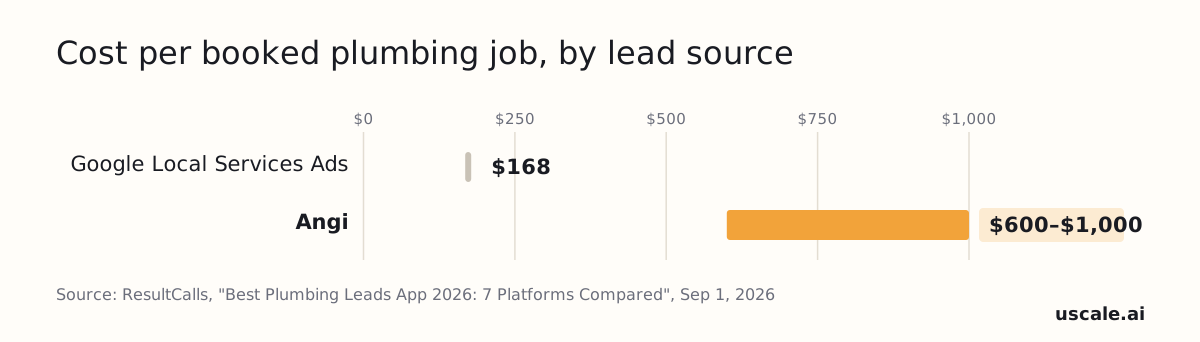
Source: ResultCalls, "Best Plumbing Leads App 2026: 7 Platforms Compared," September 2026.
The rule: price the job, not the lead
Compare every source on cost per booked job. A lead is a phone number. A booked job is revenue. A $40 lead that four other trucks are also calling closes less often than a pricier lead that comes only to you, so the cheap one can cost more per job. Divide one month's spend on a source by the jobs that source actually put on your calendar, then do the same for each source. The cheapest lead is the one that turns into a job, not the one with the lowest price.
Why many shops keep Angi only for overflow
Angi and HomeAdvisor contracts commonly auto-renew for 12 months and carry cancellation penalties of roughly 30% to 35% if you leave early. The FTC also reached a consent order requiring HomeAdvisor to pay $7.2 million, barring false or misleading claims about its leads, including that they came from people ready to hire.
Neither fact makes the leads worthless. Both are reasons to read the renewal and cancellation terms before you sign, and to use a marketplace as a backup for slow weeks while you build channels you own, starting with Google Maps.
How Do I Get My Plumbing Business Into the Google Maps Top 3?
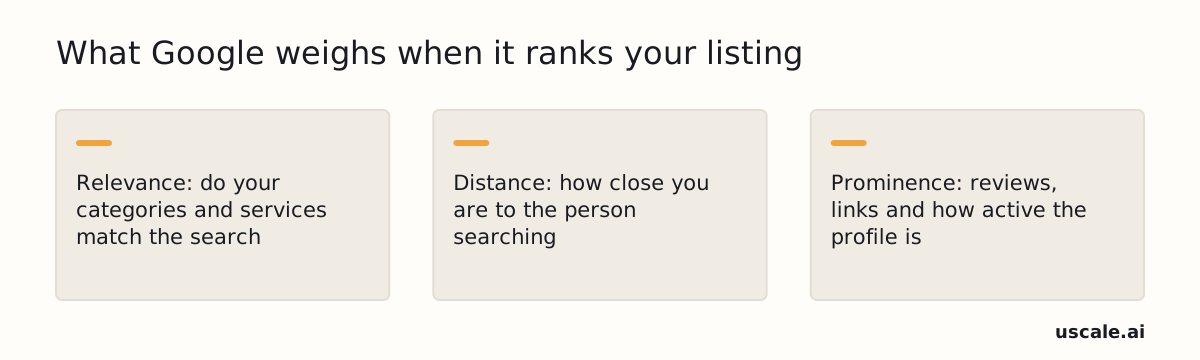
Google ranks local results mainly on three factors: relevance, distance and prominence. A plumber can't move the shop closer to every caller, so the work that pays off is making the listing match more searches and building prominence over time.
Hide the address if you go to the customer
Google defines a service-area business as one that visits customers instead of serving them at its address, and Google's own example is a plumber. Its guidelines say a service-area business should hide its address. In your profile, turn off "Show business address to customers." The listing then shows your service area instead of a map pin. These are Google's rules as of November 2026.
Set the right categories
A profile can carry one primary category plus up to nine more, for ten in total. ServiceTitan recommends "Plumber" as the primary category and secondary ones such as Drainage Service or Water Heater Installation Service, as long as they match work you actually do. A category for a job you turn down only brings calls you will lose.
Categories are the cheapest relevance signal you control. The primary category tells Google what you are, and the secondary ones tell it which searches you should show up for. Of everything in this guide, getting the categories and the address setting right is the single highest-leverage fix that costs nothing. For the rest of the ranking work, see how to rank higher on Google Maps.
That takes care of relevance. Prominence is slower to build, and for most plumbers it starts with reviews.
How Do I Get More Google Reviews (and Should I Reply to All of Them)?
The fastest way to get more Google reviews is to text every customer a direct review link right after the job, follow up once the next day, and reply to every review that comes in, good or bad. The free Google review link and QR code generator makes the short link for you.
Ask plainly and offer nothing in return. Google's help page says that offering free or discounted goods or services in exchange for a review counts as fake and misleading content and is strictly prohibited. The FTC's fake-reviews rule has been in effect since October 21, 2024. After the 2025 inflation adjustment, effective January 17, 2025, the maximum civil penalty is $53,088 per violation.
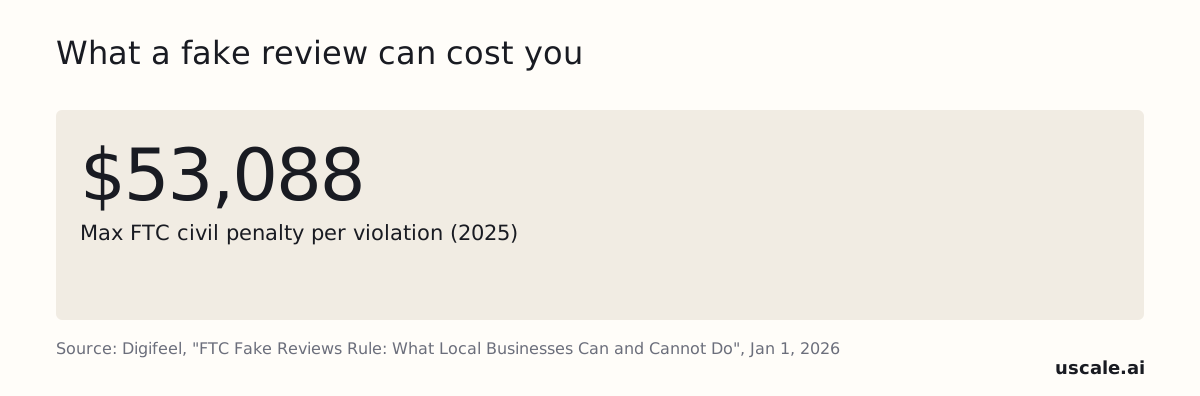
Source: Digifeel, "FTC Fake Reviews Rule: What Local Businesses Can and Cannot Do," 2026.
Text to send after the job
Hi [Name], thanks for having us out today. If we did right by you, would you leave a quick Google review? It helps neighbors find a plumber they can trust: [link]. [Your name], [Company]
Send one follow-up the next day, and no more:
Hi [Name], just a reminder in case yesterday got busy: [link]. Thanks either way.
Reply to a 2-star review
Thanks for the honest feedback, [Name]. [Name the problem in one line, e.g. "We showed up later than we told you."] That's not how we want to run a job. Please call me directly at [number] so I can make it right. [Owner name]
A reply to a bad review is written for the next caller, not the unhappy one. Own the problem, keep it short and take the details offline. For more on this, see how to respond to negative Google reviews. Every paid channel relies on reviews as proof, and paid channels are the next question.
How does your plumbing business look to people searching nearby?
Type your business name and I check your Google profile, reviews, website and whether AI answers name you, then show what to fix first.
Check my businessAre Google Local Services Ads Worth It for Plumbers, and What Keywords Should I Bid On?
Plumbers running Google Ads should bid on emergency and service-plus-city phrases such as "emergency plumber near me" and "water heater repair [city]". They should also block job-seeker and do-it-yourself searches like "jobs", "salary" and "DIY" as negatives. For paid leads in general, Google Local Services Ads are the channel to test first: in the cost-per-booked-job comparison shown above, LSA came out far cheaper than Angi.
Bid on intent, block the browsers
One rule builds the whole list. Pay for the words a person types when water is on the floor, and block the words a person types when they want a career, a lesson or a part. "Emergency plumber near me" is a customer. "Plumber salary" is a job seeker, and every click from that search comes out of your budget. Copy both columns into your account today and swap in your own towns.
| Bid on | Block as negatives |
|---|---|
| emergency plumber near me | jobs |
| water heater repair [city] | school |
| drain cleaning [city] | salary |
| burst pipe repair [city] | DIY |
| 24 hour plumber [city] | supplies |
| sewer line repair [city] | how to |
Run ads only when someone can pick up
A late-night click that rings through to voicemail is a lead you paid for and then handed to the next plumber on the list. Schedule your ads for the hours your phone is covered. If you want them running around the clock, cover the nights first with an after-hours answering service or a dedicated after-hours line.
Once the clicks start coming in, the page they land on decides whether they turn into calls.
What Does a Plumbing Website Need to Turn Visitors Into Calls?
A plumbing website turns visitors into calls when it has four things:
- a phone number on every page that can be tapped to call
- a real page for each service and each town
- visible proof that the business is licensed and local
- a fast load on a phone
The person reading is often standing in a wet kitchen, not comparing options at a desk.
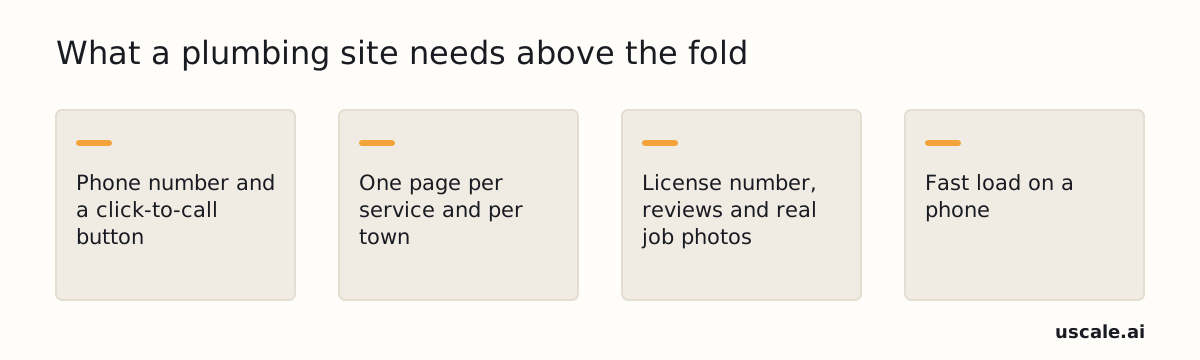
- Phone number and a click-to-call button at the top of every page, big enough to tap with a thumb. Nobody with water on the floor fills in a contact form.
- One page per main service and per town you serve. That means drain cleaning, water heaters, sewer lines, and each suburb you actually drive to. Write each page fresh. Copying the same text and swapping in a new town name gives Google nothing new to rank. The guide to local SEO for small businesses shows how to build these pages.
- License number, reviews and photos of your own trucks and crew. Stock photos make the business look like a call center.
- Fast load on a phone. Test it on your own phone over cellular data, not office Wi-Fi.
Treat the homepage as a dial pad with proof attached, not a brochure. Those same pages feed the relevance and prominence Google weighs for local ranking. They are also what Google, and whoever vets you for Local Services Ads, look at before trusting the business.
A good site turns searchers into calls. Some of the steadiest work, though, never starts with a search at all.
Which Referral Partners Send Plumbers the Most Steady Work?
Property managers, realtors, home inspectors, water-damage restoration companies, and HVAC or electrical contractors who don't do plumbing send plumbers the most steady referral work. Each one sees plumbing problems before the homeowner calls anyone, and each needs a plumber who picks up and shows up.
Drop off cards in person and keep the ask small:
Hi, I'm [name] with [company]. You probably see plumbing problems before your clients call anyone. If you need someone who answers and shows up when they say, here's my direct cell. I'll treat your people like my own customers and tell you how every job went.
Partners refer the plumber they remember, so the follow-up matters more than the first visit.
| When | What to do |
|---|---|
| First visit | Hand over cards and use the script above |
| After each referral | Text the partner that week with how the job went, and say thanks |
| Every month or so | Stop in or text with a useful tip, a before-and-after photo, and fresh cards |
| After sewer or water-line work | Hang door hangers on the neighboring houses, and put up a yard sign if the homeowner agrees |
Two cheap habits fill the gaps between referrals. Put the phone number on the truck wrap so it is readable from across the street. In Nextdoor and local Facebook groups, answer people's questions instead of only posting ads. A plain answer to "is this leak urgent?" earns more trust than another promotion.
Referrals and neighbors bring new names. The cheapest customers of all are already on your invoice list.
How Do I Get Repeat Business From Past Customers?
The cheapest plumbing lead source you have is your list of past customers. Sell them an annual maintenance plan and text them a reminder each season. A household that has already let your crew in doesn't need to be won from other trucks. It needs a reason to call you before something breaks.
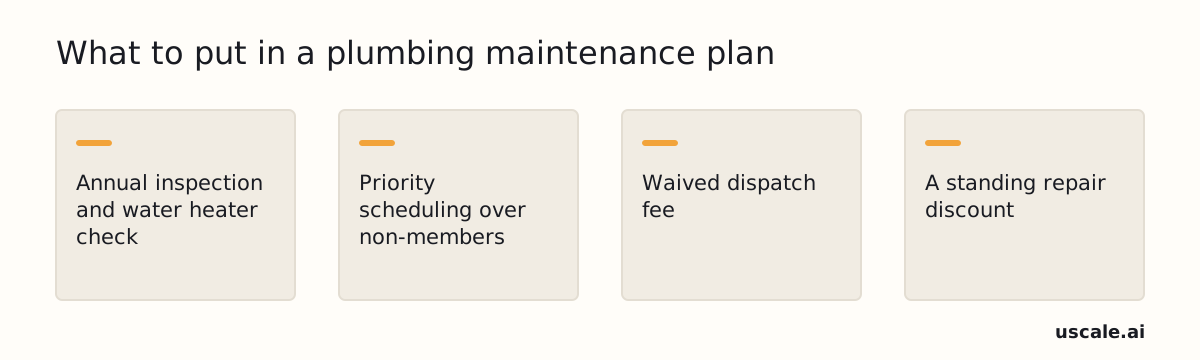
A good plan gives the customer something they notice at every visit: an annual inspection and water heater check, priority scheduling over non-members, a waived dispatch fee, and a standing repair discount. Price the plan from your own labor and dispatch costs. When you sell it, talk about what's in it, not the price tag.
Two texts cover most of the year:
Hi [Name], it's [Company]. Spring is a good time to flush your water heater so sediment doesn't shorten its life. Want us to book a visit? Reply with a day that works.
Hi [Name], [Company] here. Before the first freeze, we can check exposed pipes and outdoor spigots. Reply YES and we'll find you a time.
| Marketplace lead (as of September 2026) | Text to a past customer | |
|---|---|---|
| Cost | $15 to $100 or more per lead, plus an annual fee | The cost of sending a text |
| Who else gets it | 3 to 5 pros at once | Only you |
| Already knows your work | No | Yes |
Most owners get this backwards. They pay for strangers and leave their own list untouched. Those reminders bring calls back in, so the next step is making sure every call gets answered.
How Do Plumbers Stop Losing Emergency Jobs to the Next Plumber?
The plumber who answers first usually gets the emergency job. A homeowner with water on the floor will dial the next number on the list before leaving a voicemail. Cover after-hours and busy times in one of three ways: an answering service, a dedicated after-hours line someone on the crew carries, or an automatic text-back that reaches a missed caller in seconds.
A missed call is not a lost lead until the caller dials someone else. Each option below closes that gap.
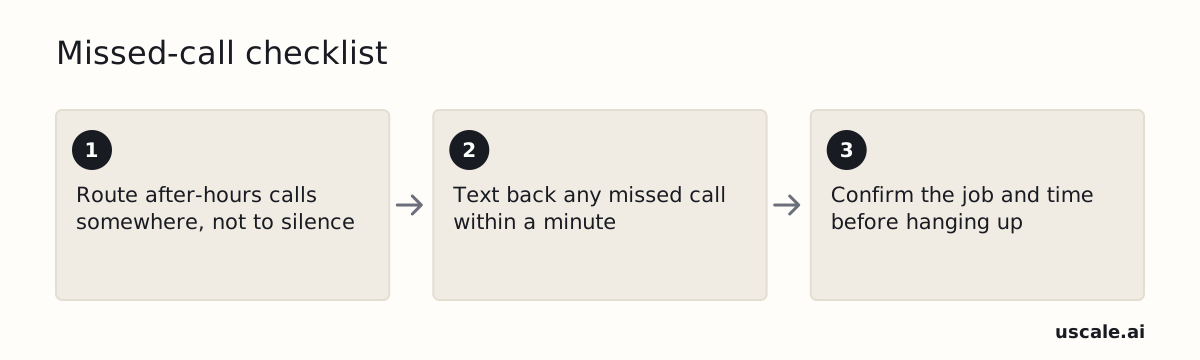
The missed-call checklist
- Route after-hours calls somewhere, not to silence.
- Text back any missed call within a minute.
- Confirm the job and the appointment time before hanging up.
Most shops skip the third step. A caller told "someone will call you in the morning" is still shopping. A caller with a time on the calendar has stopped.
Three ways to cover the phone
- Hire an answering service. A live person takes the call. Our guide to after-hours answering services covers what to ask before signing up.
- Do it by hand. Forward the line to whoever is on call, and send a missed-call text-back yourself between jobs.
- Use software. uscale, which we make, answers calls when the business is closed and texts back missed calls. It books the job into your calendar after you approve it in chat. As of November 2026, it starts at $29.99/month on the Starter plan.
Phone coverage protects every other channel in this guide. A Maps ranking or a strong set of reviews only pays off when someone picks up the call it brings in.
That is the whole plan. It doesn't land the same way for every shop, though.
When Does This Plan Not Fit?
Owning your Google profile, reviews and phone coverage does not fit every plumbing business at the same pace. Solo plumbers with no spare hours, small-town shops with little search traffic, and owners planning bulk marketing texts should adjust the plan, not drop it.
The solo plumber with no slack
If you are on the tools all day and can't return referral calls yourself, you may need marketplace leads for longer than this guide assumes. Start with the Google profile and the review texts, which take minutes a week. Cut the marketplace back as more calls come from your own channels.
The small-town plumber
Where few people search online, Maps ranking and service pages matter less. Referral partners, a readable truck wrap and yard signs at finished jobs may bring in more work than SEO.
Texting past customers
Asking a recent customer for a review is different from sending promotions to an old list. Before you send bulk seasonal texts, check the consent rules that apply to you, and give people an easy way to opt out.
Leaving Angi
Angi and HomeAdvisor contracts commonly auto-renew for 12 months, with early-cancellation penalties of roughly 30% to 35% (Adapt Digital Solutions, as of 2026). Find your renewal date and plan to leave then, not mid-contract.
These exceptions change how fast you move off rented leads. They don't change the direction. Here is what that direction looks like for a shop starting from zero.
What Should a New Plumbing Business Do in the First 90 Days?
A new plumbing business should spend its first 90 days building channels it owns. Set up the Google Business Profile and reviews first, then referral partners and the website, then Local Services Ads.
Complete your Google Business Profile and start the review text (days 1–30). Google ranks local results mainly on relevance, distance and prominence, so a full profile is the base for everything else. Set "Plumber" as the primary category. Add secondary ones, like Drainage Service, only for work you actually do. You're done when the profile is complete and a review-request text goes out after every job with no discount attached. Google prohibits incentives for reviews.
Quick win for this hour: make your link with the free Google review link tool and save the text in your phone.
Sign two or three referral partners and fix your website's first screen (days 31–60). You're done when you have handed partner cards over in person. On your website, your number and call button should show without scrolling.
Turn on Local Services Ads once reviews are coming in (days 61–90). Before you raise the budget, check how many of those calls became booked jobs. Spend more only when that count holds steady for a few weeks.
If you do only one thing, fix your profile categories this week. Once these channels bring steady calls, keep Angi on only as overflow for the weeks you can't fill yourself.
Before the Next Call Comes In
Every channel in this guide does the same job: it puts your business, not a marketplace, between the customer and the next call. You don't need all of it this month. Start with these:
- Fix your Google Business Profile categories this week. Set "Plumber" as the primary category and add only services you actually do.
- Text the review link after every job. Send it the same day with no discount or credit attached, and follow up once the next morning.
- Reply to every review that comes in. Answer the low ones first.
- Keep Angi as overflow, not the plan. Write down your renewal date and decide before it arrives.
Once those are running, the plumber marketing guide covers what to build next.
A rented lead rings every truck that paid for it. A lead you own rings only yours.
Questions
What are plumbing leads?
Plumbing leads are the calls, texts or form requests from people who need a plumber, such as a homeowner with a burst pipe or a failing water heater. They come either from channels a plumber owns, like Google Maps, reviews, referrals and past customers, or from marketplaces such as Angi, where a standard lead commonly goes to 3 to 5 pros at once. A lead only pays once it becomes a booked job.
How much do plumbing leads cost?
Plumbing leads from Angi and HomeAdvisor run roughly $15 to $100 or more each, plus an annual membership fee. Contractors report paying about $40 to $85 per plumbing lead on Angi, with a membership around $300 a year. Broader industry ranges put plumbing leads at $25 to $75. Cost per booked job is the better measure: a 2026 ResultCalls analysis put Google Local Services Ads near $168 per booked job and Angi at roughly $600 to $1,000.
How do I get more plumbing leads without paying Angi or HomeAdvisor?
A plumbing company gets more leads without Angi or HomeAdvisor by owning its channels. That means a complete Google Business Profile with the right categories, a review-request text after every job, replies to every review, a website with a tap-to-call number, referral partners such as property managers and home inspectors, seasonal texts to past customers, and phone coverage so no call goes unanswered after hours.
Are Google Local Services Ads worth it for plumbers?
Google Local Services Ads are the paid channel most plumbers should test first. A 2026 ResultCalls comparison put LSA at about $168 per booked job versus roughly $600 to $1,000 for Angi, though ResultCalls sells leads itself. LSA works best once reviews are coming in and someone can answer the phone during the hours the ads run. Judge it on booked jobs, not on the number of calls.
Should I keep Angi as a backup lead source?
Angi can work as overflow for slow weeks while a plumbing business builds channels it owns, but it is a poor main plan. Angi and HomeAdvisor contracts commonly auto-renew for 12 months, with early-cancellation penalties of roughly 30% to 35%. Write down your renewal date, compare Angi's cost per booked job with your other sources, and decide whether to renew before that date arrives.