Five jobs, not one product
Dental patient communication software is not one product. It is five jobs: appointment reminders and recall, two-way texting and phones, online booking, review requests, and new-patient marketing. No single vendor leads all five. That is why two practices can ask for "the best one" and both get a different, correct answer.
The price spread shows the same thing. Among tools that publish a price at all, RevenueWell lists a Starter plan at $189 per month. At the other end, third-party trackers put Podium's Pro plan at roughly $599 per month, usually on an annual contract. Neither number tells you which tool fits your front desk.
Below you'll find:
- how the main tools group by job
- which practice management systems each one syncs with
- HIPAA and BAA status
- prices as of November 2026
- a checklist to run before you sign
Finding the tool that fits your front desk starts with knowing which of those five jobs you're actually shopping for.
What is dental patient communication software?
Dental patient communication software is the set of tools a practice uses to remind patients of appointments, run recall, text and call patients two ways, take online bookings and ask for reviews, all kept in step with the practice management system. Some products do one of those things. The large suites try to do all of them.
Comparing these products is easier if you stop thinking of one product and think instead of the five jobs dental patient communication software covers:
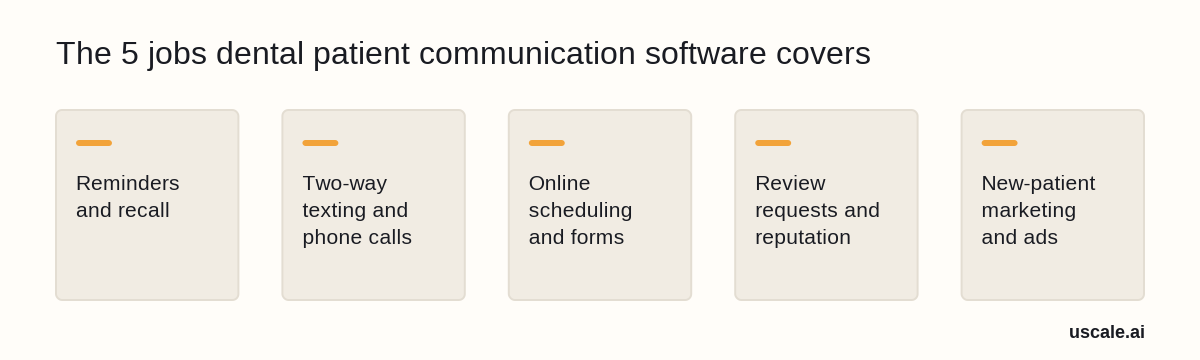
Figure: The five jobs dental patient communication software covers.
- Reminders and recall. Confirms upcoming appointments and brings back patients overdue for a cleaning. This job protects the schedule you already have. Our guide to appointment reminder texts covers the wording.
- Two-way texting and phone calls. Lets the front desk text patients from the office number and handles incoming calls, including the ones nobody picks up. Our guide to missed-call text-back covers that piece.
- Online scheduling and forms. Lets a patient pick an open time and fill in intake forms before arriving, without a phone call.
- Review requests and reputation. Asks patients for a Google review after a visit and helps the practice reply to what they write.
- New-patient marketing and ads. Reaches people who have never visited, through campaigns, ads and the listings they see first.
The jobs split along one line. Recall and two-way texting keep the patients you have. Reviews and marketing find new ones. Online booking sits in the middle because it serves both groups.
A practice losing new patients to unanswered calls has a different problem from one with a half-empty hygiene schedule, and each needs a different tool. A suite that lists all five jobs still has to be judged one row at a time.
The rest of this post groups tools by job for that reason, instead of ranking them in one list. Before reading the comparison, decide which job is costing your practice the most right now, and read with that row in mind.
What is the best patient communication software for a dental practice?
The best patient communication software for a dental practice depends on which job is losing patients right now. No single vendor leads phones, booking, recall, reviews and new-patient marketing at once. Below is the strongest name for each job, with prices as of November 2026. The job labels are our own grouping.
- Phones and texting: Weave. Weave reported 39,625 customer locations as of December 31, 2025. On March 12, 2026, ADA Member Advantage endorsed it as the patient engagement platform for ADA members.
- Online booking and forms: NexHealth. NexHealth says nearly 20,000 practices across 19 specialties use its platform.
- Recall and campaigns: RevenueWell and Solutionreach.
- Reminders plus reviews: Demandforce. Its D3 platform, now part of Henry Schein One, combines text and email reminders with review management.
- New-patient suite: Adit.
- Forms and engagement: Modento. Modento is now Dental Intelligence Engagement, with Dental Intelligence's accounts receivable (AR) and claims features added.
- Reviews first: Podium and Birdeye.
| Tool | Best job | Price on the vendor's own site | Monthly price you can cite |
|---|---|---|---|
| Weave | Phones, texting | Seen once: "from $199/month," onboarding included | $199 as observed, not confirmed |
| NexHealth | Booking, forms | Quote-based | Ask for a quote |
| RevenueWell | Recall, campaigns | Quote-based; vendor-provided price on G2 | Starter $189 |
| Solutionreach | Recall, campaigns | Not published | $329 flat, per review sites |
| Demandforce | Reminders plus reviews | No price in our sources | Ask for a quote |
| Adit | New-patient suite | No tiered pricing published | $399 flat, per trackers |
| Dental Intelligence Engagement | Forms, engagement | No price in our sources | Ask for a quote |
| Podium | Reviews | Usually not published | Core about $399, Pro about $599, typically annual |
| Birdeye | Reviews | No price in our sources | About $299 to $349, one location |
Sources: Weave and NexHealth price status from TheBigBot (checked September 16, 2026). RevenueWell from G2 (November 2026). Solutionreach from Software Advice, Adit from Capterra, Birdeye from Skill Mammoth (all 2026). Podium from Pabau and Skill Mammoth, which saw prices listed briefly on October 5, 2026. The RevenueWell sources disagree, so ask RevenueWell directly.
Choose by situation
- Missed calls and a texting backlog: Weave.
- Patients want to book after hours: NexHealth.
- A cold recall list: compare RevenueWell, which has the lowest price you can cite here, with Solutionreach.
- Reviews are the main gap: Podium or Birdeye. Choose Demandforce if you want reminders in the same tool. See the Podium alternatives and Birdeye alternatives guides.
- Already on Dental Intelligence: its Engagement product. New-patient growth first: Adit.
Rule of thumb: pick the job first and shortlist two tools from that row. Treat any price that isn't a written per-location quote as a starting point.
Before prices matter, check whether each tool works with your practice management system. That one check can knock a tool off the shortlist.
Does dental patient communication software work with my practice management system?
Dental patient communication software only saves the front desk time if it syncs two ways with the practice management system (PMS) already in use. Check the PMS list before booking any demo. If the tool doesn't cover Dentrix, Eaglesoft, Open Dental, Dentrix Ascend or Denticon, someone retypes every new booking by hand.
NexHealth publishes its own list. Its Synchronizer page names on-premise support for Dentrix, Eaglesoft, Open Dental, Dentrix Enterprise, PracticeWorks, Dolphin and OrthoTrac. It names cloud support for Dentrix Ascend, Cloud9 and Denticon, among 15+ systems through one API. NexHealth's EHR-integration comparison page also lists what Weave and RevenueWell connect to.
Two of the three columns below come from a competitor's page. Treat them as a starting point, not a final answer.
| PMS | NexHealth (own page) | Weave (per NexHealth) | RevenueWell (per NexHealth) |
|---|---|---|---|
| Dentrix | Listed | Listed | Listed |
| Dentrix Ascend | Listed | Not named | Listed |
| Eaglesoft | Listed | Listed | Listed |
| Open Dental | Listed | Listed | Listed |
| Denticon | Listed | Listed | Listed |
| Others named | Dentrix Enterprise, PracticeWorks, Dolphin, OrthoTrac, Cloud9 | athenaOne, eClinicalWorks, "among others" | WinOMS |
Weave's entry on that page ends with "among others." A blank in its column means NexHealth didn't name the system there. It does not mean Weave can't connect to it, so ask Weave directly.
The question that matters more than the logo
A logo on a list doesn't tell you which way the data flows. Ask each vendor whether the sync is read-only or two-way.
- Read-only: the tool pulls appointments out of the PMS to send reminders.
- Two-way: the tool also writes new bookings, confirmations and patient details back into the PMS.
A sync that only reads still leaves someone at the front desk typing every booking in twice. Get the answer in writing for your exact PMS and version.
Once PMS fit has cut the list down, the tools that remain can be compared on price.
How does your dental practice look to people searching nearby?
Type your business name and I check your Google profile, reviews, website and whether AI answers name you, then show what to fix first.
Check my businessHow much does dental patient communication software cost?
Dental patient communication software costs roughly $189 to $599 a month among the tools that publish a price, as of November 2026. RevenueWell's Starter plan is the lowest published figure at $189.00 a month. Podium's Pro plan is the highest at roughly $599 a month.
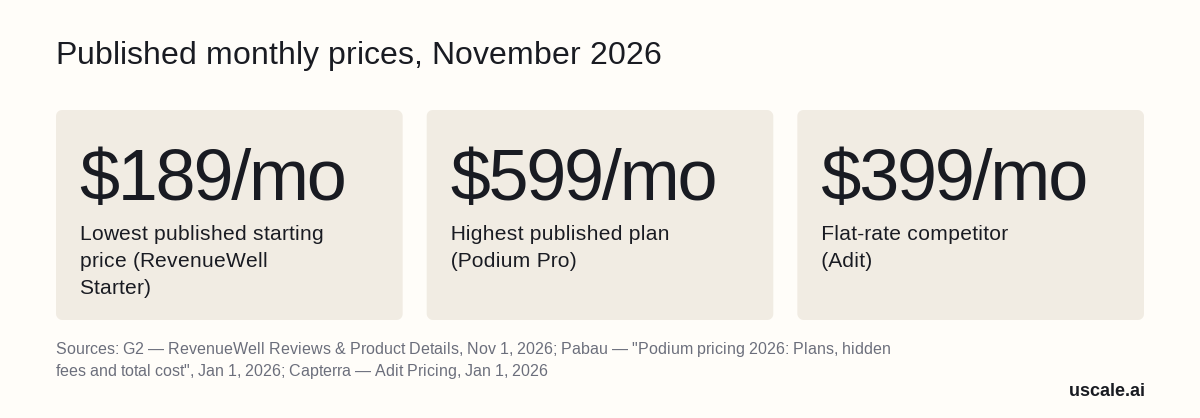
Sources: G2, "RevenueWell Reviews & Product Details," November 2026; Pabau, "Podium pricing 2026: Plans, hidden fees and total cost," 2026; Capterra, "Adit Pricing," 2026.
The middle of the range:
- Adit: independent trackers list one plan at $399.00 a month, flat rate.
- Birdeye: roughly $299 to $349 a month for one location. The price falls as you add locations.
- Podium Core: roughly $399 a month.
Podium usually doesn't publish its prices, so these figures come from third-party trackers. Both Podium plans are typically sold on annual contracts. One tracker saw the prices on Podium's own page on October 5, 2026. For review-first tools, see our Podium alternatives guide.
The big names are mostly quote-based
Weave, NexHealth and Solutionreach don't show a standing price you can compare. One third-party comparison site checked Weave's own pricing page on September 16, 2026, and saw plans starting from $199 a month with onboarding included. Treat that as a snapshot, not a confirmed price. Review sites list Solutionreach as a single plan at $329.00 a month with no free trial. Solutionreach doesn't publish that figure on its own site.
Why a "starting at" price misleads
A published starting price is the cheapest way into the product. It is not what your practice will pay. It usually covers one plan for one location, and the feature you came for may sit in a higher tier.
Get three things in writing from every vendor:
- the per-location monthly price
- any setup fees
- the contract length
Compare those quotes only against tools that do the same job. A lower price matters only if the vendor can legally handle patient texts, and that is the next question.
Is texting dental patients HIPAA compliant?
Texting dental patients can be HIPAA compliant when the texting vendor signs a business associate agreement (BAA) with the practice. Each message should also carry only what the patient needs to book or show up: a name, a day, a time, a place. Diagnosis, treatment plans and clinical detail stay out of the text.
Ask every vendor on your shortlist about this before you sign. Don't rely on the marketing page. A "HIPAA compliant" badge on a vendor's site is a claim, but a signed BAA is a contract. Ask for the BAA itself, check that it names your practice, and keep a copy with the service agreement.
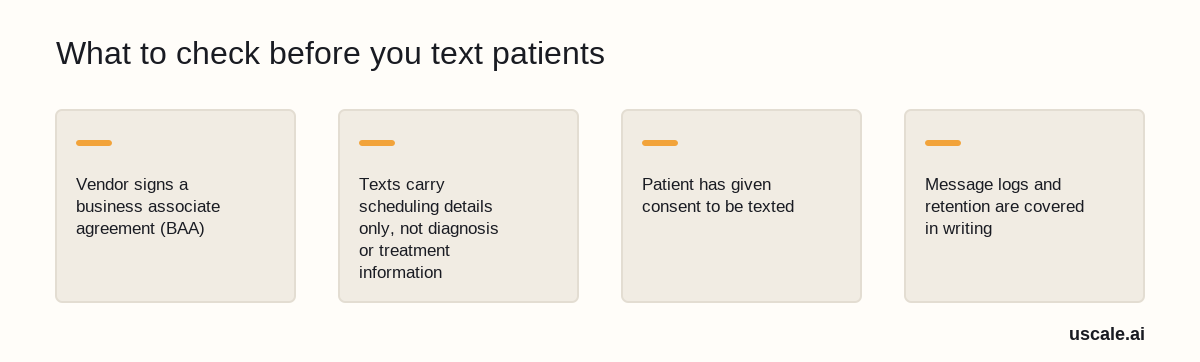
Four things to confirm in writing before any patient text goes out.
What to check in the vendor's answer
- The BAA. The vendor signs it, and it covers the texting and calling features you will actually use, not only the core product.
- Message content. The default templates hold scheduling details only. Also check what staff can type in free-form replies. A two-way text thread is where clinical detail tends to slip in.
- Patient consent. The software records that each patient agreed to be texted, and it honors an opt-out when a patient replies to stop.
- Logs and retention. The contract says how long message logs are kept, who can see them, and how you get them back if you cancel.
A reminder that passes these checks looks like this:
Hi [first name], this is [practice name]. You're booked [day] at [time]. Reply C to confirm, or call us at [phone] to reschedule.
For more wording that stays within those limits, see our guide to appointment reminder texts. Once the BAA is settled, the same questions apply to the next job many practices add: asking patients for Google reviews.
Which dental software asks patients for Google reviews?
Demandforce is the clearest answer among dental tools: its D3 platform, now part of Henry Schein One, is described as automating email and text reminders, managing online reviews and running patient reactivation campaigns in one product. Podium and Birdeye are the usual reputation-tool names a practice compares against. RevenueWell and Solutionreach are recall-first tools. For those four, the sources here confirm a price, not exactly what the review feature includes.
Price is the difference you can actually check, so compare on price within this job.
| Tool | Review role, per sources | Price as reported in 2026 | Where the price comes from |
|---|---|---|---|
| Demandforce (D3) | Reviews bundled with reminders and reactivation | Not found in our sources | Ask for a quote |
| Podium | Reputation-tool shortlist | Core roughly $399/month, Pro roughly $599/month, usually annual contracts | Third-party trackers. One saw the prices briefly listed on Podium's page on October 5, 2026 |
| Birdeye | Reputation-tool shortlist | Roughly $299 to $349/month for one location, lower per location as you add more | Third-party tracker |
| RevenueWell | Recall-first | Starter $189/month | Vendor-provided pricing on G2, November 2026 |
| Solutionreach | Recall-first | $329/month flat, one plan, no free trial | Third-party review sites, not Solutionreach's own site |
A pricing page tells you what the plan costs. It rarely tells you what happens after a patient leaves a review. Ask each vendor two things in writing:
Does the plan only send review requests, or does it also draft replies to the reviews that come in? Are replies included, or billed separately?
A review request with no reply behind it does half the job. Patients reading your Google listing see whether you answered the last unhappy review, not how many requests you sent. For more on that side, see how fast practices should reply to Google reviews and the roundups of Podium alternatives and Birdeye alternatives.
Reviews bring patients to the phone, and the next question is what happens when nobody picks up.
What about calls the front desk misses?
A missed call at a dental practice can be a new patient who books somewhere else. Most tools compared here treat that call as a side feature rather than the core product. Only Weave's cited materials describe what happens in the first minute after a missed call: an automatic text that lets the caller book.
ADA Member Advantage, part of the American Dental Association, endorsed Weave as its patient communications and engagement platform on March 12, 2026. In that announcement, Weave describes an "Always-on AI receptionist." It follows up on missed calls with a text that lets the patient schedule, answers FAQs in real time and escalates to staff when needed. Business Wire's syndicated release on the same endorsement is dated March 13, 2026, a day after the ADA's own post.
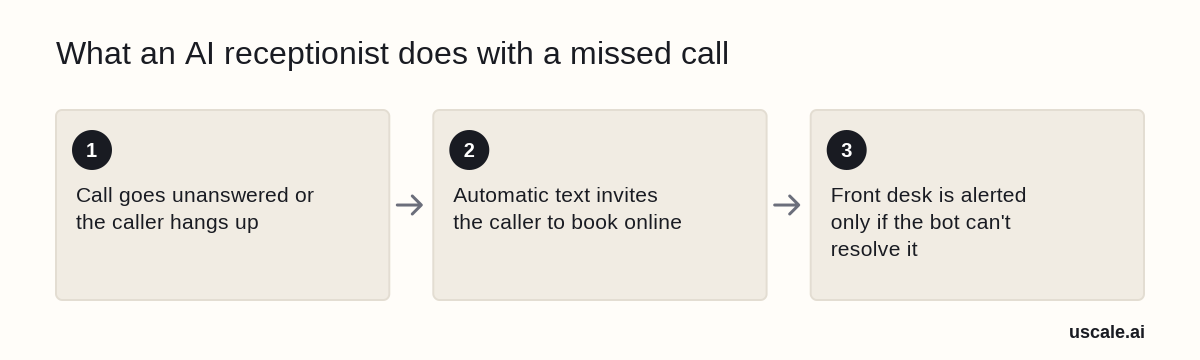
The three steps Weave describes for its AI receptionist. Step three is the one most demos skip.
Most buyers skip that third step during a demo. Vendors show the text going out and the booking link working. Fewer show what happens when a patient replies with something the system can't handle, such as a cracked tooth on a Saturday. That hand-off decides whether the feature keeps the patient or only delays the bad news.
Ask every vendor on this list the same three questions, and ask to see each answer live:
1. If a caller hangs up before anyone answers, does your system text them back automatically? 2. Can the patient book from that text into our real calendar, or only request a time? 3. When the system can't resolve the conversation, who on our staff gets alerted, and how?
For the wording of the text itself, see our guide to missed-call text back. For nights and weekends, see the after-hours answering service guide. The next section asks whether a practice needs this job inside a full suite at all.
When don't you need the whole suite?
A dental practice may not need a full patient communication suite if it has one location, modest call and text volume, simple scheduling, and a front desk that already keeps up. In that case, two or three narrow tools can cover the real gaps for less than one bundled platform.
The case for skipping the suite is a strong one. Suites usually charge a flat monthly platform fee. Third-party review sites, for example, list Solutionreach as a single plan at $329.00 per month flat rate. That fee covers recall campaigns, marketing tools and multi-provider scheduling whether the practice uses them or not. A one-dentist office whose front desk returns every call the same day may be losing patients in only one place, such as after-hours calls or unanswered reviews.
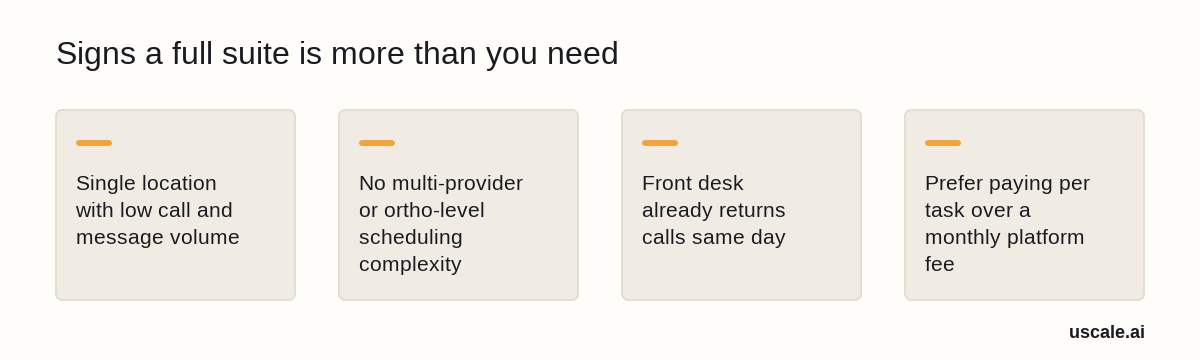
If most of these signs fit your practice, a narrow tool for the one job that is losing patients can be enough. A missed-call text-back tool or a review-reply tool closes a specific gap, and you pay nothing for features that sit idle.
The trade-off runs both ways. Narrow tools mean more logins, more vendors to check for a signed BAA, and more places where patient data lives. A bundled suite means one login and one BAA. In a small, steady practice, though, its recall and marketing features go unused, and you still pay for them.
Decide this before you compare prices, not after. Once you know whether you need a suite or one narrow tool, the price comparison above shrinks to the vendors that fit. The cheapest suite is no bargain if you only needed one job done.
Whichever way you go, suite or single tool, the deal comes down to what the vendor will put in writing.
What should a practice ask before signing?
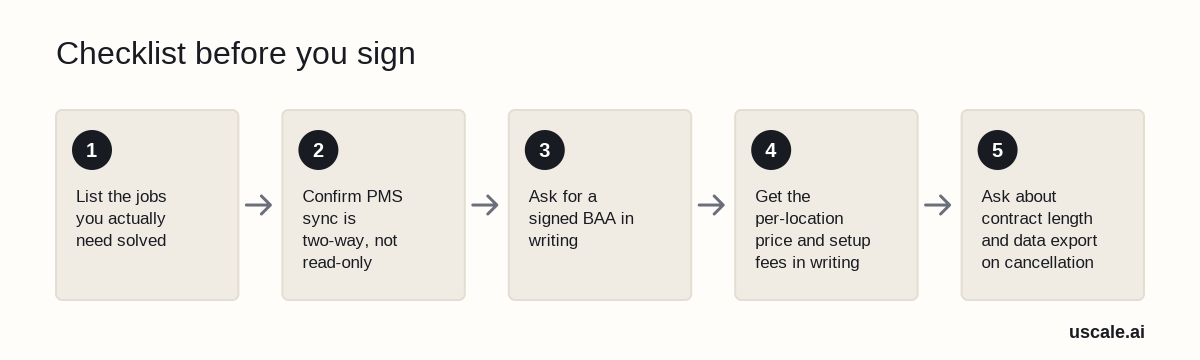
Before signing any dental patient communication software contract, a practice should get five answers in writing: whether PMS sync is two-way, whether the vendor signs a BAA, the per-location price and setup fees, the contract length and data export terms, and whether phones are included. Ask these questions of the two or three tools that came out of the job-by-job comparison, not every vendor on the list.
Confirm the sync writes back
Ask whether the tool writes appointments and confirmations back into your PMS or only reads from it. With read-only sync, the front desk still re-types. You're done when the vendor names your exact PMS and puts "two-way" in an email.
Get the BAA signed, not promised
A marketing page that says "HIPAA compliant" is not a BAA. You're done when you hold a signed copy, before any patient data moves.
Get the price per location in writing
A "starting at" number can leave out setup, onboarding and per-location fees. You're done when a written quote shows the monthly price for each location and every one-time fee.
Ask how you leave
Ask about contract length, the notice period, and whether patient lists, message history and forms export in a usable file if you cancel. You're done when the answer is in the contract, not just said on a sales call.
Ask whether phones are included
Some suites bill phones and missed-call text-back as an add-on. You're done when the quote says which.
The quick win: one email, sent today
Within the hour, paste this into one email to every vendor on your shortlist. It needs no software:
Before we sign, please confirm in writing: (1) Is your sync with [our PMS] two-way or read-only? (2) Will you sign a BAA before go-live? (3) What is the monthly price per location, and what are all setup or onboarding fees? (4) What is the contract length, and can we export patient data and message history if we cancel? (5) Are phones and missed-call texting included or billed separately?
If you do only one thing, send that email. You'll end up with written answers side by side and a shorter list of vendors worth a demo.
Start with the job that costs you patients
The fastest way to choose dental patient communication software is to fix one job at a time, starting with the one losing the most new patients. Three steps get you there:
- Name that job this week: unanswered calls, lapsed recall, no online booking, thin reviews, or slow new-patient follow-up.
- Shortlist two tools from that job's row in the comparison table above, not the whole list.
- Run the five pre-signing questions against both before you look at any other job.
If the job is review replies, missed-call text-back and after-hours booking, uscale, which we make, is one option alongside Podium and Birdeye. It doesn't sync with your practice management system, doesn't sign a BAA and doesn't run recall campaigns. It isn't a Weave or NexHealth replacement, only a narrower tool for that one job.
For the wording itself, the guides on what to send in a missed-call text back and how to write an appointment reminder text have messages you can adapt.
The right software is the one your front desk stops working around.
Questions
What is dental patient communication software?
Dental patient communication software is the set of tools a dental practice uses to remind patients of appointments, run recall, text and call patients two ways, take online bookings and ask for Google reviews, all kept in step with the practice management system. Some products handle only one of those jobs, while larger suites try to cover several. Choosing well starts with naming the one job that is costing the practice the most patients.
Which dental patient communication software integrates with Dentrix or Eaglesoft?
NexHealth's own Synchronizer page lists support for Dentrix, Eaglesoft, Open Dental, Dentrix Ascend, Denticon and more, across 15 or more systems through one API. NexHealth's comparison page also lists Weave and RevenueWell as connecting to Dentrix and Eaglesoft. A listed logo does not show whether data flows both ways, so ask each vendor in writing whether it writes bookings and confirmations back into your exact Dentrix or Eaglesoft version.
How much does dental patient communication software cost per month?
Dental patient communication software that publishes or has tracked prices ran from about $189 to $599 a month in 2026. RevenueWell's Starter plan is $189, Solutionreach is reported at $329 flat, Adit at $399 flat, and Podium at roughly $399 for Core and $599 for Pro, usually on annual contracts. Weave and NexHealth are mostly quote-based, so get the per-location price, setup fees and contract length in writing.
Is texting dental patients HIPAA compliant?
Texting dental patients can be HIPAA compliant when the texting vendor signs a business associate agreement with the practice and each message carries only scheduling details such as name, day, time and place, with no diagnosis or treatment information. A compliance badge on a vendor's website is a claim, not a contract. Ask for the signed BAA, confirm it covers the texting and calling features, and check consent, opt-out and message-log terms.
Which software sends dental recall reminders and asks for Google reviews?
Demandforce's D3 platform, now part of Henry Schein One, is described as automating text and email reminders, managing online reviews and running patient reactivation campaigns in one product. RevenueWell and Solutionreach are recall-first tools, while Podium and Birdeye are the usual review-focused options. Before buying, ask each vendor whether the plan only sends review requests or also drafts replies to incoming reviews, and whether replies cost extra.