Why busy shops stall
To scale a service business, you move through five stages: solo operator, first hires, owner off the tools, building management and a leader-run company. Growth rarely stalls for lack of calls. It stalls when pricing, phones or management don't get rebuilt for the stage you're actually in.
One benchmarking firm, LevelCFO, sets a planning target of $250K–$400K in revenue per field technician per year, illustrated with a $310K residential truck. It's an operating target, not a measured average, so it's useful for sizing what each truck should carry. Say your own truck already clears that. Adding two more trucks doesn't triple the total on its own. Your unpaid hours stay with you, and so do the calls you answered between jobs and the decisions you kept in your head. None of that comes with the new trucks.
Below are a stage table, a cost-per-billable-hour worksheet, a hiring order and a software-by-stage map. Use them to find what breaks first in your shop. But before you can find what's breaking, you need to know which stage you're actually in.
What are the stages to scale a service business from one truck to a real company?
A home-service business usually grows through five stages of growth: solo operator, first hires, owner off the tools, building management, and a leader-run company. At each stage, the habit that got the business there starts to break. To scale a service business, spot what is breaking and rebuild it before adding the next truck.
The stages run in order, and each fix sets up the next. Prices that cover real labor costs pay for office help. Office help frees the owner to set standards. Standards let managers run crews. Managers let the company run without the owner on every decision.
| Stage | Trucks | What breaks first | Key fix | Key hire |
|---|---|---|---|---|
| 1. Solo operator | Just you | Your hours, and prices set on unpaid owner time | Price from cost per billable hour | First tech |
| 2. First hires | A couple | Phones and scheduling while you're on jobs | Phone coverage that books the call | Office person (CSR or dispatcher) |
| 3. Owner off the tools | A handful | Quality on jobs you don't see | A written "done" checklist per job | Lead tech |
| 4. Building management | A growing fleet | Cash flow and hiring | Collect at completion, open a credit line, move to field service software | Service or operations manager |
| 5. Leader-run company | A fleet run by managers | Every decision still waits on you | Managers own their own numbers | General manager |
Sizing your own stage
No reliable source gives revenue totals for each stage, so use a per-truck yardstick instead. LevelCFO's HVAC financial benchmarks put the operating target for revenue per field technician at $250K–$400K a year, illustrated with a $310K residential truck scenario. That figure is a planning target, not a measured average. Divide last year's revenue by your number of trucks to see where you sit.
Start with stage one. For almost every owner, the first things to break are the same two: your own hours and your prices.
What breaks first when a one-truck business starts to grow?
Your own time and your pricing break first when a one-truck business starts to grow. Prices that worked when the owner's labor was free go underwater once payroll, payroll taxes and overhead land on every job. The owner's week also has no spare hours left to absorb the difference.
After that, the order below reflects what practitioners commonly report. It is not a measured statistic, and individual shops vary:
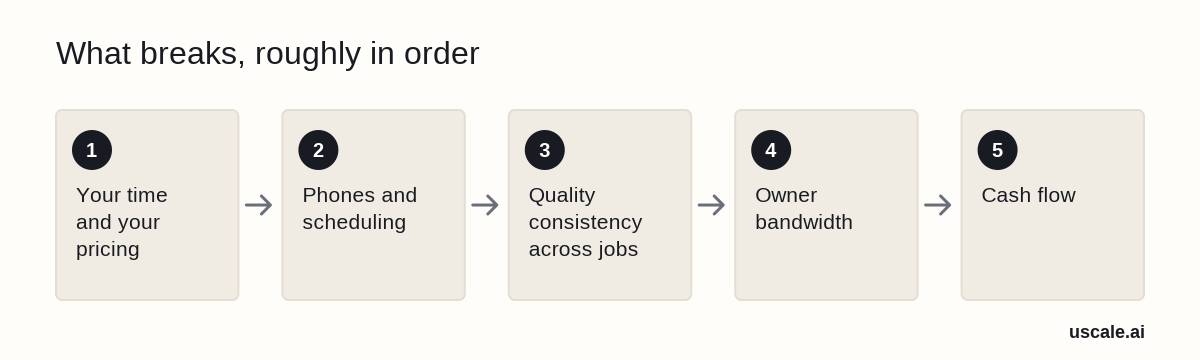
Phones and scheduling slip next, because the person who answers the phone is also the person on the ladder. Then quality drifts between techs and the owner runs out of hours. Cash gets squeezed because payroll goes out before customers pay. Last, hiring and middle management become the limit.
A price that only works when you don't pay yourself is not a price. It is a subsidy. That is why the math on your prices comes before any hire.
How do I know if my prices can actually support an employee?
Your prices can support an employee if they cover your full cost per billable hour plus a margin on top. To find that cost, add up the truck, insurance, tools, software, payroll taxes, workers' comp and a market wage for yourself. Then divide by the hours you actually bill. Drive time, shop time and callbacks are paid hours that no customer pays for.
Most owners get this step backwards and divide by paid hours. Price to the hours you bill, not the hours you pay for.
| Cost line | What to plug in | Benchmark |
|---|---|---|
| Your own wage | What you'd pay someone to replace you on the truck | Your local market |
| Truck, insurance, tools, software | Your actual yearly costs | Your own books |
| Employer payroll tax | FICA on every wage | 7.65% employer share, 15.3% combined with the employee's, 2025 rate (Patriot Software) |
| Workers' comp | Rate per $100 of payroll | HVAC about $4.00–$7.50, plumbing about $4.50–$8.00, varies by state (myworkerscompcalc.com, 2026) |
| Billable hours | Paid hours × utilization | Average tech bills 5.7 of 8.8 paid hours, about 65% (ACHR News, 2026). Common target: 65% to 85% (FieldEdge, 2026) |
| Margin on top | Gross margin target | 50–65% on service revenue, using a loaded-cost multiplier of roughly 2.0x to 2.9x (SmartService, 2026) |
The 50–65% target is a goal, not what most shops hit. LevelCFO's 2026 benchmarks, measured across 259 companies, put the median service-agreement margin at 37.9%, with 53.5% at the upper quartile.
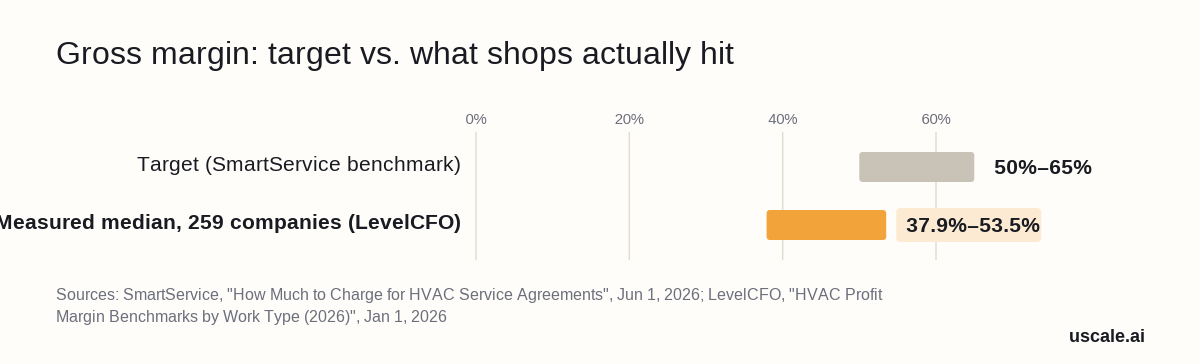
If your math lands under 50%, you are not automatically failing. You are near the typical shop, and the table shows which line to work on. A gap there usually calls for a price raise, not a hiring freeze. Once the price covers the hour, the next fix is making sure the phone gets answered so those hours get booked.
How do I stop missing calls when I'm on a job?
To stop missing calls while you're on a job, get phone coverage in place before you feel you can afford it. A caller who reaches voicemail usually doesn't leave a message. They call the next company on the list, and the job is gone before you're out of the attic.
Most owners wait until they can pay a full-time office person. Meanwhile the phone rings out during every install. Coverage doesn't have to start as a hire. Here are the options, roughly from lightest to heaviest:
- Automatic text-back on missed calls, so the caller hears from you while you're still on the job. The setup is in our guide to missed-call text back.
- After-hours answering that books the job, not one that only takes a message. See how after-hours answering services compare.
- An answering service for daytime overflow.
- A part-time CSR for your busiest hours.
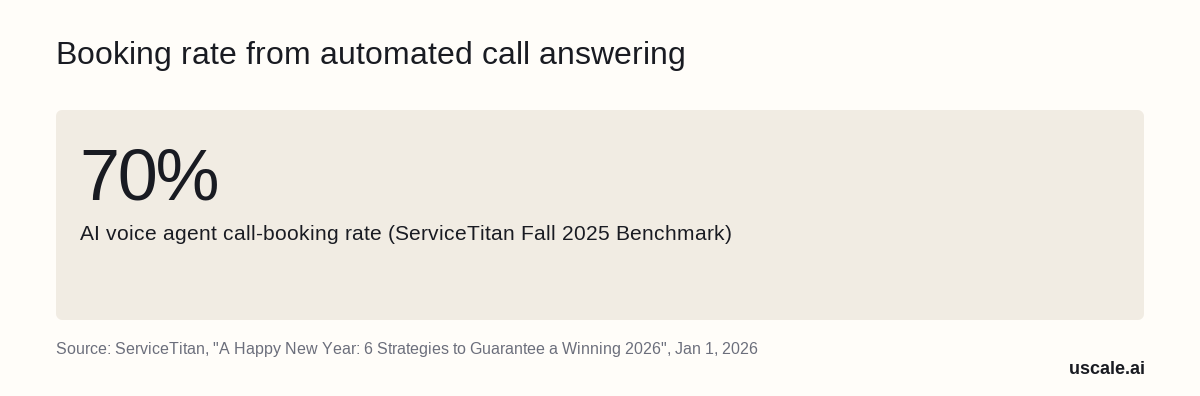
Automated answering can now book jobs, not just take messages. ServiceTitan's blog (January 2026) says that, according to its Fall 2025 Benchmark Report, AI voice agents are reaching a 70% call-booking rate as an industry standard.
uscale, which we make, is one option on that list. It texts back callers who hang up, answers when you're closed and books the caller into your calendar. None of these options replace the dispatcher you'll need later. They keep booked work coming in until that hire pays for itself. Which raises the real question: when that hire comes, should it be an office person or another tech?
How does your business look to people searching nearby?
Type your business name and I check your Google profile, reviews, website and whether AI answers name you, then show what to fix first.
Check my businessShould my next hire be another tech or an office manager?
Once a home-service business is running a few trucks, the next critical hire is usually an office person (an admin, CSR or dispatcher), not another tech. Owners often get this backwards. A tech brings in revenue and an office hire looks like overhead. But a tech can only bill jobs that someone booked, scheduled and followed up on. A new truck without someone owning the phones and the schedule adds a second source of chaos, not a second source of profit.
Read the signals in your week, not your revenue:
| What you see | Next hire |
|---|---|
| Jobs back up while the phone rings unanswered | Office (CSR or dispatcher) |
| Quotes and invoices go out days late | Office (admin) |
| Techs call you all day to ask where to go next | Office (dispatcher) |
| Estimates go out but nobody chases them | Office (CSR or admin) |
| The schedule is clean but booked further out than customers will wait | Tech |
| Crews are turning work away, not waiting on it | Tech |
| You still run calls yourself because nobody else can | Tech |
If most of your checks land in the top four rows, trucks aren't your limit yet. Once the office runs the day, the next problem is getting every tech to do the job the way you would.
How do I keep quality consistent when I'm not on every job anymore?
Quality stays consistent without the owner on every job when "done" is written down for your most common jobs and then measured tech by tech. Your brand is only as strong as its weakest repeatable behavior.
| Standard | What to write down |
|---|---|
| Completion checklist | The steps every tech confirms before leaving |
| Required photos | Before, after, and the equipment label |
| Cleanup standard | Floor covered, debris out, work area wiped |
| Customer script | What to say at the door and at handoff |
"Here's what we did, here's what we found, and here's who to call if anything changes."
Then track callback rate and reviews for each tech. Set your own baseline first. Repeat visits on one tech's jobs show you which line of the checklist isn't being followed.
Written standards also make the next hire trainable. That matters once you step back from the tools.
When should I get off the tools and stop being the main tech?
A trades owner should get off the tools when their own calendar is what caps the company's growth. For most owners, that happens once a handful of trucks are running and the owner is still the only person who can quote a job, calm an upset customer or run payroll. No sourced figure pins an exact truck count, so watch for these signals instead.
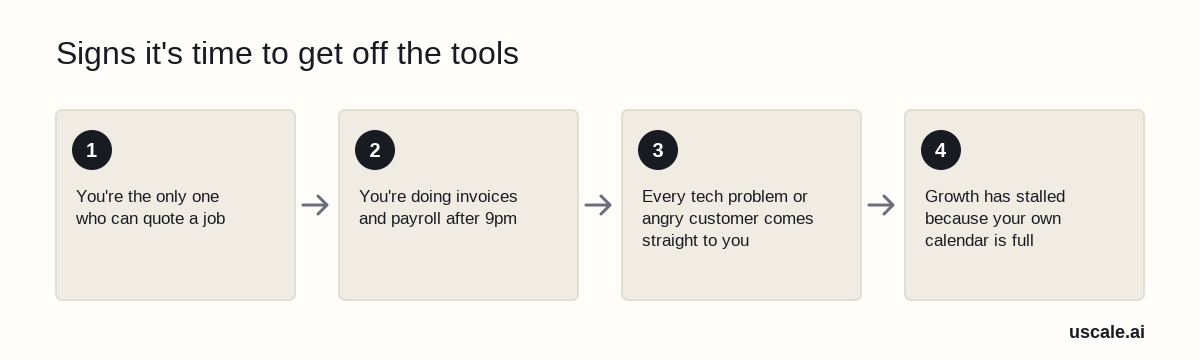
As a rough rule of our own: if two or more of these describe your week, your hour is worth more spent on selling, hiring and pricing than on running a service call. Most owners wait until the business feels calm enough to step back. It never does, because the calm comes after you step back, not before. Stepping off the tools also exposes the cash strain growth creates, which is the next thing to plan for.
Why is cash tight even though we're busier than ever?
Cash gets tight in a growing service business because growth spends money before it brings money in. Payroll goes out every week and materials get paid for upfront, while customers pay later. Every new truck or hire costs money before it earns any back. A full schedule can drain the bank account faster than a slow one.
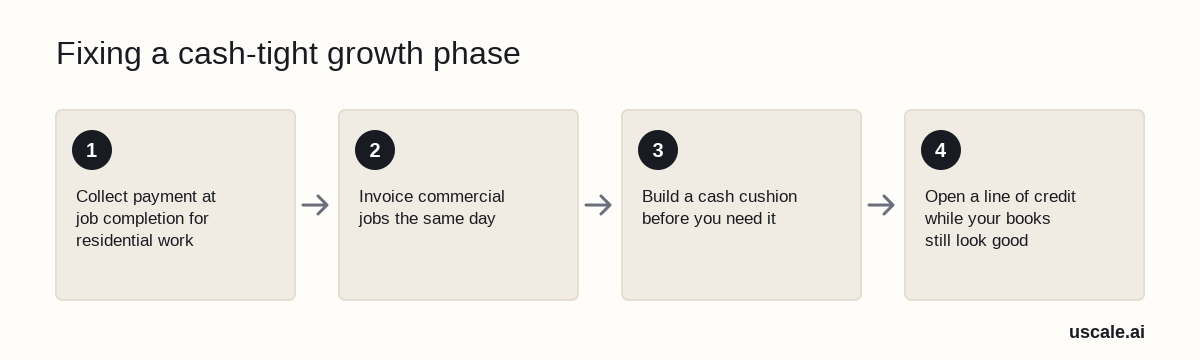
Work the list in order:
- Collect at completion on residential jobs. The homeowner is standing there and the work is visible. Take payment before the truck leaves the driveway.
- Invoice commercial work the same day. An invoice that sits in the truck for a week adds a week to when you get paid.
- Build a cash cushion. Move part of every payment into a separate account so payroll never depends on one check clearing.
- Open a line of credit early. Most owners get this backwards. They apply when cash is already short, which is when a lender is least likely to say yes. Set up the credit line while your books still look good.
Once cash stops being the bottleneck, the next question is where the steady flow of new jobs comes from.
How does marketing have to change once word of mouth isn't enough?
Once word of mouth isn't enough, a service business needs a repeatable lead system: steady Google reviews with owner replies, an accurate Google Business Profile, local SEO pages, Local Services Ads, and call tracking that shows cost per booked job by source. It has to be a system because review replies and profile updates are the first jobs to slip when the owner gets busy.
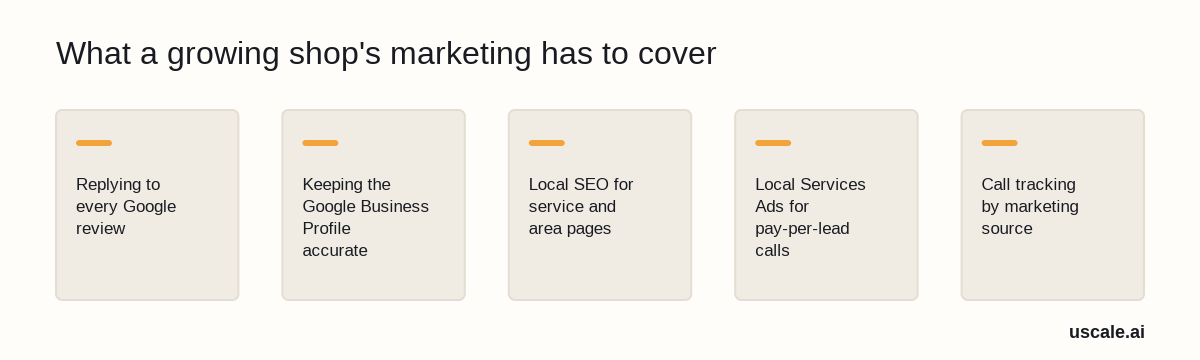
Most owners build this in the wrong order. They buy ads first, then send paid clicks to a listing with unanswered reviews and last year's hours. Ad clicks, map searches and referrals all end up on that profile, so fix it before you pay for traffic. Then judge each paid channel by booked jobs rather than leads. A cheap lead that never books is the expensive one.
For the details, see how to respond to negative Google reviews and how to rank higher on Google Maps.
uscale, which we make, is one way to keep this layer current without it landing on you at 11pm. It drafts a reply to every Google review, fixes for your Business Profile and a weekly Google post, and nothing goes out without your OK. An office manager with a weekly checklist can do the same job. What matters is that one named person owns it, because the software you pick at the next stage assumes the leads are already coming in.
What software do home-service companies use once they outgrow their first few trucks?
Once a home-service company outgrows its first few trucks, most owners move onto a full field service management (FSM) platform: one system for scheduling, dispatch, quoting, invoicing and payments. Jobber, Housecall Pro, Workiz, Service Fusion and FieldPulse suit smaller residential shops. ServiceTitan, FieldEdge and Successware are built more for larger HVAC, plumbing and electrical shops.
The core platform is only half the stack. Around it, shops add accounting, call tracking, fleet GPS, customer financing and a review tool. Most add these one at a time, as each gap starts costing jobs.
| Stage | Typical core platform | What gets added around it |
|---|---|---|
| Owner-run, a few trucks | An entry plan of a residential FSM, or a simple invoicing app | QuickBooks, a way to ask for reviews |
| Growing residential shop | Jobber, Housecall Pro, Workiz, Service Fusion or FieldPulse | QuickBooks sync, call tracking, fleet GPS, customer financing |
| Larger HVAC, plumbing or electrical shop | ServiceTitan, FieldEdge or Successware | The same add-ons, plus deeper dispatch, pricebook and reporting |
Prices are left out because we found no verified current figures. Check each vendor's own pricing page in the month you buy.
Buy for the bottleneck you have this quarter, not for the company you hope to run someday. A dispatch board you don't need yet is one more login for the office. For side-by-side picks, see our guides to the best HVAC software and the best plumbing software. The harder call is when to leave a residential platform for a larger system.
When should I switch from Jobber or Housecall Pro to ServiceTitan?
Switch from Jobber or Housecall Pro to ServiceTitan only when an HVAC, plumbing or electrical shop has grown into a large fleet and needs a dispatch board, a flat-rate pricebook, memberships and marketing attribution working together. Below that point, upgrading the software you already run is usually cheaper and less disruptive than migrating.
Let the bottleneck decide, not the truck count. A migration means retraining every tech and the office, often mid-season. It pays off only when your current tool can't fix the problem in front of you.
| What's breaking | What it looks like | First move |
|---|---|---|
| Dispatch | The office reshuffles the board by phone all day | Check whether a higher plan covers it |
| Pricing | Techs quote the same repair differently | Build a flat-rate pricebook in your current tool |
| Attribution | Nobody knows which source booked the job | Add call tracking before switching |
When all three break at once and your current plan can't fix them, the switch earns its cost. Check features and prices on each vendor's own page before you decide.
All of this assumes you want a bigger fleet. Not every owner does.
Does this growth playbook fit every service business?
No. The five-stage playbook for scaling a service business assumes two things: the owner wants more trucks, and the local market has room for them. Three cases need the playbook adjusted.
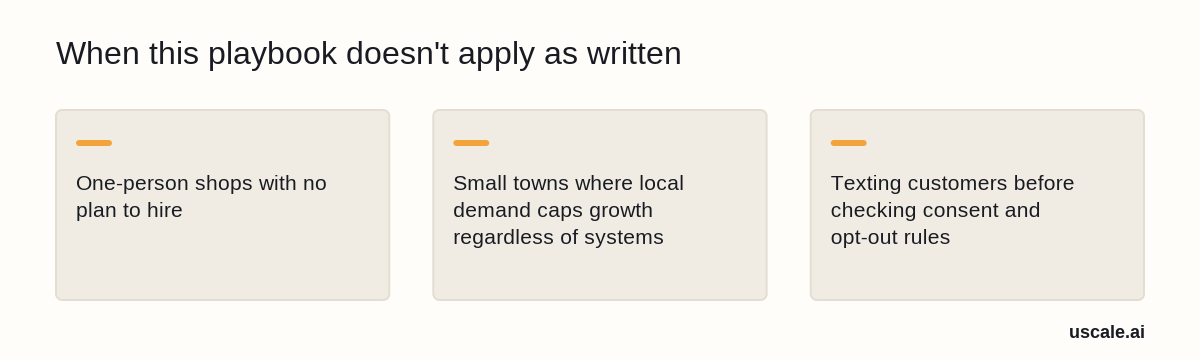
A one-person shop with no plan to hire. Skip the hiring order and the management stages. The pricing worksheet still matters, because prices built on unpaid owner time leave nothing for a slow month. Phone coverage still decides who gets the job.
A small town where local demand is the ceiling. Better systems won't create customers who aren't there. Use the same fixes to raise margin on the work you already win, or widen the service area before you add a truck.
Texting customers back and forth. Before you automate text-back or reminder messages, check the consent and opt-out rules for business texting where you operate. Make sure every thread gives customers an easy way to stop.
For everyone else, the order holds, and it starts with a short list.
How to scale a service business, starting this week
To scale a service business this week, fix things in the order they break: prices first, then phones, then quality, then the next hire. None of these steps needs another truck.
- Run your cost-per-billable-hour math before you hire anyone. Use the worksheet above with your real truck, insurance, payroll-tax, workers' comp and drive-time costs, plus a market wage for yourself. If your price doesn't clear your margin, raise it before payroll grows.
- Close the phone-coverage gap. Pick one stopgap from the phones section: a part-time CSR, an answering service, missed-call text-back or after-hours answering. Get it running before your next busy week.
- Write down what "done" looks like for your most common jobs. Include the completion checklist, the required photos, the cleanup standard and what the tech says before leaving. Then watch callbacks and reviews by tech.
- Choose your next hire with the tech-or-office signals. If jobs back up while the phone rings unanswered, hire the office person first.
Keep the stage table where you'll see it, and check it every few months. You will usually reach a new stage before your habits from the last one catch up. Once these four fixes are in place, these HVAC marketing ideas cover how to fill the schedule you can now handle.
Growing doesn't mean working harder. It means you stop being the person every job runs through.
Questions
What does it mean to scale a service business?
Scaling a service business means growing revenue and crew size without the owner's own hours growing at the same rate. In home services, that usually means moving through five stages, from solo operator to a leader-run company. At each stage, pricing, phone coverage, quality standards and management get rebuilt so new trucks add profit instead of chaos. Adding trucks alone is growth. Growth that no longer runs through the owner is scale.
How do I scale a service business without losing profit?
A service business keeps its profit while scaling by pricing from cost per billable hour, not paid hours. A Field Promax study covered by ACHR News found the average HVAC tech bills only 5.7 of 8.8 paid hours, about 65%. SmartService puts the typical target at 50–65% gross margin on service revenue, while LevelCFO measured a 37.9% median on service agreements. Raise prices to close that gap before adding payroll.
What numbers should I track every week as I add trucks?
A growing home-service company should track revenue per truck, technician utilization, close rate, cost per booked job by lead source, and callbacks and reviews by tech. Useful yardsticks: LevelCFO's operating target of $250K–$400K revenue per technician per year, a common utilization target of 65% to 85% per FieldEdge, and an industry-average close rate of roughly 20–25%, citing ServiceTitan's 2025 benchmark data.
Why has my home-service business stopped growing at around $100k–$400k?
No sourced data ties a growth stall to an exact revenue figure. That range does overlap LevelCFO's $250K–$400K operating target for revenue per technician. That suggests a single owner-run truck may simply be near its practical ceiling. The usual limit is the owner's hours: still quoting, answering phones and running calls. Fix prices first, then phone coverage, then hire an office person so the next truck can be kept busy.
Should I start maintenance agreements or memberships, and does it make the business worth more?
Maintenance agreements can carry strong margins. Grandy & Associates puts them at roughly 50–65% gross margin, against 45–55% for HVAC service calls. LevelCFO's measured dataset found a lower 37.9% median, with 53.5% at the upper quartile, so pricing matters. We found no sourced figure on how agreements change a business's sale value. Ask a business broker or valuation advisor before counting on that.